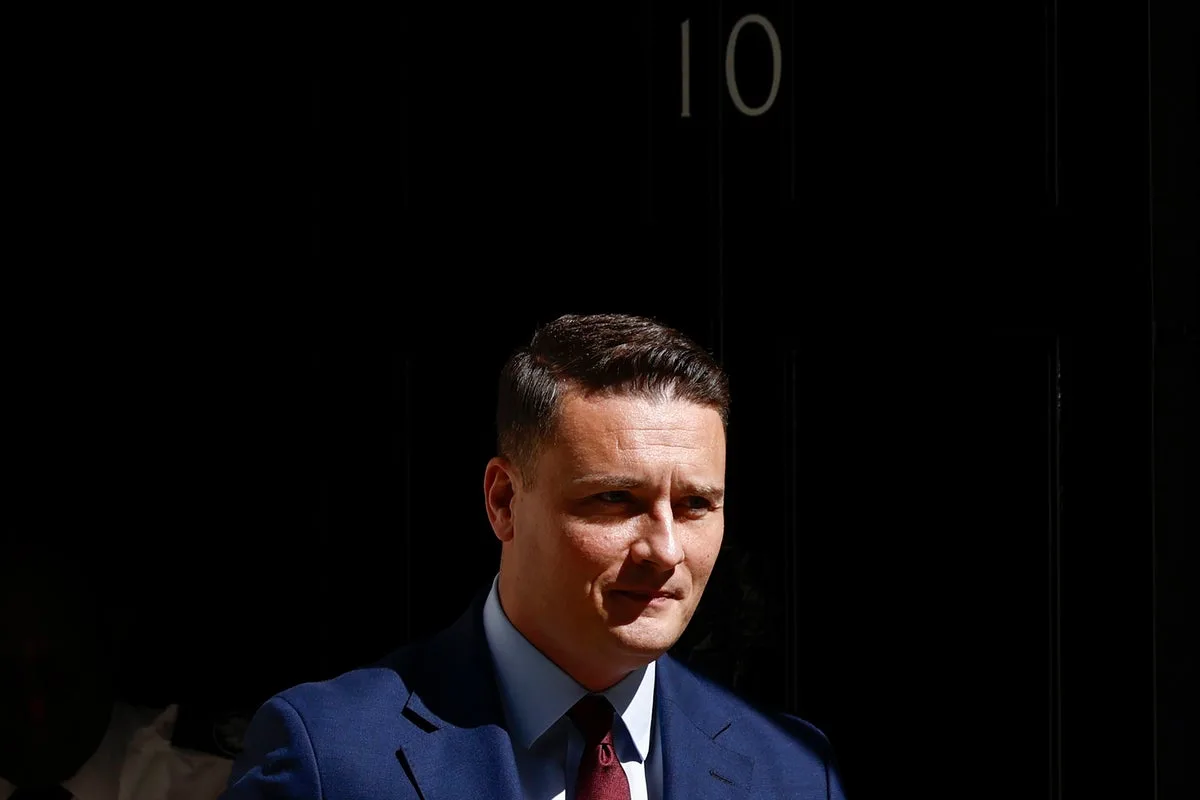
As momentum grows for Sir Keir Starmer to step down, some argue that changing prime minister now would make Britain appear unserious. But indulge me for a moment as I let out a shameless squeal at the prospect of Britain’s first ever openly gay prime minister in Wes Streeting.
I’m gay, but it isn’t just his sexual orientation that chimes with me. The “lightly cockney-accented” Streeting would be the first PM I’ve ever truly related to – and sounded like. Both of us worked for Stonewall, back when it represented sensible, unifying equality.
When I met Wes Streeting – then in opposition – in his office in October 2023, he was flustered. He’d just realised he had a speaking engagement that night at The Garrick members' club, and didn’t have a posh enough outfit to hand that day to match their strict dress code. A staffer – at Streeting’s apologetic and grateful request – dashed out to buy him something suitable before shops closed. “Bloody nightmare,” Streeting joked.
Immediately, I warmed to him – this is the exact kind of class-based boo boo I’d make, and humour I’d employ. It’s the same Streeting who admits he felt more comfortable in trackie bottoms, who arrived at Cambridge University on an access scheme, having “no idea what a lounge suit was” and wore an Arsenal top to non-school uniform days to ward off bullies, “like a suit of armour, hiding a big secret I’d never shared with anyone”. Streeting and I shared the same “desperate to fit in yet refusing to conform” attitude at our respective Ofsted-failing schools. “I already stood out as a self-confessed swot,” he wrote in his 2023 memoir. “I continued to wear the merit badges I’d earned, even if they… invited the extra shoves and punches that came with being a geek.”
At 43, Streeting and I are the same age. It’s difficult to underestimate the importance that Britain’s first out and proud gay prime minister would hold in a country where the state’s Section 28, which forbade the “promotion of homosexuality” in schools, made us feel utterly ashamed of ourselves. Of course, he wouldn’t be the only gay political party leader – Zack Polanski is that already – but, in the three years since we met, I’ve seen Streeting become statesmanlike without coming across as someone still in student politics, or betraying his roots.
Those roots matter. The most common gripe about politics is that MPs appear out of touch with reality, so people feel consistently switched off and disillusioned. I can't think of a single PM I've even vaguely related to: I also grew up in a relatively working-class family and area, have centre-left progressive values and an “estuary” accent that dissuaded me from ever entering “received-pronunciation only” broadcast journalism. Streeting wouldn’t be the only PM from a working-class background – John Major is often cited as a rare exception – but he neither sounded nor acted as someone with working-class sentiments. Every time I get on an extortionate and privatised train, I curse his name.
Streeting listened to UK garage, grew up in relative poverty on a council estate, and his mum was born in prison. A world apart from the multimillionaire Rishi Sunak, who “didn’t have working-class friends”, and from Boris Johnson, who wishes he didn’t.
A relatable PM during a cost-of-living crisis won’t solve the crisis itself. But it goes some way towards ending the “us and them” political elite narrative that destroys trust. It’s high time a PM felt relatable to me because, if a leader doesn’t connect with me, they won’t resonate with the millions of Britons who share one or more of my demographics and resulting values. As it turns out, Streeting and I share a fair few key ones.
Of course, the electorate cares far less whether you’re gay or straight, posh or common. They want someone with vision who can make bold decisions in a tough economic climate. Streeting has proven capable of making decisions in cabinet, even when it has divided his beloved LGBT community. Unlike other contenders, Streeting is ready to run now – and should. For many of the people who have felt judged, Streeting would make them feel seen, heard and, perhaps for the first time, able to achieve this country's highest office.
Identity politics? Maybe, but it's identity politics at its most powerful, and groundbreaking in ways that massively matter, and really connect.