The UK Government has rejected a DUP-led request to use the Stormont brake to block new EU customs legislation in Northern Ireland, a decision the Alliance Party said was destined to fail.
The brake was a central part of the Windsor Framework, a post-Brexit agreement between the UK and EU in 2023, and was put in place to address unionist concerns about Northern Ireland's Brexit deal. It is designed to give Stormont the power to object to amendments to EU rules that apply in Northern Ireland.
Request rejected
The DUP, along with MLAs from other unionist parties, submitted a request to the UK Government on November 6 to implement the brake, but it was rejected by Northern Ireland Secretary Sir Chris Bryant on Tuesday.
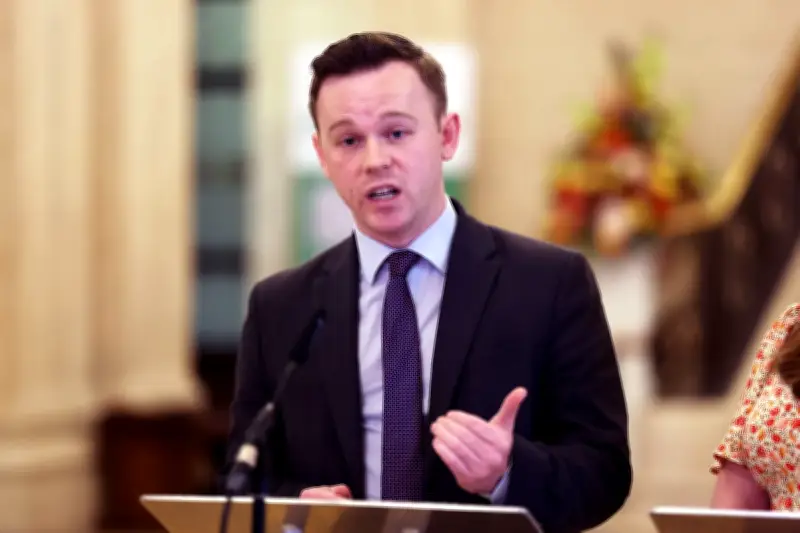
Alliance deputy leader Eóin Tennyson said the request was an "attempted abuse of the Stormont brake" and was always destined to fail.
Speaking after the UK Government confirmed that the request did not meet the legal threshold, Mr Tennyson said: "This stunt was always destined to fail.
"The DUP's intervention was particularly counterproductive and unhelpful in the run-up to a major UK-EU summit, at a time when progress is being made towards an agreement which could significantly reduce checks in the Irish Sea, cut costs and provide much-needed certainty for businesses.
"Rather than building on that momentum and grasping the opportunities afforded by dual market access, this ongoing war of attrition is fuelling uncertainty and instability.
"Perhaps it is unsurprising that the DUP is keen to reopen old Brexit battles, given that its former MP for Upper Bann admitted that the party had 'actively misled' its own supporters on the issue. Northern Ireland cannot afford to keep paying the price for the DUP's disastrous Brexit strategy and internal wrangling."
Union Customs Code
The request was made as a result of revised EU rules for importers and exporters, called the Union Customs Code. The new legislation will see a single, centralised online portal replace national customs IT systems.
The MLAs who petitioned for the use of the Stormont brake said the new system reforms would create complexity for business and would increase costs and burdens both within Northern Ireland and for Great Britain to Northern Ireland movements.
Rejecting their request, Sir Chris concluded that the test was not met, because the reform is aimed at simplifying the customs rules and processes that apply in Northern Ireland, rather than making them more complex. Also, the process of change will be implemented over a period to 2034, allowing businesses time to adapt.
Reactions
DUP leader Gavin Robinson said that while he disagrees with the decision, he was happy with the co-operation between the unionist parties.
"Whilst we condemn the Secretary of State for this decision it was right for unionist MLAs to work co-operatively to raise our significant concerns," he said.
"Those small number of unionist representatives, who thrive on attacking the DUP, would be better served by recognising it was the Secretary of State who made this decision, and yet he would hold all power in Northern Ireland if we followed the course of action they advocated."
TUV leader Jim Allister said that, in rejecting the request, the UK Government has chosen to prioritise the interests of the EU over its own people.
"Once more the contemptuous rejection of the Stormont brake demonstrates that, for all the Government's hyping of it as part of the Windsor Framework, it is as useless as a brake with no cable," he said.
"It underlines how for Northern Ireland the EU reset is not the answer because it highlights that the reset will not touch the main expression of the Irish Sea border, the customs border. Indeed, under the new customs code the customs border will present a greater economic challenge to businesses in Northern Ireland.
"The new border legislation is toxic, effectively declaring 74 times that Great Britain constitutes a third country, that is a foreign country in relation to Northern Ireland."
Ulster Unionist Windsor Framework spokesman Dr Steve Aiken said the Windsor Framework's safeguards have been shown to be "worthless".
"That the Secretary of State has refused to act on the Stormont brake shows that the so-called 'democratic' safeguards in the Windsor Framework are worthless. Regrettably, it comes as no surprise," he said.
"Unionist MLAs pulled the brake because the new Union Customs Code will deepen the divergence within the United Kingdom and reinforce the Irish Sea border. For well over a year the Ulster Unionist Party has warned of the consequences: extra cost, more bureaucracy and a heavier burden on our companies and our constituents.
"It will further divide us from our greatest market, the rest of the United Kingdom. There is no upside to this. While the Prime Minister talks of ever closer alignment with the EU, today the Government is creating more divergence within our own country."
Previous rejection
This is the second time that a request has been made for the brake to be used, and the second time the request has been rejected. In January 2025, the UK Government rejected the use of the mechanism to halt the appliance of EU rules on packaging and labelling of chemicals which applied in Northern Ireland.
The office of the Northern Ireland Secretary said they were very clear at the time the framework was agreed that specific legal tests have to be met and it is fundamentally a determination based on the evidence in a specific case-by-case situation. The fact, they said, that it has not been applied yet does not mean it will not be applied if the requirements are met.