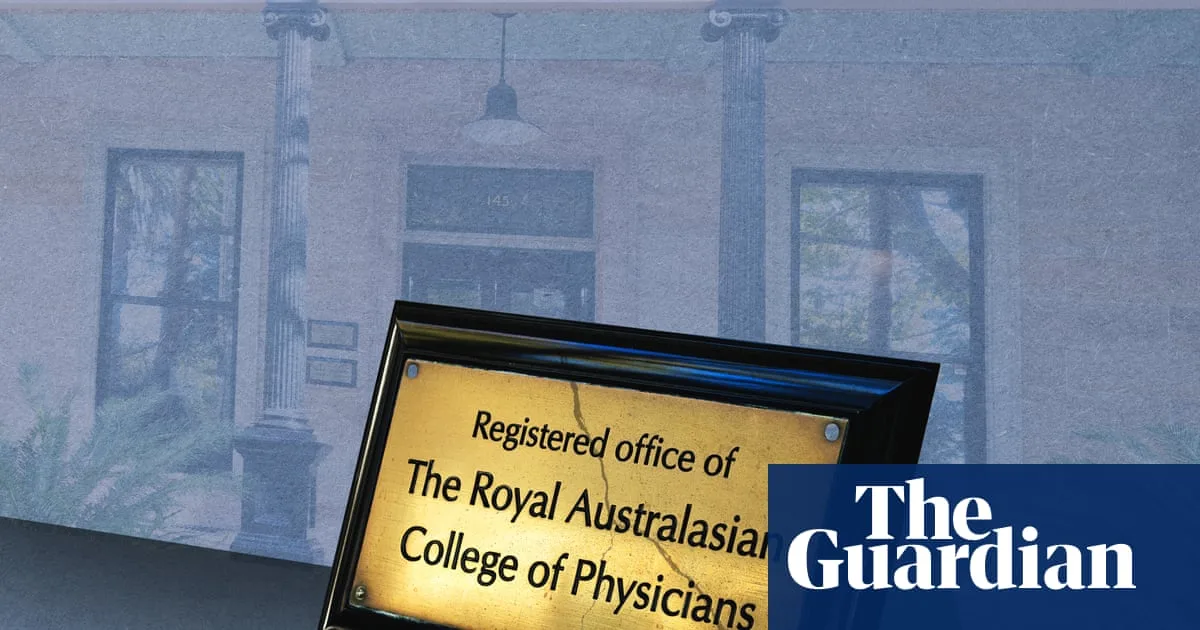
Inside the Implosion of Australia's Royal Australasian College of Physicians
RACP Implosion: Inside Australia's Medical College Crisis

The wealthy and historically powerful Royal Australasian College of Physicians (RACP) has been riven by internal conflict for years. The infighting has been described as a 'royal mess', an 'absolute shitshow', and a 'trainwreck in slow motion' by frustrated physicians across Australia, culminating in a public dispute that required police intervention.

Police Called to Extraordinary General Meeting

On a quiet Wednesday morning, on the 27th floor of a sleek building overlooking Sydney Harbour, doctors from one of Australia's oldest medical colleges prepared to vote in an extraordinary general meeting (EGM). The agenda was unusual, but no one expected the police to show up. Their arrival signalled a climax to months of turmoil within the RACP.

In one room was Professor Jennifer Martin, the president and board chair, facing a vote on her removal five weeks early. In another room, on her laptop, sat Dr Sharmila Chandran, the president-elect who was due to take over next month. It was Chandran's husband who called the police.

Wide Pickt banner — collaborative shopping lists app for Telegram, phone mockup with grocery list

Conflict Over Constitutional Reform

The pair had long disagreed on Martin's push for constitutional reform to separate the roles of president and board chair, in line with other medical colleges. The board, whose directors work in a voluntary capacity, has been beset by months of conflict. The infighting has been lambasted by physicians across the country, highlighting deep fractures in a wealthy and historically powerful organisation riven by longstanding dysfunction, which is underscored by wider cultural problems within medicine.

The RACP comprises more than 32,000 physicians in Australia and New Zealand across 33 specialties, including cardiologists, gastroenterologists, haematologists and neurologists. Trainee doctors have no choice but to pay thousands of dollars each year in membership fees to become accredited as specialists.

The Vote to Remove President Martin

Last week's vote to remove Martin as president was requisitioned by at least 100 RACP members, who cited board instability and poor oversight of expenditure among reasons they had 'lost confidence in the leadership of Martin'. Each board chair is elected by RACP members to serve a two-year tenure first as president-elect, then a further two years as president. Martin became RACP president in 2024 and was due to finish in May.

Conflicting accounts paint a spectacular picture of the chaotic gathering, which began with a disagreement over who would run the meeting. Martin sought to chair it, but Chandran allegedly 'spoke over the chair and did not stop', according to a board statement. Chandran claimed it was not appropriate for Martin to chair due to her conflict of interest.

Chandran says she felt intimidated and her husband called the police. NSW police said officers attended but determined no crime had been committed. Only 4,260 RACP members voted, with a majority (2,179) in favour of ousting Martin. The board believes the vote is invalid, stating that 'Martin remains the chair'.

Two Competing Boards

By Wednesday evening, Martin had been removed as a director in documents lodged with the Australian Charities and Not-for-profits Commission (ACNC) and the Australian Securities and Investments Commission. A day later, three new directors were added to the board. However, another email from 'the RACP board' said there had been 'no change to the composition of the RACP board'.

Five days later, the other two board members issued a statement describing a 'constitutional crisis', with 'two competing boards'. They requested that the ACNC suspend the board and appoint acting responsible entities. The Australian Medical Council has also expressed concerns about governance standards.

Cultural Problems in Medicine

Doctors have been bombarded with dozens of emails from the RACP. 'We're bombarded with endless emails documenting these catfights – it's embarrassing, it's absurd,' says a paediatric trainee in Victoria. 'How is this the most important thing that they have to do given the current state of the healthcare system?'

Pickt after-article banner — collaborative shopping lists app with family illustration

Last August, the board passed a vote of no confidence in Chandran, accusing her of engaging in adversarial and disrespectful behaviour. Chandran rejected the claims and revealed she had lodged an anti-bullying application with the Fair Work Commission, which she later dropped. In March, the RACP was found in breach of workplace health and safety laws for not adequately managing the risk of harmful behaviour within the board.

One physician says the turmoil reflects a 'culture of doctors that's hidden from the public', characterised by constant competition and power struggles. 'You can't have a conflict between two people eat up an entire organisation unless this was truly part of its culture.'

Costly Extraordinary General Meetings

Last Wednesday's vote was the fifth EGM in six months. Two of the previous four meetings were attempts to remove Chandran, which were voted down. The five EGMs were estimated to have cost at least $640,000 in total. 'We continue to pay money for this accreditation in a college that seems to be just wasting the funds on these EGMs and arguments,' says an advanced trainee.

Junior doctors must complete three years of basic training and three to four years of advanced training before qualifying as a specialist physician. Annual membership for trainees amounts to $4,000, with additional exam costs. 'In an exam year, I easily spent $10,000 in college fees,' one physician says. 'I've had friends commit suicide. I've moved 10 times during my advanced training.'

The RACP generated $87.3 million in revenue in 2024, mostly from membership fees and examination costs. It had more than 400 full-time employees and logged $87.4 million in expenses. Many members question the value, noting that supervisors and examiners work for free. 'What do these 400 people do?' one member asks, describing the college as 'quite obsolete now'.

Broader Implications and Future Concerns

Since October 2024, federal legislation changes mean specialists no longer need to be members of a medical college to practise. For Dr Luke Gaffney, a general physician in Queensland, the infighting prompted him to leave. 'It was this endless stream of extraordinary general meetings... it's so childish, so unprofessional.'

Questions are now being asked about president-elect nominees for the 2026 election, for which online voting closed on Tuesday. No candidates are women. Among the nominees are Professor Nikolai Petrovsky, who has been criticised for advocating his own Covid-19 vaccine without substantial peer-reviewed evidence, and Dr Phillip Morris, who advocated for ivermectin for Covid-19 after gold-standard research found it ineffective.

The RACP declined to respond to detailed questions. The crisis highlights deep-seated issues within the medical profession and raises questions about the future of the college.