Manchester City host Paris Saint-Germain in the Champions League on Wednesday, just days after an independent commission found the club guilty of breaching Premier League financial rules. The fixture pits together the two Gulf-owned clubs that have won three of the last four Champions League titles between them, after investing billions into their projects to the fury of the previous rulers of European football.
PSG arrive at the Etihad as back-to-back Champions League winners, having shifted away from superstar players and embraced a collective approach under coach Luis Enrique. The French club were even celebrated as moral victors for beating Arsenal in May, with Sir Alex Ferguson reportedly messaging PSG president Nasser Al Khelaifi to praise them for the football they played.
From Qatar Saint-Germain to European Respect
Qatar Sports Investments (QSI) were for a long time the butt of many football jokes in Europe, spending huge sums to bring galactiques to Paris without making a mark in the Champions League. PSG president Nasser Al Khelaifi felt emboldened to do a lap of honour around the Parc des Princes in 2017 after watching his team beat Barcelona 4-0, only for the famous remontada to see the Parisians destroyed 6-1 in the return fixture.
There is still a dislike for PSG in France, but a switch away from superstar players and an embracing of the collective with Luis Enrique has brought spectacular results. "Most people in France see Nasser as the PSG chairman and not Qatar any more. That’s probably his biggest victory because when he arrived in 2011 everybody was like 'Okay, PSG is becoming a tool of the Qatari state'," French AFP journalist Jeremy Talbot tells the Manchester Evening News. "It’s like a new superpower built on money and influence rather than passion and history. Some people even called the club Qatar Saint-Germain."
"They managed to get rid of this name in the last two or three years because now they are behaving like a big club and big institution with this idea that the team is more important than the players. I think the perception has changed since Luis Enrique arrived," Talbot added.
A Business Venture as Much as a Football Project
PSG's success has also seen them and Al Khelaifi embraced more in Europe. Where once they were regularly criticised by Bayern Munich CEO at the time Karl Heinz Rummenigge - as City were - Al Khelaifi has been the head of the prestigious European Football Clubs (EFC) since 2021.
That kind of influence only makes PSG a more valuable asset for Qatar, and the economics are important. As well as growing state-owned brands by associating them with one of Europe's most successful teams, the state is reaping the rewards of buying a club in a major European city with no immediate competition, a huge fanbase, and an extraordinary pool of young talent. "They paid €70m for the club and it’s worth about €5billion now, which is a staggering increase in value. QSI is an investment fund, it’s not a vehicle designed to generate soft power. It’s entire raison d’etre is to make good secure investment that will generate cash and everything else is a plus," said Ross Griffin, a professor at Qatar University and Middle East Editor for The International Journal of the History of Sport.
"They are also an amazing club for generating income. The headlines are the Messis, Neymars and Mbappes but if you did a study of how many PSG academy products are littered around Bundesliga, Premier League and Spain, there is an entire regiment of them. This is what PSG have been doing for the last 10 years," Griffin added. "The Parisian catchment area is a hotbed of footballing talent and guys who might not make it there like [Bradley] Barcola, impact sub at best, goes to Liverpool for £123m. He’s one of just a flow of these guys. PSG can generate soft power in its successes eventually for Qatar but it’s also a business venture and a highly profitable one at that."
Different Purposes, Shared Strategic Interests
Soft power is a handy term for describing what the owners of City and PSG get for their investment - certainly more useful than sportswashing. It is far more important for City chairman Khaldoon Al Mubarak to use City to help business and political opportunities for the UAE in the UK than it is to have people singing his name at the Etihad. Setting up the City Football Group has given the UAE more links to populations and economies including China and Brazil, while City's owners have bought up cheap land in Manchester and turned it into expensive housing as part of their transformation of the area. City is the flagship in the football portfolio, yet it is only one part of an enormous business venture as the UAE looks to diversify its economy - in contrast to Qatar with PSG.
"The ambition is similar, but the purpose is different," says Raphaël Le Magoariec, who teaches at the University of Tours with a specialism in Gulf countries and their sport policies. "Abu Dhabi, the emirate that owns Manchester City and City Football Group, aims to invest in a network of clubs designed to build ties with the economic sectors it needs to diversify the economy of this wealthy oil emirate. As with Qatar, this is part of an effort to establish itself as a power. But whereas Qatar uses it as a pillar of its security strategy, Abu Dhabi treats it as a vehicle for its shift to a new economic model. These are two distinct visions."
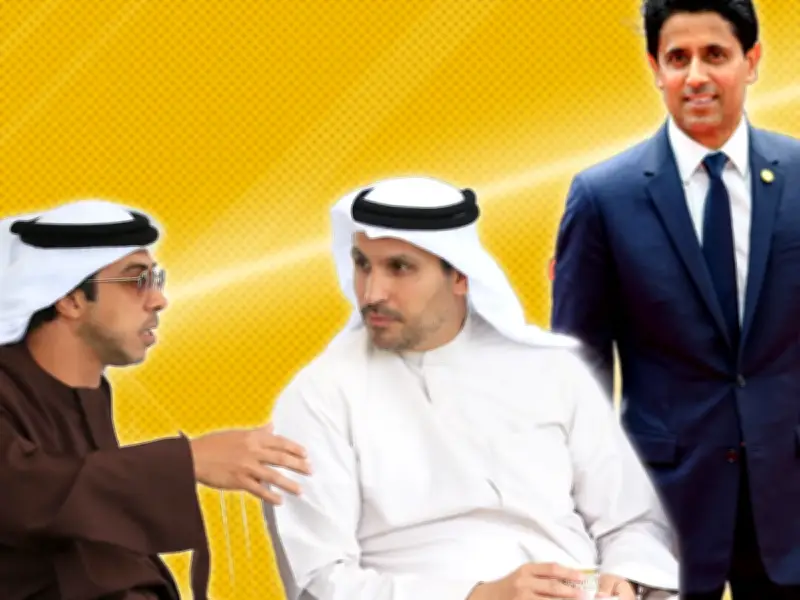
That may come as a surprise to those who have heard City and PSG banded together as two sides of the same coin, and UAE and Qatar have very much been on opposite sides in recent years. The former was part of a group of four countries that blockaded the latter between 2017 and 2021, making it even more important for Qatar to ensure its national security through other means. Things can change quickly though, and the recent conflict in Iran is changing old alliances. Qatar and UAE are on much friendlier terms now, and padel partners Al Mubarak and Al Khelaifi have each other's back: following news of City's guilt, the PSG president has been one of the strongest in publicly defending the Premier League club.
"There’s not much else he can do," says James Dorsey, academic and author of The Turbulent World of Middle East Soccer. "Given his position, if he were to come out against the UAE or Manchester City, that would have real consequences and he knows that. None of this is independent of broader issues. You just cannot separate it, just like you can’t separate sports and politics. They’re Siamese twins joined at the hip and inseparable, so it’s a question of management rather than separation."
Strategic Interests Outweigh Regional Rivalry
As much as football is only a small part of a much bigger and more serious picture, any private enjoyment that there may be in Qatar for the scandal City are now embroiled in is outweighed by the need to protect the wider reputation of the region. Dorsey describes it as the costs outweighing the benefits and Griffin compares it to two brothers supporting City and United; "United win 2-0 on Sunday and on Monday at the breakfast table one of them has a smirk on his face. There's a general one-upmanship but that’s the extent of it."
Like brothers who fight but defend their family, or fans who disagree but stick by their club, so stripping City of their status and reputation would not be helpful to QSI. PSG may be riding the crest of a wave, yet this would serve as a painful reminder that they can quickly be wiped out. "Abu Dhabi and Doha remain regional rivals, and some private satisfaction cannot be ruled out," said Le Magoariec. "But that rivalry has been overshadowed by more pressing tensions in the region, from Iran to oil policy. Strategic interest outweighs rivalry here. A weakened City would not be a Qatari victory. It would signal that European institutions can, in the end, sanction a Gulf state’s flagship club, and that is a precedent no Gulf owner wants to see established."
City found out on Sunday that they do not have many rooting for them as they fight to overturn the decision of the independent commission. As much as they welcome Guardiola back on Wednesday, Blues bosses will also be grateful for some of the friendlier faces they are likely to receive in the directors' box all season.