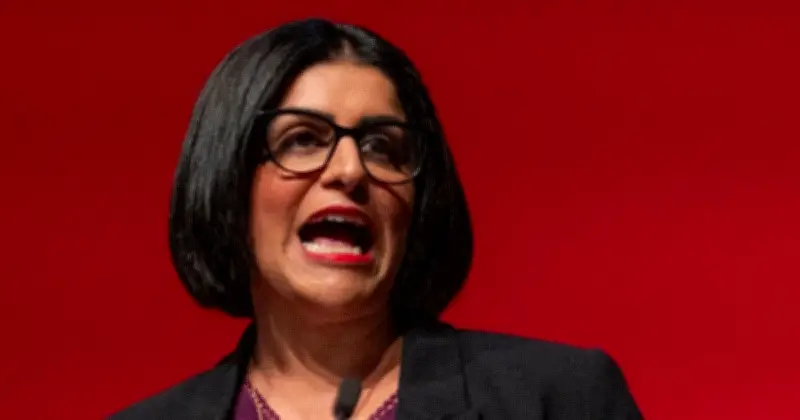
Home Secretary Shabana Mahmood has threatened to ban all Eritreans from entering the UK unless a returns deal for criminals and illegal migrants is agreed. From Thursday, diplomats from the east African country will also face restrictions on their movement outside London while VIPs will be stripped of access to fast-track visas as preferential processing is scrapped.
Officials appointed to represent Eritrea abroad will be barred from travelling 37 miles (60 kilometres) beyond London without permission from the Foreign Office, mirroring similar restrictions placed on British civil servants in the country’s capital Asmara. The warning comes amid a row Britain and Eritrea have been locked in for months over migrant returns.
Home Secretary's Warning
Ms Mahmood said: “Eritrea has had every chance to accept the return of criminals and those with no right to be in the UK. Unlike other countries, it has refused.
“My message to the Eritrean government is simple: take back your nationals or face a complete ban on your citizens entering the UK.
“I will not hesitate to impose further measures on other countries refusing to co-operate.”
Diplomatic Strain and Legal Powers
The move, made using powers under then home secretary Priti Patel’s Nationality and Borders Act 2022 (NABA), could deepen the diplomatic strain between the two nations. It follows similar threats of visa sanctions made against Angola, Namibia and the Democratic Republic of Congo in 2025.
The UK wants to restore a deal in place between 2024 and March this year which saw Eritrea issue emergency travel documents to nationals without a valid passport so they could be deported to their home country but then “abruptly withdrew” its co-operation.
The Home Office views such agreements as “vital” for the UK to remove failed asylum seekers and foreign criminals. Officials have tried to resolve the matter privately but the Eritrean government has “refused to engage constructively”, the department said as it pressed the country to “rapidly improve” its co-operation or “face a total visa shutdown”.
Impact and Statistics
It is unclear how much of an impact the restrictions will have as the number of Eritreans travelling to the UK legally is relatively small. Home Office figures show just 77 work visas were issued to Eritrean nationals in the year to June, making up 0.03% of the total of 234,841. Eritreans accounted for an even smaller proportion of study visas issued in the 12 month period, at 0.01% (33 out of a total of 385,974).
Similarly, they account for only 269 of the total 2.2 million tourist visas issued in the same time frame (0.01%). By contrast, Eritreans were the most common nationality among migrants arriving in the UK after crossing the Channel in the year to June, according to the Home Office. Some 18% of arrivals in the 12-month period whose nationality was known were from Eritrea (5,875 out of 32,234).
Eritrean was also the second most common nationality of people claiming asylum in the UK in the 12 months to June, accounting for 8% of the total (6,952 out of 85,891). The grant rate for initial asylum decisions from Eritreans was 84% – the second highest. It is understood there are around 230 Eritrean foreign criminals the UK is seeking to deport.
Of the 85,858 prisoners behind bars in England and Wales at the end of June, 160 (0.2%) were Eritrean, Ministry of Justice figures show.
Previous Sanctions and Eritrea's Response
Angola and Namibia later agreed to co-operate with demands on migrant returns in the wake of the warnings, while the Democratic Republic of Congo faced visa restrictions before reaching an agreement with the UK in February. In March, ministers also placed an emergency brake on visas for nationals from four countries after the Home Secretary accused them of exploiting Britain’s generosity to claim asylum. Study visas for nationals from Afghanistan, Cameroon, Myanmar and Sudan were also halted, as were work visas for Afghans.
Eritrea’s UK embassy has dismissed the Home Secretary’s threatened visa ban in the row over migrant returns as a “perfunctory political gimmick”. In a statement it said: “The Government of the state of Eritrea does not accept the forced return of its citizens and has duly communicated this fact to British Government officials on various occasions.
“Despite Eritrea’s repeated requests for constructive discussion with relevant UK authorities on the dignified return of its citizens, the UK has shown no interest to engage in meaningful and appropriate dialogue.”
Describing the Home Secretary’s decision as regrettable, the statement added: “The act is nothing more than a perfunctory political gimmick. The fact is, the UK has not issued a single visa to an Eritrean official since 2023.”