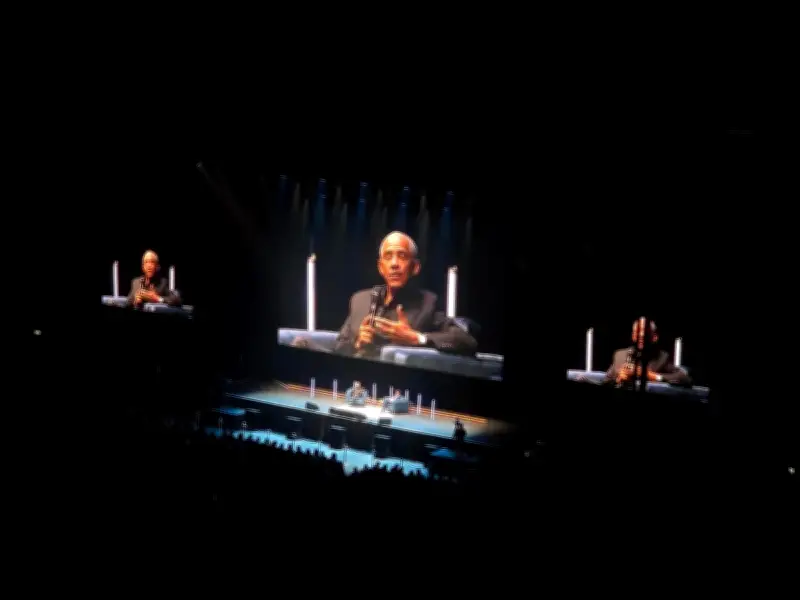
Barack Obama has told an audience in Glasgow that hope is worth fighting for, despite modern world challenges. The 44th president of the United States addressed more than 12,000 people in OVO Hydro on Wednesday night, reflecting on his time in the White House and exploring the political and social challenges facing the US and the world.
Social media's dual role
Speaking to British journalist and author Sathnam Sanghera, Obama said he saw the budding internet as a beacon for hope during his presidential campaign in 2008, when social media and technology were just gaining traction. But he said it turns out that the same positive forces and tools that could mobilise people around democracy or human rights could also be used by hate groups, noting a shift in recent years on online platforms.
Obama said: "It connected people for good - but also for ill. It turns out that the reptilian side of our brain really gets attracted to anger, fear, resentment and the sense that someone is out to get you. So a lot of social media and a lot of our information is informed around that."
Extremism is not inevitable
Obama said this drift towards extremism is "not inevitable". He said: "After World War two, at least in the US and Europe as well, the federal government said 'we're going to set up some rules because we've seen what propaganda can do in the hands of somebody like Hitler. We can see how big lies and misinformation can distort and enrage and incite violence. So we're going to hold these folks responsible'. We have not chosen to do that."
The 65-year-old said the world and its leaders are going to need to find mechanisms and new institutions that allow the world to have rigorous debate and disagreement while helping people sort out basic facts. Obama said: "If I had a blame pie for why politics is so polarised and why we're seeing a rise of populism in many places, it's because of that information that is going into our brains every day. It's part of the reason why young people can feel discouraged. It's not a healthy diet that our brains are on at the moment, and it's going to get even more difficult for us with AI to distinguish between what is true and what is not. It's hard for democracy to function if we can't at least agree on the facts."
Hope as an active choice
Speaking about hope, Obama was asked if he still believed in a Martin Luther King Jr phrase he quoted years ago about the arm of the moral universe being long, but ultimately bending towards justice. Obama said he stands by the quote and argued that hope is an active "almost theological" choice people must make. He said: "It's about how do we face and embrace this finite amount of time we have on the planet."
He told the crowd that he believes it is healthier for people to believe that change is possible. "I think when we act on that basis, it doesn't always work out, but over time things do get better," he said. After the Second World War, Obama said the world collectively agreed to put some guardrails in place and guard against tyranny and power conflicts, but "the question then becomes how do we remind ourselves of those victories and defend them".
He said there seems to be a cycle in humanity where people forget the lessons learned from the past and start to take things for granted. He went on: "We start thinking 'maybe using language in public from our politicians that fosters hatred and scapegoats certain people – immigrants, Jews, or blacks or gays – that's just talk, it's humour'. We forget what that leads to when it becomes a common habit and we normalise it and we start thinking 'democracy is not that important', and we forget what authoritarianism leads to and we become less vigilant in our defence of our core values and we become less tolerant."
He told the audience that the world is going to be dealing with "big challenges", but he said he thinks "we can be better". "When we choose, when we make that decision, I do believe – and there is evidence for this – that the world gets incrementally better, and that is a worthy goal and it's worth fighting for."
The Glasgow show formed part of a three-night UK tour. The former president also visited Belfast on Tuesday night and will be in Manchester on Thursday.