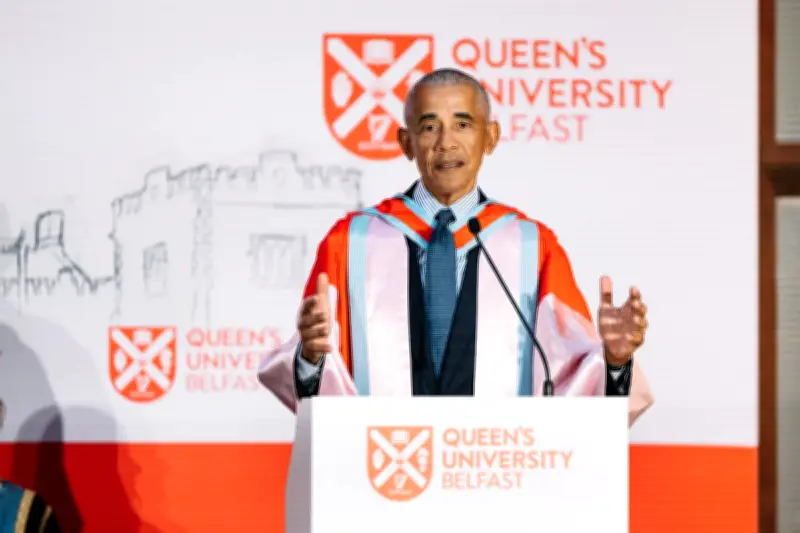
Barack Obama has told crowds in Belfast to “insist that we can do better than we’re doing right now” as he spoke about striving for peace at a time of global instability. Earlier in his visit to the city, the former US president also accepted an honorary doctorate from Queen’s University Belfast.
Conversation at the O2 Arena
On Tuesday evening Mr Obama addressed a packed O2 arena in a conversation hosted by writer and journalist Susan McKay, where he talked on a number of issues including the preservation of democracy, press freedom and the situation in the Middle East. He was asked what hope means to him.
Mr Obama said people need to “rediscover what’s the story we tell about how we’re going to live together, and see each other, and recognise each other, and disagree, and yet, still care for each other”.
“The Good Friday Agreement came about not just because of exhaustion and people being weary of violence,” he said. “It was also – somebody started imagining something better, and they saw themselves and each other in a different kind of way.”
On hope and kindness
He added: “People ask me sometimes how I can still be hopeful. It’s an assertion. It’s a practice. It is me saying: this is how I prefer to live. I am going to assume the best in people. I am going to be willing to recognise my own flaws and consider how I can be better. I’m going to insist that we can do better than we’re doing right now.”
“And there’s something in us that recognises ourselves and others, that has an impulse towards kindness, but also an impulse towards cruelty, and I know which side of that contest I want to be on. And I will fight for that, even if I don’t always think it’s going to win.”
Middle East peace and the Good Friday Agreement
Ms McKay read the concluding lines from Michael Longley’s poem “Ceasefire”, and asked what Mr Obama believes can be done to bring peace to the region. He said that he is “not as hopeful as I want to be in the short term” given the “aftermath of what’s happened in Gaza and the nature of political changes that have taken place in Israel”.
“Right now I think that the anger, the strengthening of right-wing forces inside of Israel, the settler movement; the constant changing of the facts on the West Bank, the continued suffering that’s taking place in Gaza, and I think the hardening of attitudes inside of Israel after October 7 means that we have to probably work for a genuine cessation of violence and relief for the people of Gaza as a step, then to even talk about the kinds of long-lasting peace that you described earlier, and it pains me, and it should pain everyone,” he said.
“To witness what happened there, it’s a distillation of us being trapped in history and a tribal, elemental, unforgiving divide that obviously there were times where we saw here in Northern Ireland, we have seen on every continent, and we see we have seen in every race, religion, ethnic group, and it’s a sort of madness once it breaks out. And the sense of grievance on either side feeds on itself to the point where, ‘I cannot even see that other person’, and it will justify anything.”
Honorary doctorate and challenge to students
Earlier on Tuesday, accepting his doctorate at a ceremony at Queen’s, Mr Obama praised Northern Ireland’s progress and challenged the next generation to continue building a peaceful and inclusive future. He told students at Queen’s: “The Good Friday Agreement is still a shining example of what can happen when people put aside old wounds and choose peace. But as we have seen in many countries, including in my home country the United States, peace and democracy are not inevitable. They have to be chosen, again and again.”
In his closing remarks, Mr Obama encouraged the Queen’s community to continue demonstrating what is possible through inclusion and ambition. “I want to use this opportunity as an honorary Queen’s graduate to leave you all with a challenge and that is to keep showing the way,” he said.