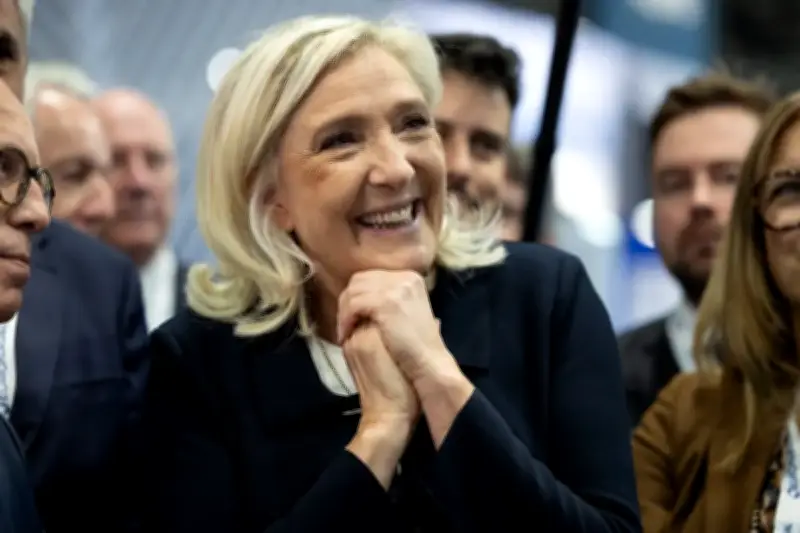
European leaders are neglecting to prepare for the possibility that Marine Le Pen wins France's presidential election in six months, a scenario that could cut off Ukraine's financial lifeline and undermine the three pillars of Europe's support for Kyiv, according to Mujtaba Rahman, managing director for Europe at Eurasia Group.
In an opinion piece, Rahman argues that a President Le Pen would suspend France's bilateral aid to Ukraine and could jeopardise EU-wide funding by threatening to veto the bloc's next seven-year budget, including a proposed €100bn facility for Ukraine, the mechanism through which the EU hopes to sustain Kyiv financially beyond 2028.
Le Pen's Potential Impact on EU Support
A Le Pen presidency could also give governments further from the frontline political cover to scale back their support. For Italy, Spain, Greece, Austria, Hungary and Slovakia, Ukraine is a lower priority, and Italian support could weaken further after next year's election. This could lead to a bilateralisation of aid, leaving a smaller group of northern and western European countries shouldering the burden.
Le Pen would also threaten Ukraine's EU membership prospects and the bloc's sanctions regime against Russia. Ukraine's membership of the EU would become virtually impossible because key decisions require unanimity, and Le Pen has already opposed Kyiv's accession. Sanctions would be equally vulnerable, as Le Pen has advocated lifting EU sanctions on Russia since 2017. The bloc's economic sanctions are due for renewal in July 2027, and a French veto could bring them to an end.
Worst-Case Scenario for Ukraine
Rahman outlines a worst-case scenario where, as a result of Europe's inability to sustain Ukraine after a Le Pen victory, Kyiv is pushed into a settlement on Moscow's terms. This could involve constitutional recognition of Russia's annexation of Donetsk and Luhansk, a prohibition on Nato membership, a cap on the size of Ukraine's armed forces, and other political demands.
Such a deal would be a humanitarian tragedy, leaving tens of thousands of civilians under Russian occupation, facing mass detentions, forced disappearances and torture. Because any transfer of territory requires a referendum, President Volodymyr Zelenskyy would have to hold one, and Ukrainians would very likely reject it, opening an unprecedented political crisis.
Economic and Political Fallout
The economy is likely to follow, with donors and investors pulling back, stalling reconstruction and prompting millions more Ukrainians to head west. Many soldiers would refuse to lay down their arms and keep up a guerrilla war in the ceded parts of Donbas, possibly handing Moscow a pretext to resume full-scale fighting.
Rahman notes that none of this is inevitable, as Ukrainians have shown little appetite for capitulation. However, he argues that policy should be built on the worst-case scenario rather than wishful thinking that Le Pen will moderate her view of Ukraine in the way that Giorgia Meloni has. He concludes that Ukraine's outlook is bleaker than at any point since Russia's full-scale invasion in 2022, and that Europe could become the weakest link in its own strategy to defeat Russia.