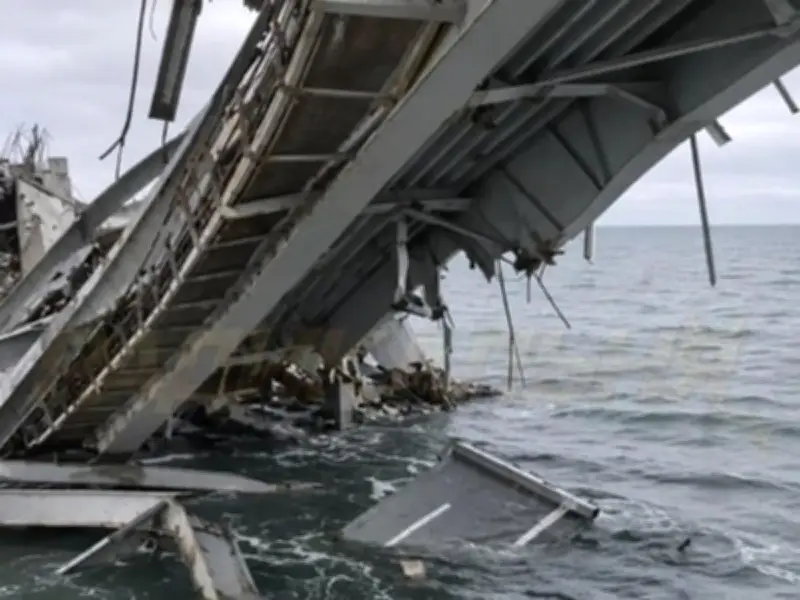
Ukraine has struck the Kerch Bridge for the third time in four days, halting rail traffic in a move that appears timed to embarrass Vladimir Putin as he meets Donald Trump and Xi Jinping in China.
The latest attack on the bridge linking Russia and illegally annexed Crimea follows earlier strikes that shut down the road section of the landmark. The Kerch Bridge is a key route for military and civilian supplies to Crimea, which Moscow seized in 2014 and uses to support frontline troops. It is a potent symbol of Russia's illegal annexation and has been a prime target for Ukraine.
Rail traffic halted after overnight strike
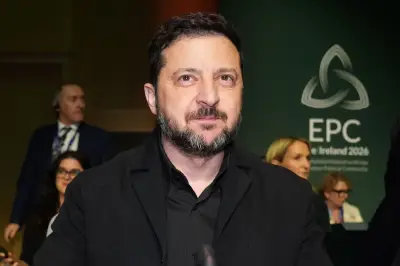
Train traffic across the bridge stopped after the overnight strike while authorities assessed the damage, but it was due to be restored from around 4pm local time on Thursday, the Moscow-appointed head of Crimea, Sergei Aksyonov, said. A large section of the road deck and an arch collapsed in this week's attack, which was the culmination of weeks of preparatory strikes over seven stages of the operation, according to Ukrainian President Volodymyr Zelensky.
The assault came hours before the start of talks in Berlin on Thursday between US envoys Jared Kushner and Steve Witkoff and President Zelensky alongside European leaders.
Russian and Ukrainian strikes continue
The Russian defence ministry said on Thursday that its air defences intercepted 53 Ukrainian drones over 10 Russian regions during the night. Ukrainian authorities said that Russia launched anti-ship missiles and 98 drones at Ukraine, with hits recorded at 18 locations, according to the statement. At least 10 people were reported wounded as Russian strikes caused damage in 12 regions, Prime Minister Serhii Koretskyi said.
Russia's larger army hopes to exhaust Ukraine on the front line through sheer weight of numbers in soldiers, armour and weapons. But Kyiv's defences are largely holding the Russians back, sapping Russian momentum with the help of drones that quickly choke off troop advances. Russia has resorted to strategic bombing to wear down Ukraine's resistance, placing special emphasis on knocking out power ahead of winter, while Kyiv's domestically developed long-range drones and missiles have struck deep inside Russia, often targeting its oil refineries.
Diplomatic tensions and peace efforts
In China, Mr Trump called Mr Putin "my friend". The American president's relationship with Mr Zelensky, meanwhile, has soured. European leaders have tried to isolate Mr Putin diplomatically and have heavily sanctioned the Russian economy.
Ukrainian officials fear their country's fate could be determined by agreements between Mr Trump and Mr Putin, while European governments alarmed by Moscow's aggression are trying to avoid being sidelined by Washington and Moscow. The question of US support for Ukraine, severely curtailed under Mr Trump, could be raised by Democrats in Congress after their wins in midterm elections.
Mr Kushner and Mr Witkoff have led efforts to end nearly five years of war following Russia's all-out invasion of its neighbour and recently have mediated new discussions, though the talks have yielded no major breakthrough. Mr Kushner said on X that Washington's priority at Thursday's meeting in Berlin is to "further strengthen our close co-ordination with Ukraine and Europe, work toward a unified position on the key elements of a lasting peace, and to jointly prepare the agenda and proposed format for the next round of multilateral negotiations". The meeting will also explore how Ukraine's European backers can fit into post-war security arrangements. Kyiv wants to ensure that Russia does not invade again, while Moscow wants to keep the Nato military alliance away from its borders.