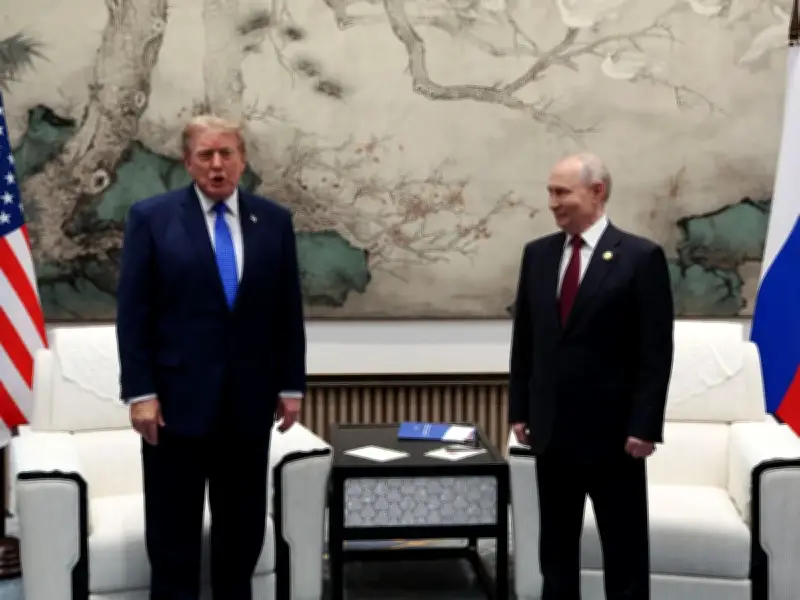
US President Donald Trump appeared to treat Vladimir Putin like a little boy, leaving the Russian leader to stand by himself during an awkward meeting on the sidelines of the Asia-Pacific Economic Cooperation (APEC) summit in Shenzhen, China.
Photographs and footage from the high-stakes gathering show Putin standing alone with his hands clasped awkwardly in front of him while Trump commanded the room, gesturing broadly and speaking to the assembled press. The scene sparked online ridicule, with critics questioning Trump's mental state and accusing the 80-year-old leader of behaving like a playground bully towards his Russian counterpart.
Awkward Photo Opportunity
During the photo opportunity ahead of their closed-door talks in Shenzhen, Trump stood towering beside Putin in front of the American and Russian flags, waving his arm and addressing reporters while the Russian President stood rigidly with a tight smile. At one point, Trump reached across with both hands during a prolonged handshake, leaning in closely as Putin appeared visibly uncomfortable.
The bizarre scene sparked fierce mockery online, with critics questioning Trump's mental state and accusing the 80-year-old leader of behaving like a mentally unwell schoolyard bully towards his Russian counterpart.
Concerns Over Cognitive Health
Speculation surrounding Trump's cognitive health has mounted in recent months, with opponents pointing to a string of public outbursts, apparent confusion, and physical slip-ups as potential warning signs of dementia. Critics and medical commentators have highlighted everything from erratic tirades against reporters and bouts of daytime drowsiness to a recent White House ceremony where the President struggled to cut a ribbon without assistance from aides.
His own niece, clinical psychologist Mary Trump, has also repeatedly alleged that her uncle suffers from untreated psychiatric issues, while social media users have seized on clips of him appearing disorientated or waving to imaginary friends outside the White House as evidence of cognitive decline.