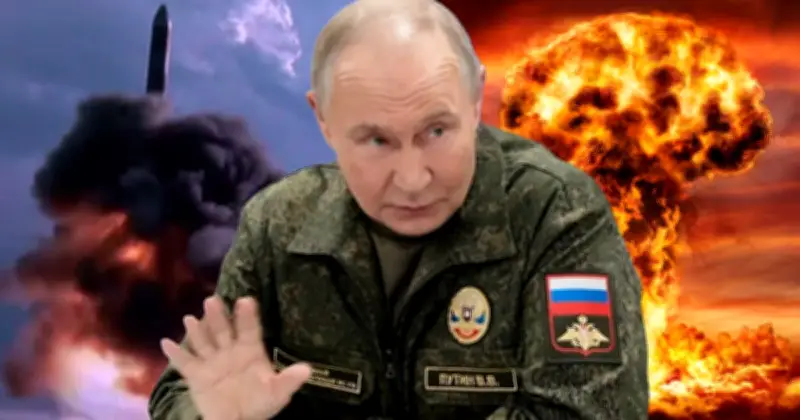
Vladimir Putin could unleash a devastating nuclear strike if his grip on power begins to weaken, a former Kremlin insider has warned. Abbas Gallyamov, the Russian president's former speechwriter, told the Daily Express that Putin could resort to nuclear weapons if his situation deteriorates, raising fears of a potentially catastrophic escalation.
However, Mr Gallyamov suggested China's President Xi Jinping could hold the key to preventing such an attack, claiming Putin would be unlikely to launch a nuclear strike if it risked angering Beijing.
Former speechwriter's warning
Speaking exclusively to the Express about the possibility of Putin using nuclear weapons, Mr Gallyamov said: "I think now it would not happen, but there is a chance. There is a small chance, but the situation is not so horrible for him than it has been."
"Maybe he could use a nuclear strike if his situation deteriorates, but not for now. Nobody is threatening to capture Moscow or a revolution," he added.
"He would definitely try to threaten a nuclear strike but a lot depends on China. If this displeases Xi Jinping then Putin would not take this action."
Three-way talks in Shenzhen
His comments come amid continued international efforts to negotiate an end to Russia's war in Ukraine, with the prospect of a wider confrontation remaining a concern.
Donald Trump, Vladimir Putin and Xi Jinping gathered in Shenzhen, China, on Thursday (November 19) for historic three-way talks on the sidelines of the Asia-Pacific Economic Cooperation (APEC) summit. The leaders are expected to discuss several major international issues, including the war in Ukraine and nuclear arms control, although the official agenda has not been made public.
Trump and Putin also held separate talks lasting approximately 40 minutes, marking their first meeting since discussions in Alaska last year failed to secure a breakthrough in the Ukraine conflict. The US president struck an optimistic tone following the meeting, describing Putin as a friend and expressing hopes of improving relations between Washington and Moscow.
"He's my friend," Trump said, adding: "We've had a great relationship for many years." He also suggested the discussions could lead to progress, saying: "Wonderful things can come out of this — or at least start."
Nuclear arms control efforts
The meeting comes as Trump continues efforts to broker a peace agreement between Russia and Ukraine, with significant disagreements remaining over Moscow's territorial demands. The US president has also expressed hopes of reaching a new nuclear arms control agreement involving Russia and China following the expiry of the New START treaty in February.
The agreement previously placed limits on the deployed strategic nuclear arsenals of Russia and the United States, but Trump has called for "a new, improved and modernised" deal that would include Beijing. However, China has previously resisted joining such negotiations, with its nuclear arsenal significantly smaller than those held by Washington and Moscow.
Security experts raise concerns
The talks have also prompted concerns among security experts about the potential consequences of any agreement involving concessions to Russia. Professor Anthony Glees, a security expert at the University of Buckingham, warned that the meeting could pose a "grave danger" to Britain and Europe if Trump agreed to Putin's demands over Ukraine.
Speaking to the Daily Express, he said: "Trump should not be meeting Putin. It's a disgrace. That is the grave danger for us in Europe - that Trump will sell out Ukraine, and Europe at the same time."
Professor Glees suggested the Russian president was using the high-profile gathering to strengthen his international standing and persuade Washington to make concessions over Ukrainian territory. He also warned that Russia could seek to extend its influence over former Soviet republics and weaken NATO's position in Europe.
The expert urged Britain and its European allies to strengthen their defences against Russia and China, arguing that military strength was essential to deterring further aggression. He said: "There's only one language Putin and Xi understand and that is the language of force. We can only speak from a position of power if we are strong."