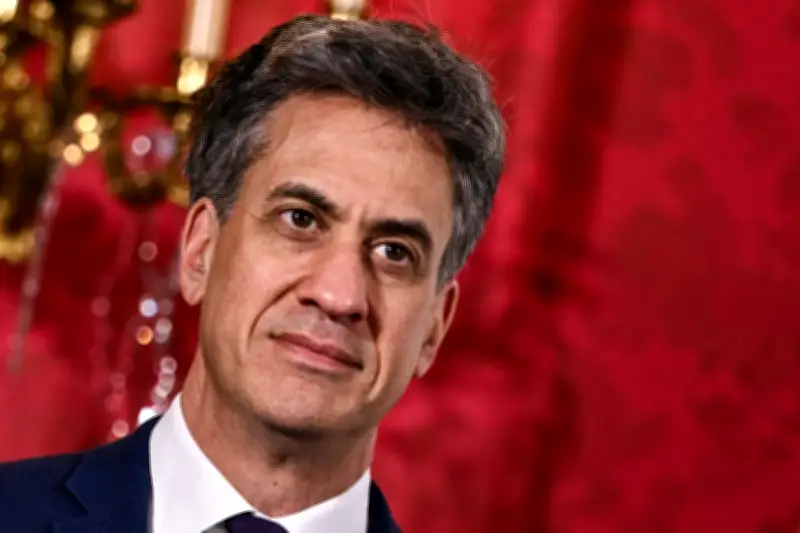
Foreign Secretary Ed Miliband has stressed the need to move beyond the "no war, no peace" stalemate in the Iran conflict, which he warned was causing "deep economic pain" for the UK and its allies.
Speaking after US President Donald Trump said the war with Iran was militarily "effectively over" and it was "highly unlikely" the US would resume strikes, Mr Miliband called for an "all-out diplomatic effort" to end the conflict and properly reopen the strategic Strait of Hormuz waterway.
Mr Trump said: "We're just keeping it the status quo."
Stalemate 'not a stable equilibrium'
While welcoming the reduced chance of a return to major combat, the Foreign Secretary stressed the need to move beyond the current impasse. He spoke after attending this week's G7 foreign ministers' meeting in France.
Mr Miliband said: "The status quo is bad economically for us and it's not a stable equilibrium.
"We need to move beyond the 'no war, no peace' stalemate, which is causing deep economic pain for our countries.
"We must see an all-out diplomatic effort to end this conflict, prevent a nuclear Iran and the threats it poses around the world, and get the Strait of Hormuz properly reopened. Economically, that is essential for our country and the world economy."
Shipping attacks continue
Despite continued claims in Washington that Iran's military has been wiped out, Tehran has continued to attack shipping in the Strait of Hormuz, disrupting oil supplies and sending fuel prices soaring. The Gulf channel had been fully open to vessels before the US and Israel launched hostilities earlier this year, aimed at preventing Iran getting a nuclear weapon.
US Secretary of State Marco Rubio insisted "oil is getting out", but acknowledged the Iranians "are still launching a couple drones a night trying to sink commercial vessels" and renewed his call for other countries to help protect maritime traffic.
Speaking this week at the G7, Mr Rubio said: "We shouldn't have to defend global shipping, but in this particular case, because the IRGC (Islamic Revolutionary Guard Corps) is intent upon trying to sink these ships, we'll continue to do that and have been doing it quite effectively."
Call for allies to 'step up'
Mr Rubio said he had raised the idea of other countries assisting but claimed he "didn't get a response", and again argued they "should step up". The White House has previously criticised the response of the UK and other allies, insisting they need the waterway more than the US.
Britain and France had spearheaded plans for a defensive mission to secure freedom of navigation in the channel after the war, an initiative derided by Mr Trump and branded a "catch-22" by Mr Rubio.
The US secretary of state said: "Part of the challenge we have is there's countries out there that say, well, we're ready to provide forces to help defend shipping once there's no risk of conflict.
"But if there was risk of conflict, we wouldn't need them. So it's kind of a catch-22.
"Look, we're going to continue to do it, we've done it quite effectively.
"Frankly, we think it's in the interest of the world to protect shipping, because the US doesn't get any oil from there.
"We don't rely on Middle East energy for our own economy. So I think these countries should step up. I think a couple are thinking about it, to be honest with you."