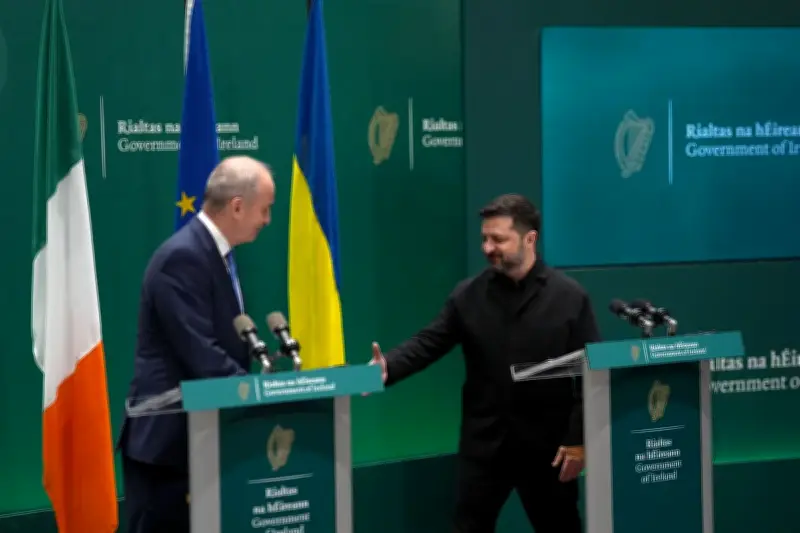
Ireland and Ukraine are exploring a joint memorandum on drone technology following a bilateral meeting between Ukrainian President Volodymyr Zelensky and Taoiseach Micheál Martin in Dublin on Wednesday.
The two leaders confirmed the move during a joint press conference, with Mr Martin saying they are looking at drawing up a joint memorandum in terms of the two countries having a relationship with regard to drone technology and manufacture.
Drone cooperation and security talks
Mr Martin said that given Ukrainian expertise in drone technology, Ireland could avail of that technology, particularly unmanned drones in terms of maritime security, but that work is still ongoing.
Mr Zelensky said Ukraine is ready to help with drone technology, adding: “We are ready for co-production with Ireland, and we expect our drone deal with Ireland to become operational.”
The meeting came as Mr Zelensky indicated he expects to be updated by US President Donald Trump’s envoys, Steve Witkoff and Jared Kushner, following talks with Russia in Abu Dhabi. This is expected to include a proposed prisoner exchange as well as security guarantees which Ukraine has asked of Russia.
Prisoner exchange and security guarantees
Mr Zelensky said he expects to get reaction from the Russian side to the issues that were raised, including potentially exchanging 1,000-1,200 prisoners of war. “That would be a very positive thing, and I don’t see any reasons for Russia to not accept that proposal,” he said.
He also said several formats of security guarantees for Ukraine were discussed, noting that the sides have engaged in more detailed dialogue on this issue.
Mr Zelensky stressed he wanted to see Europe involved in the talks, as well as the United States and Russia, saying that ending the war without Europe’s participation “would be impossible”.
Major security operation in Dublin
Mr Zelensky is among more than 50 world leaders gathering in Dublin this week for two major EU presidency events, amid the biggest security operation in the history of the state.
The European Political Community (EPC) summit takes place on Thursday, followed by an informal meeting of the EU Council on Friday. Both events will be held at the Convention Centre on the North Wall Quay, followed by a dinner event at the National Gallery on the south side of the city.
An Garda Síochána has put in place vast barriers around the area, preventing access for vehicles, cyclists and pedestrians. Air and maritime exclusion zones have also been established, and thousands of gardaí will be deployed throughout the city.
There will be 100 specially trained motorcycle escort officers who will perform a minimum of 200 movements of VIPs, including heads of state. Gardaí will take part in 15,000 rolling 12-hour shifts and have drafted in officers from Northern Ireland, Latvia and Portugal.
Garda Commissioner Justin Kelly said there will be approximately 500 public order-trained Garda members along with 500 officers of various disciplines, some of whom will carry firearms in various tactical roles in the form of emergency response and close protection. Equipment including water cannon, public order dogs and horses will also be available.
Traffic disruption and protest stance
Extensive road closures will run through until late on Friday, with security cordons and public diversions in place. Transport chiefs expect every bus route in the capital to be affected by knock-on traffic disruption, and they have asked people to consider if their plans in Dublin on Thursday and Friday are necessary.
Real-time information on arriving buses will not be available on display boards at stops but will still be accessible through apps, the National Transport Authority said, advising people to check its website for all information on route changes.
Mr Kelly said there will be a zero-tolerance approach to protests which block infrastructure or interfere with the running of the major EU events. “In relation to fuel protests themselves, there’ll be absolutely no toleration for any blockage, anything in the next few days, anything around motorways, critical infrastructure, or any of the EPC locations,” he added.
Assistant Commissioner Jonathan Roberts said he is aware of some people wishing to protest over Thursday and Friday, and asked that anybody minded to protest engage with An Garda Síochána, which will facilitate lawful, peaceful protest. He added that there is nothing to suggest any planned protest will be anything other than peaceful, but there will be no tolerance for any protest involving the blocking of roads or obstruction of any aspect of the event, and no tolerance of any interference with critical infrastructure.