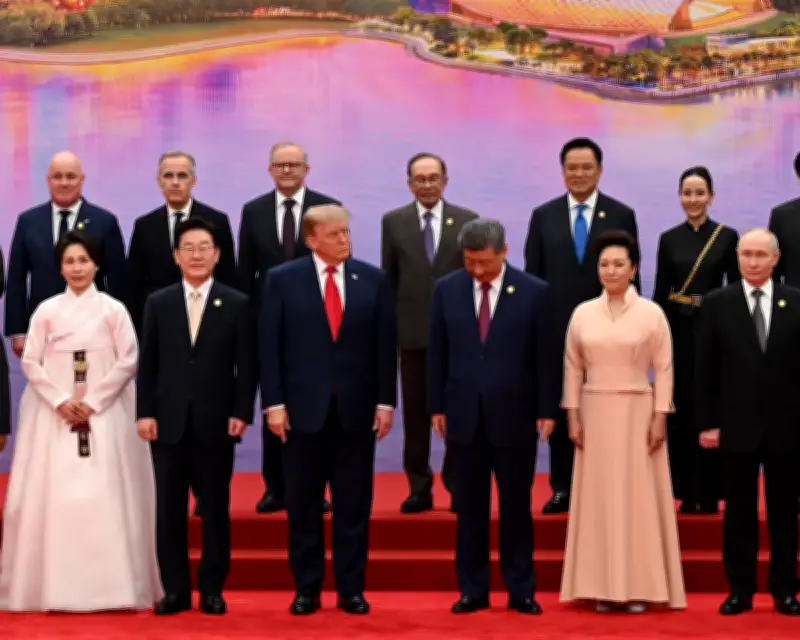
Anthony Albanese has appeared in a leaders' photo with Vladimir Putin at the Apec summit in China, despite Australia's Ukrainian community urging the prime minister to protest Russia's war.
After arriving in the Chinese tech capital Shenzhen on Wednesday, Albanese said he would respect the wishes of China as the hosts of this week's Asia Pacific Economic Cooperation summit and take part in the photo. He appeared in a group shot which included Putin, the US president Donald Trump, and China's Xi Jinping at the summit banquet on Wednesday night. The traditional leaders' "family photo" is due to be taken on Thursday morning.
Albanese Defends Participation
"I will bear in mind the wishes of our host," Albanese said before the event. "China are our host here, I respect that, but we also make our position very clear when it comes to Ukraine." Other leaders including Canada's Mark Carney said they would take part, despite foreign ministers at this month's G20 talks in the United States refusing to pose with Russia's Sergey Lavrov.
It is the first time Putin has had a place at the forefront of a grouping of world leaders in nearly a decade. Professor of international law at Australian National University, Don Rothwell, said posing with Putin risked undermining trust in the International Criminal Court, where the Russian has been indicted as a war criminal over his invasion of Ukraine and the four-year war.
Criticism from Ukrainian Community
"For the Australian prime minister to appear on a photograph with Vladimir Putin is not consistent with the international values Australia is seeking to espouse," Rothwell told Guardian Australia. Australian Federation of Ukrainian Organisations chairwoman, Kateryna Argyrou, had urged Albanese to boycott the event.
"Vladimir Putin is not just another world leader attending an international summit," said Argyrou. "He is an indicted war criminal and the architect of a brutal war against Ukraine – a war that has brought death, destruction and unimaginable suffering to millions of people."
Diplomatic Tour and Trade Agenda
China is the latest stop on Albanese's intense diplomatic tour. After Quad leaders' talks in Manila on Tuesday night, the prime minister attended a business event and toured a supermarket selling Australian-made products in Shenzhen. The city – known as a major hub for electronics, drones and companies including Huawei and electric vehicle brand BYD – is seeing intense security as world leaders gather. Many of the streets have been cleared of local residents, allowing motorcades speedy access to the summit hubs and nearby luxury hotels.
Spruiking investment in Australia, Albanese recalled first visiting Shenzhen in the 1990s and said AI could help bridge economic divides and allow for sustainable growth in the region. "The economic potential and opportunity of artificial intelligence is enormous," he said. "Not just for the Asia Pacific, but for the world."
As well as the main summit, Albanese will take part in bilateral meetings on Thursday, including with Mexico's president Claudia Sheinbaum. He will attend a lunch with Carney, and the leaders of Singapore and New Zealand. But the trilateral talks with Trump, Xi and Putin on Thursday are set to dominate conversations in Shenzhen and in capitals around the world. Already likened to the Yalta summit after the second world war, Ukraine's president Vladimir Zelenskyy warned against decisions about his country's future being made without him.
Albanese will make a diplomatic call on Xi on Friday, ahead of a meeting in Beijing with the Chinese premier, Li Qiang. On the agenda with both leaders is a push for China to remove 55% tariffs for Australian beef exports, imposed after the country hit an annual quota for sales. Albanese said he would lobby in Australia's interests. "Of course we'd rather not have any quotas on Australian goods anywhere in the world, but the fact they've hit it is a signal that Chinese consumers want to buy Australian beef because of its quality."
He said he would raise a full suite of trade issues, as the federal government works to stabilise trade with China after Beijing imposed a major diplomatic freeze on Australia during the former Coalition government. Albanese praised Xi's engagement and knowledge of Australia, noting the Chinese leader had visited every state and territory.