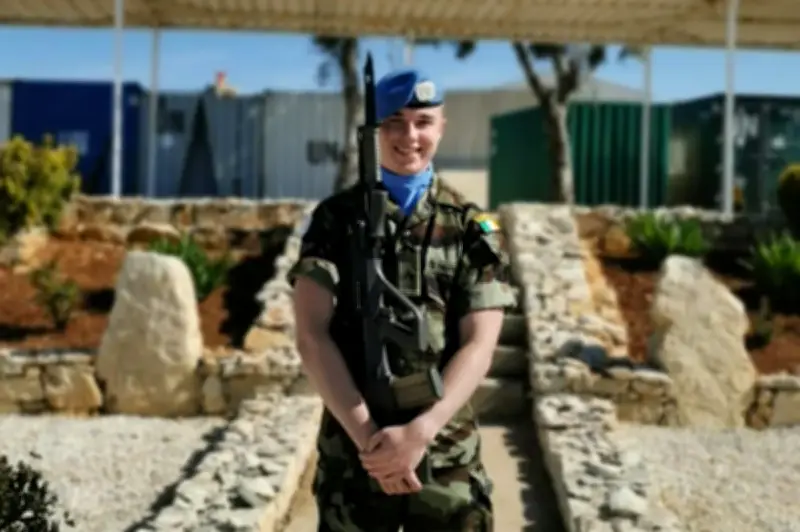
An Irish peacekeeper seriously injured in the same attack in which Private Sean Rooney was killed has told an inquest they did not know the route on the night had a sharp turn they missed after being separated from another lead vehicle. Trooper Shane Kearney said the last thing he remembers from the incident in Lebanon was bullets "hitting the car", having woken up in hospital in Dublin days later seriously injured.
Attack on convoy
Tpr Kearney served alongside Pte Rooney, who was fatally shot when their armoured Toyota Land Cruiser was surrounded while on a planned journey to Beirut Airport on December 14, 2022. Both had been serving with the Unifil peacekeeping force in southern Lebanon when they were surrounded and fired upon.
The jury previously heard they were both in the back vehicle in a convoy of two armoured Toyota Land Cruisers which were transporting two peacekeepers to the airport after they had been granted bereavement leave. Pte Rooney, 24, from Newtowncunningham in Co Donegal, was killed in the attack.
Tpr Kearney, who told the inquest he sustained a significant head injury in the assault, said he was not in uniform or armed at the time as he was one of those being transported back for a funeral.
Missed turn and hostile crowd
The inquest heard on Wednesday that the second car, driven by Pte Rooney, cut out after both vehicles stopped along the route to remove UN flags from their exteriors. Tpr Kearney, from Killeagh in Co Cork, said the first vehicle drove off with "no bother" but the Land Cruiser he was in with Pte Rooney and two others had difficulty.
During the public session, the jury heard several minutes passed before the second vehicle in the convoy was able to move again. Tpr Kearney said there was a time within this period when everyone got out to look for a key. He also said a civilian car had passed in the meantime.
The jury heard it was normal practice for the lead vehicle to look in the rear view mirror to see if the second Land Cruiser was following, and said they may have seen the civilian car and assumed it was them as the flags had already been removed.
In the questioning, Tpr Kearney said it was his belief that the second vehicle was to find its way to the airport by following the lead Land Cruiser. He also said it was his belief that no-one in the second vehicle knew the specifics of the route – including a sharp turn along the way.
He outlined how they had continued straight on the road for about 10-15 minutes without catching up to the first vehicle, missing the sharp turn on the proposed route, and ended up in a village. Tpr Kearney said their vehicle then – within two minutes – became surrounded by a "very aggressive and hostile" crowd in the village of between 50-60 people.
Inquest proceedings and context
He said they began shaking and hitting the car with whatever they could get their hands on, with a van later pulling up and three or four people emerging from that with assault rifles. The inquest heard this was more serious than a usual "denial of freedom of movement" (DFOM) and Tpr Kearney said he also saw one man "hammer" his window with a pistol.
The hearing was told the peacekeepers initially thought they were safe, with Tpr Kearney saying "we thought we were in a bulletproof car", but they began to have doubts for their safety when the rear window was later smashed. He told gardaí "it got hostile very quickly" on the part of those in the village, also saying the peacekeepers "didn't know at this stage help wasn't coming for us".
Sean Guerin, a barrister representing Pte Rooney's family, told Tpr Kearney they wanted to thank him for serving with his colleague "to the very end". Under questioning from Mr Guerin, Tpr Kearney also told the inquest he did not complete the full "formal" pre-deployment training before going overseas – adding that this "would happen often enough" with other peacekeepers.
The inquest comes as the final Irish infantry group prepares to deploy to Unifil, bringing almost five decades of continuous Irish service in Lebanon to a close. The Irish army has participated in Unifil since it was established in 1978 following the Israeli invasion of Lebanon. A UN Security Council decision last year means Unifil's mandate ends on December 31, followed by a withdrawal phase.
In the 48 years Irish troops have been deployed to Lebanon, 48 soldiers have died and others have been injured, including Tpr Kearney. The inquest at the Coroner's Court, Store Street, Dublin, is expected to continue for three to four weeks.