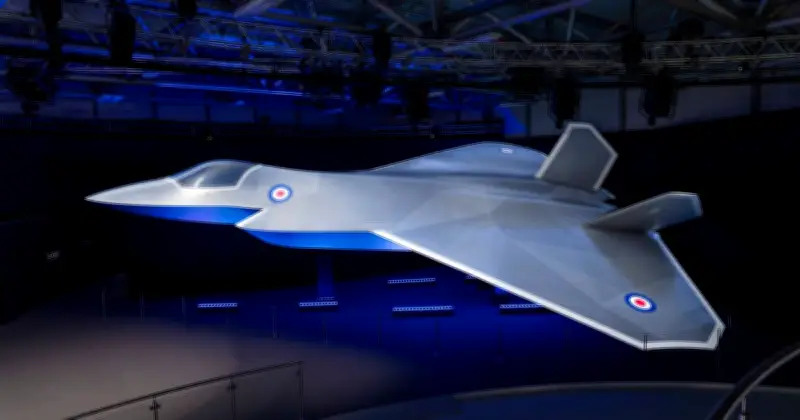
The head of the Royal Air Force has confirmed that uncrewed fighter jets will begin flying in UK airspace next year, and that the new GCAP fighter could be the last with a pilot in the cockpit.
Air Chief Marshal Sir Harv Smyth said AI-enabled, uncrewed aircraft will “transform military aviation as profoundly as the shift from propellers to jets”. He stated that the Global Combat Air Programme (GCAP), a project involving Britain, Italy and Japan to build a sixth-generation stealth combat aircraft, would require a crew, but future projects would likely be drones.
GCAP and the Tempest Jet
Dubbed “Tempest”, the new GCAP jet will be equipped with technologies including AI and next-generation sensors, as Western nations seek to maintain air superiority amid threats from rival powers such as Russia and China.
Britain signed a £4.6 billion contract in July for the aircraft’s design alongside Italy and Japan, with GCAP aiming to produce a cutting-edge fighter by 2035. The new aircraft is being developed by Edgewing, a joint venture between the UK’s BAE Systems, Italy’s Leonardo and the Japan Aircraft Industrial Enhancement Company.
Future RAF and Autonomous Systems
The Chief of the Air Staff said the “future RAF will combine Typhoons and F-35s with autonomous systems”. Writing in The Telegraph, Air Chief Marshal Sir Harv said: “Used properly, AI and machines will tackle the most dangerous tasks instead of humans, but technology must enhance human judgment, not replace accountability.”
He added: “The GCAP jet is perhaps the last crewed fighter we will ever build, not because people will become less important, quite the opposite.”
Uncrewed Flights and International Partners
The four-star commander also confirmed flights of uncrewed fighter jets will begin in 2026. He said: “Uncrewed fighter jets will start flying in UK airspace next year. This is exciting and necessary in equal measure.”
GCAP, initially a pact between the UK, Italy and Japan, welcomed Canada as an “observer nation” in July. Canada’s “observer nation” status means it will not have a decision-making role, but will have privileged access to the scheme. In October, Prime Minister Andy Burnham said the UK was “open” to Germany joining the international coalition to build the next generation of fighter jets.