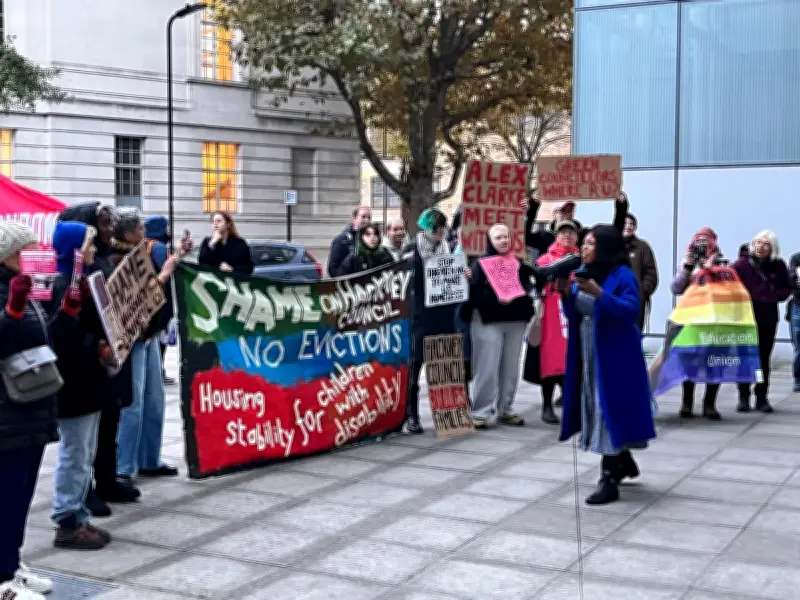
Hackney Council's new Green-led administration has admitted it does not have the power to stop the eviction of a disabled boy and his family, despite a pre-election pledge to prevent it. The admission came as activists staged a third protest outside the council's headquarters on Monday, demanding answers over the case.
Charity Oppong and her eight-year-old son Kayden, who has severe autism and is non-verbal, are facing eviction over the subletting of a council flat from a named tenant. The family are set to be moved into temporary accommodation elsewhere in the borough, a move the London Renters Union (LRU) and clinicians say will cause "deep distress" and lasting harm to the boy, who is prone to meltdowns and has "no safety awareness".
Three-week deadline sparks protests
Officers gave the family a three-week deadline to move, warning that otherwise the council would relinquish its homelessness duty. Campaigners marched on Monday from the Town Hall to the council's corporate headquarters, demanding "justice" for the family.
An LRU spokesperson said the council was "recklessly" forcing the family into temporary accommodation in a block with known "safety hazards", while another criticised the council's "threatening" communication. "The only way to ensure a safe and suitable home for Charity's son is to let him stay in the area where he has grown up, and where his support network is. Needlessly removing him from his school and support network will cause lasting harm," the spokesperson said.
Years of tenancy dispute
Almost 20 years ago, Ms Oppong moved into the flat when her sister-in-law, Janet Antwi, was named on the tenancy agreement. Ms Antwi later moved to America and never formally transferred the tenancy, but Ms Oppong stayed and continued paying rent and council tax.
The council learned of this in 2021 and continued to accept payments from Ms Oppong while triggering eviction proceedings on grounds of tenancy fraud. The local authority maintains that what she paid was "not rent and [did] not create a tenancy". In 2025, a judge granted the council a legal warrant to evict the family, who have since fought the decision in the courts.
The local Green Party backed the cause ahead of the council elections in May, when the Greens won power in the borough for the first time. In February and March, two politicians who now sit as senior cabinet members joined activists in physically blocking bailiffs from evicting the family.
Mayor and deputy respond
Addressing the crowd on Monday, Mayor of Hackney Zoë Garbett said: "We came into this administration wanting to do as much as we could about situations like this. We've done whatever we could – we've received independent legal advice on decision-making. We've challenged policies, we've got extensions, we've supported the family to have a place inside the borough."
Deputy Mayor Dylan Law, who holds the cabinet portfolio for housing, added that there had been a "steep learning curve" for him upon entering office. "This situation has been highly tenuous, extremely stressful […] and to be honest, I thought it would be an easier situation than it turned out to be. There is a lot of regulation, a lot of bureaucracy, a lot of rules which we have to adhere to, which may not be something which I necessarily understood when I first got in," he said.
Prior to his election, Mr Law was among those "resisting" the eviction. He said at the time that if the Greens won control of the council he would "definitely amend the succession rules" to let the family stay, and urged then-Mayor Caroline Woodley to "do the right thing".
The LDRS understands Mayor Garbett commissioned an external barrister to advise on what the new administration could do. The lawyer confirmed that elected politicians could not legally overrule officers on this decision.
Clinicians and campaigners respond
Dr Hannah Caller, a paediatrician from Homerton Hospital, told the Local Democracy Reporting Service (LDRS) that NHS staff were "gobsmacked" by the council's three-week timeframe for the move. She said clinicians and social workers have explicitly warned the council against an abrupt move, which can be "deeply distressing" for autistic children.
Housing officers argue that they are legally bound to allocate social housing in line with statutory rules and national legislation. However, campaigners and the family's lawyers argue that under the council's housing allocations policy, in exceptional circumstances the Town Hall has the discretionary power to grant a tenancy, a temporary licence or charge a "use and occupation" fee. Officers maintain that the family's case is not exceptional.
Before her election, Ms Garbett also urged the then-Labour Mayor to have the council withdraw the eviction notice. In an email, she reminded Woodley that the council had been accepting rent from Ms Oppong and highlighted the boy's acute needs. "This is about making sure that children are safeguarded, harm is avoided and that the council is acting in line with its statutory responsibilities," Ms Garbett wrote.
At the time, Ms Woodley said she recognised the family's "stressful" situation but said it would be "deeply unfair" to the 7,900 residents on the borough's housing waiting list if the council made an exception.
In March, a judge granted an eight-week suspension of the council's eviction warrant, which has since lapsed. The family were given a fresh notice of eviction on August 17. The council has since offered Ms Oppong a temporary flat on the Woodberry Down estate, which is slated for eventual demolition.
One campaigner told the LDRS the Greens had been "naïve about what was possible", adding that the LRU's target was the officers making the decisions. "The allocations policy needs major reform. That's something the Greens should have been thinking about as soon as they stepped into power," the activist said.
Following negotiations with Ms Garbett at Monday's demo, the group said the politicians had put "serious pressure" on officers to grant the family an extension until December to move to Woodberry Down. The LDRS understands the council has agreed to this. When asked to justify the three-week deadline, the local authority said the family had been given sufficient time to decide on their new accommodation.
The council declined to offer a statement on the protest, but added that officers had assessed the ground-floor property and designated it "suitable" and safer than the family's current home, which has a balcony that presents a safety risk to autistic children. The council also maintains that officers gave careful consideration to the medical letters of support it had received. The LDRS approached Ms Oppong for comment.