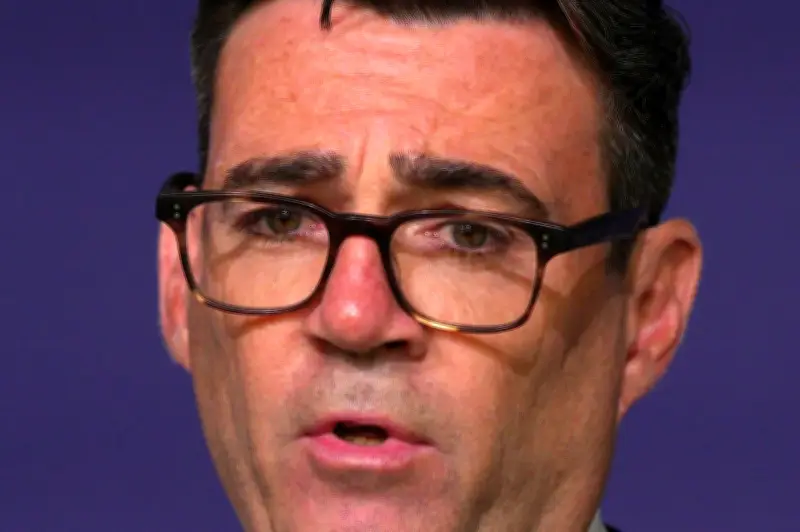
Prime Minister Andy Burnham has said he wants to help “move things forward” with regard to solving Stormont’s budget crisis. However, he dampened down hopes of any immediate cash injection for public services when he said he was in “listening mode” during his first visit to Northern Ireland since entering Downing Street.
Meetings with Stormont leaders
Mr Burnham met later with First Minister Michelle O’Neill, deputy First Minister Emma Little-Pengelly and Stormont political parties to discuss financial pressures in the region. Devolved ministers have failed to agree a budget for the current financial year, with departments operating on contingency budgets since April.
Ministers have consistently made the point that they need more funding from the Treasury to address a funding crisis facing public services in Northern Ireland.

Prime Minister's comments
Asked about the budget impasse during a visit to the Oh Yeah Music Centre in Belfast, the Prime Minister said: “I am five weeks in office and I am here in Northern Ireland because I want to work with the new Northern Ireland Secretary to see if we can move things forward, listen to what people have to say.”
He added: “I realise how pressing it is, I realise the concern people have, but we are here because we want to listen. We want to have an honest exchange, I think there are things we would say, if we can work together, have a look at where possible savings could be made or where things could be done differently, that’s right and proper that I ask for those assurances given that we have got to make sure it is fair across the whole of the UK when it comes to a budget.”
He said: “I am saying I am here to have that honest conversation, and I am somebody who comes with an open mind. My emphasis is on problem solving in this job. I love this part of the world, I am a regular visitor. I want to see people here with a budget, with public services set up to succeed. That is what I want to try and achieve working with the Northern Ireland Secretary but first and foremost we have to sit around that table and hear where all the parties are. I will be taking that back to London later today.”
Praise for Executive leaders
Mr Burnham was also asked about comments from him where he referenced “political point-scoring” restricting opportunities in Northern Ireland. He said he believes Sinn Féin’s Ms O’Neill and the DUP’s Ms Little-Pengelly, who lead the Stormont powersharing Executive, are a “model” for other politicians.
He said: “It wasn’t so much a criticism I was making of politicians here. If you look at how the First Minister, the deputy First Minister work, I think it is to their great credit that they work in the way that they do. In some ways I would say they are something of a model for politicians elsewhere in the UK, where you often don’t see politicians prepared to put differences aside. Here people have the greatest differences but still are able to work like that.”
He added: “I do feel politics more broadly needs to move to a different way of working where we put the place first, rather than the party first. We put people first and that is something I want to see in politics right across the UK.”
Earlier, the Prime Minister had announced plans to bring together the leaders of Wales, Scotland and Northern Ireland in the autumn for a summit to help boost the UK economy.
Party leaders' responses
Speaking ahead of his meeting with the Prime Minister, DUP leader Gavin Robinson said he wanted to discuss Northern Ireland playing a “full and integral” part within United Kingdom politics. He said: “Clearly, there are issues around budget resettlement in Northern Ireland. People at home are familiar with those and the challenges that creates in public service, so that will form a key part, not only of our discussion about what we can do collectively and politically in Northern Ireland to reach agreement around a budget, but what assistance is required from our UK national parliament and from this Prime Minister to support us in that endeavour. There is a need for politicians in Northern Ireland to get real with some of the issues that face our people, our public services, and those on the front lines, and confidence is key in devolution and in politics in Northern Ireland.”

Ms O’Neill said she had told Mr Burnham that there had to be a “proper funding model” for public services. The First Minister said: “We underlined very, very clearly that for decades now we’ve been underfunded, and that we need to get an adequate budget in place. We want to agree a budget, but it must be the right budget – a budget that allows us actually to invest in public services to give our nurses the pay that they deserve. We’re now apparently about to start on a process, process that will start over the coming week, where we’re going to get into the nitty gritty of the budget itself. But if Andy Burnham does the same thing as all of his predecessors and comes in at a crisis point and puts a few pounds on the table and then walks away again, we’ll be in that vicious circle again. So I made the point to him today, what we need is proper funding, a funding model that reflects the needs of our people here, a funding model that matches what they get in Scotland and Wales.”
Alliance Party deputy leader Eóin Tennyson said there was a “short but crucial window” to get a budget agreed. He said: “That will require compromise both from the UK Government who need to recognise that Northern Ireland has been under-funded compared with Scotland and Wales, but also local parties who now need to be serious about some of the difficult decisions we need to face up to around transformation of our public services. That is what people want us to be focused on, transforming our health service, tackling the cost of living and delivering better public services for people and with a willing partner in the UK Government and goodwill on all sides I believe that is possible.”