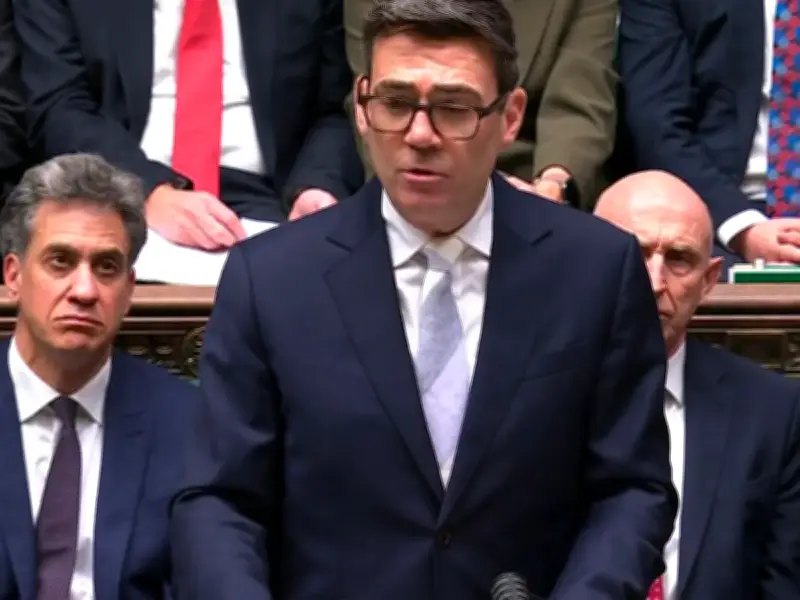
Prime Minister Andy Burnham has said he wants to open up a discussion about the UK's future relationship with the European Union but has not confirmed whether that will require a second referendum.
The prime minister was responding to comments made by Neil Kinnock, who claimed it was 'obvious' that Mr Burnham wants the UK to re-join the European Union.
Kinnock's comments
When asked by la Repubblica, an Italian newspaper, if the prime minister would take the UK back into the EU, Baron Kinnock replied: "Yes, sure, sure, sure. His commitment is authentic. He really does understand from the grassroots up why restoring what I think of as normality in our continent is vital for every party economically, politically, culturally, all in security terms, and is able to articulate it in language that people can understand. So yeah, he is definitely."
Mr Burnham has described Baron Kinnock, who was leader of the Labour Party from 1983 to 1992, as one of his mentors.
Asked if he was playing down the desire to revisit the 2016 referendum result during the Makerfield by-election, Lord Kinnock replied: "Andy's not changed direction. He's always been a committed pro-European. In the by-election, he rightly didn't make a noise about it. That's tomorrow's debate. Simply because the by-election wasn't about Europe. It was about winning Makerfield in order to enable him to become leader of the party. That's all it was about."
No confirmation on referendum
However, the prime minister has been evasive on whether this will be put to the British public in a second referendum or if re-joining the customs union will be mentioned in Labour's manifesto for the next general election.
In a long statement to MPs on Monday, Mr Burnham repeatedly refused to rule out taking the UK back into the EU single market after the general election.
He told the Commons that it would be a 'dereliction of duty' not to seek deeper partnership with the EU. But he maintained that the British public would be the 'boss' at every stage of renegotiating that relationship.
Spokesperson and opposition response
In a briefing to journalists on Tuesday, a spokesperson for the PM said: "There is a need for a closer relationship with the EU while making clear the red lines in the manifesto. The prime minister has made it clear he will respect the red lines that are in the manifesto in this parliament."
The spokesman said Mr Burnham wants 'the country to be clear' on where it's heading in the next decade 'but said there are no assumptions here'.
When asked what mechanisms were in place to decide this, the spokesman said: "This is not about rushing to outcomes. It's about opening up discussions on what options are available at strengthening long-term relationships with Europe."
Mr Burnham told Parliament that he will push for new post-Brexit deals with the EU at a summit in Brussels on November 20.
He said 'deeper cooperation' on youth mobility, food and drink, energy, and controlling immigration would help drive the UK's economic growth.
However, Kemi Badenoch criticised the prime minister for 'unpicking the deal this country signed with the EU a decade after the referendum'.
The leader of the opposition said Mr Burnham would not get a better deal than the one secured by the Conservatives, accusing him of giving the game away ahead of the summit.
By-election promises and public opinion
During the Makerfield by-election, Mr Burnham promised not to 're-run' Brexit arguments.
While he claimed Brexit had been 'damaging, he said 'Britain will be stuck in a permanent rut if we're just constantly arguing'.
In a speech at a conference in Leeds, Mr Burnham said: 'I am not proposing that the UK considers re-joining the EU. I respect the decision that was made at the referendum and it is going to undermine everything I have said about strengthening democracy if we don't respect that vote.'
In a recent YouGov poll, 64 pc of Britons said there should be another referendum before deciding to re-join, compared to only 23pc who said the government should be able to make the decision without a referendum.