Scientists have used new analysis of traces of radioactive fallout from nuclear weapons testing trapped in the teeth of stranded whales to help reconstruct the stories of their lives.
Researchers created what has been described as a kind of “dental time machine” using sophisticated radiocarbon dating techniques on samples of whale teeth to find out details about their lives. As with the rings of a tree, each layer of growth in a whale’s tooth is thought to form annually.
The harmless trace radiocarbon information in their teeth, together with stable isotopes, provided clues about what the whales ate, where and how long they lived.
Teeth from five whales analysed
The researchers’ discoveries are based on the analysis of teeth collected from three killer whales and two sperm whales which died on Scottish shores in recent decades.
The team drew on the distinctive rise and decline in radiocarbon caused by nuclear weapons testing, which began in the mid 20th century before later ceasing, with the fallout entering ecosystems in the sea and on land. Analysis of the radiocarbon preserved in the teeth allowed experts to determine whether layers formed before, during or after weapons testing, and estimate when different parts of the tooth were created.
One of the sperm whales they analysed was Moby, who became stranded on mudflats along the Firth of Forth in 1997. His skull is displayed in the National Museum of Scotland.
Moby’s age and the Sellafield signal
Testing carried out by the team found that when he died, Moby was aged at least 43 as the innermost layers of his teeth were formed before fallout from nuclear weapons testing affected the marine environment.
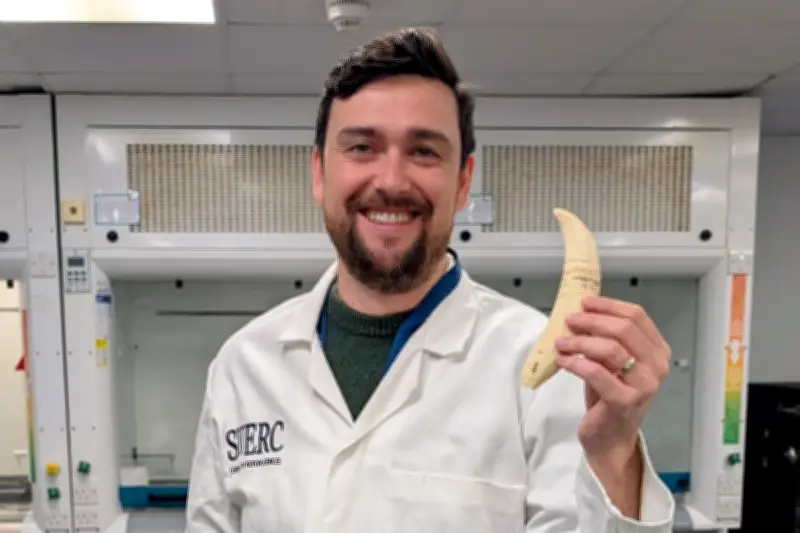
The findings are published in the journal Frontiers In Marine Science. The research has a personal resonance for the paper’s lead author Dr Kieran Tierney, of SUERC: Centre for the Isotope Sciences.
He said: “My parents took me to see Moby when he arrived in the Firth of Forth in 1997, when I was six years old. A few days later, we saw pictures of him dead on the shore, and I had so many questions: How could this huge, amazing animal die so suddenly? Where had he come from? What sort of life had he had?
“Those questions have always stayed with me, and they have been a fundamental part of what has driven my career at the overlap of marine science and isotope research. To be able to hold one of Moby’s teeth 30 years later and do work which helps us understand a bit of the life he had is something I’m really proud of.”
Killer whale findings
The research was led by scientists at SUERC: Centre for the Isotope Sciences in partnership with researchers from the universities of Glasgow, St Andrews, Edinburgh and National Museums Scotland. The team used SUERC’s accelerator mass spectrometer to analyse the radiocarbon found in each layer of the teeth.
Also among those analysed was a tooth taken from killer whale Lulu, who washed ashore on Tiree in the Hebrides in 2016 with signs of entanglement. The scientists found no clear sign of the nuclear-weapons testing signal but found a different radioactive fingerprint, the so-called “Sellafield signal” produced by radiocarbon discharges from the Sellafield nuclear reprocessing facility into the Irish Sea and carried to the west of Scotland.
The team also examined stable isotopes of carbon and nitrogen in the tooth samples. Their analysis of a tooth from a killer whale stranded on South Uist in 2015 suggested he was aged around 65 or perhaps even older, which researchers said would make him one of the oldest male killer whales on record.
Dr Tierney added: “By combining radiocarbon with stable isotope analysis, we can get a much richer picture of how these animals lived. We hope that this study adds a useful piece to our ever-growing understanding of the life histories of these two whale species.”
The research was supported by funding from the Natural Environment Research Council, part of UK Research & Innovation.