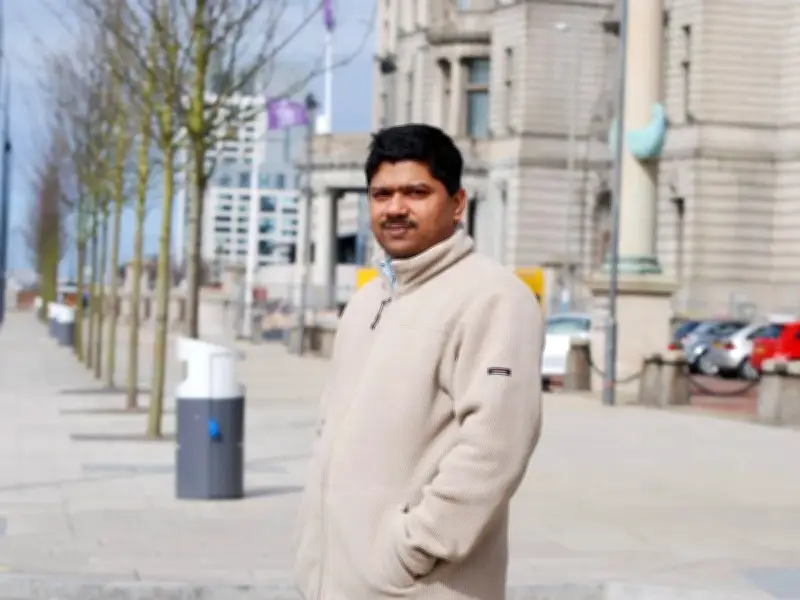
Bindhu Brion Xavier, 51, a nurse living in Manchester, has told how her husband Brion Xavier died at 41 after a severe bleed on the brain, but her quick CPR response meant his organs were donated to save three other people's lives.
Brion, a professional driver, first complained of a headache on the afternoon of November 16 2014, for which Bindhu gave him paracetamol and ibuprofen. By 11pm he complained of pain at the back of his neck, so Bindhu called an out-of-hours GP. While she was on the phone to emergency services, she heard a “snoring noise” and turned to find her husband unconscious and unresponsive, with his tongue blocking his airway. She immediately began CPR.
Paramedics arrived within minutes and performed further resuscitation before rushing Brion to hospital in Wythenshawe. He stayed in intensive care for three days before brainstem testing confirmed the brain was no longer capable of supporting life due to a severe bleed.
A nurse's instinct to check on her husband
Bindhu, who was an ICU nurse at Wythenshawe Hospital, said Brion's health had been “good” throughout their relationship, as they enjoyed going on walks together and he “never needed to go” to doctors. Every two years, when they returned to India to visit family, they had full screening tests, and Bindhu said all of Brion's came back “fine” a month before his collapse.
When Brion complained of a headache at around 2pm on November 16 2014, Bindhu assumed it might be a seasonal cold or flu and gave him both paracetamol and ibuprofen. By the time she left for her night shift at 7.30pm, his headache persisted and he was doing steam inhalations to try to clear it. “I actually started teasing him by asking if it was a man-flu,” Bindhu said.
At around 11pm, during a 1.5-hour break at work, Bindhu asked her manager if she could go home to check on Brion – something she said she had “never done” before. She found him sitting on their bed in the dark and noticed he was squinting in the light, and he complained of pain at the back of his neck. Thinking it might be meningitis, she asked him to touch his chin to his chest, which he could do, and his temperature was normal. She decided to call an out-of-hours GP after noticing “beads of sweat” on his forehead.
Organ donation becomes a gift of life
Bindhu said: “As I was kneeling beside him and relaying information to the doctor… I suddenly heard a snore and when my gaze fell on his face, he had collapsed and was unresponsive. That 'snore' was from his tongue blocking his airway… then I felt his pulse and it was going down.” She hung up and called 999, who advised her to pull her husband to the ground and start CPR.
Brion was rushed to the same hospital where Bindhu works, and over three days doctors learned he had a grade 5 subarachnoid haemorrhage – a rare type of stroke that causes bleeding on the brain. After brainstem testing on his third day in ICU, the decision was made to take him off life support, but not before Bindhu disclosed Brion's wishes to donate his organs. Because she had gone home by chance during her break and started CPR immediately, his organs were deemed viable for transplant, including both kidneys and his liver.
“I believe I was supposed to come home that day in order to preserve his organs for someone else,” Bindhu said. “When I told the consultant to call the organ donation specialist nurses in, she got up from her seat and hugged me.” Bindhu has since received cards from recipients whose lives were changed by Brion's organ donations.
Advocating for donation among ethnic minorities
Bindhu has become actively involved in Upahaar, a charity initiative by her friend Agimol Pradeep, who used to work in the kidney transplant ward at Manchester Royal Infirmary, which has registered more than 10,000 organ and stem cell donors. She is encouraging people of colour to register as blood and stem cell donors, as, according to NHS Blood and Transplant, only 11% of people registered as potential donors through the NHS Stem Cell Donor Registry are from ethnic minorities, and fewer than 5% of blood donors who gave blood in the last year were from black, Asian and minority ethnic communities.
Bindhu told PA Real Life: “One day Brion was fine and we were all together, the next day he was in hospital with a brain haemorrhage. We don't know what's around the corner, but Brion's death has drilled into me that… unless we talk about (organ donation) and make it a normal conversation in people's households, we won't get anywhere with this. Even with my husband, he wasn't open to the idea of it at first, and it was only when it hit close to home when a friend of ours was diagnosed with cancer that you realise how precious life can be.”
Bindhu and Brion, both originally from India, moved in together in Manchester after they married in February 2003 and had two children, Austin, 22, and Ashlene, 18. “Organ and stem cell donation can be a gift of life for someone,” Bindhu said. “I can't think of a better gift than that.”