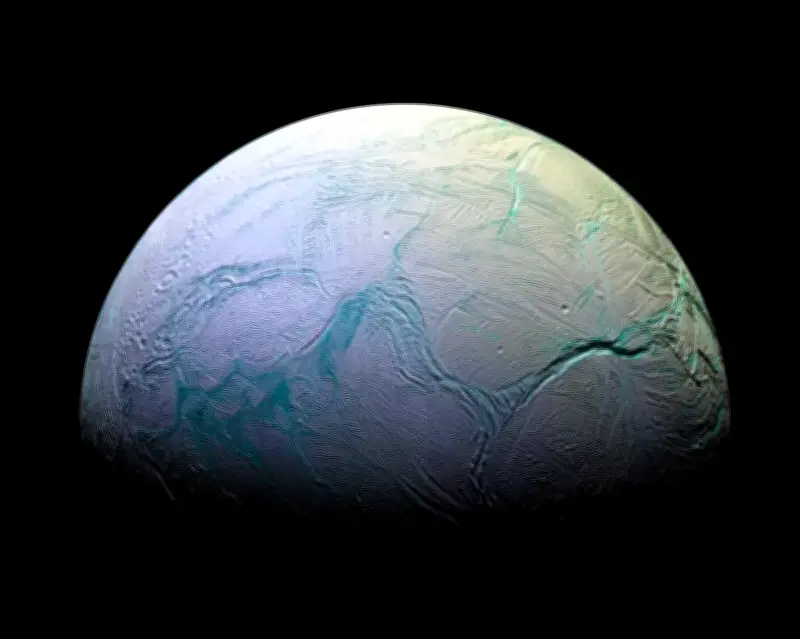
Experiments have shown that Earth microbes can survive in conditions mimicking the ocean of Saturn's moon Enceladus, strengthening the possibility that the icy world could support life.
Researchers found that organisms living in deep-sea waters off Japan survived in a brine that replicated the briny ocean beneath Enceladus's icy crust. The microbes, which thrive near hydrothermal vents by converting hydrogen and carbon dioxide into methane, grew in the simulated environment despite its extreme alkalinity.
Simulating Enceladus's Ocean
Scientists have long been intrigued by Enceladus since spotting plumes of water erupting from the moon. Observations from Nasa's Cassini probe and the James Webb space telescope have revealed gigantic plumes of water vapour and ice grains spewing from Enceladus, along with evidence of a huge saltwater ocean under its frozen crust.
William Orsi, a professor of geomicrobiology at Ludwig-Maximilian University in Munich, and his colleagues recreated a miniature version of the ocean in the laboratory. By combining water with salts and carbonates and adding powdered rock, they reproduced the extremely alkaline environment and the crucial reactions between water and the rocky seafloor.
Microbial Survival and Implications
The rock-water reactions were active enough to produce hydrogen, a process thought to occur on Enceladus. The researchers then tested whether methanogens, microbes that survive by converting hydrogen and carbon dioxide into methane, could survive in the solution. They used microbes originally found near deep-sea hydrothermal vents in the Okinawa trough between Japan and Taiwan.
Surprisingly, the microbes grew despite the pH reaching 11, far more alkaline than their known limit. They even adapted their metabolism to cope with low concentrations of carbon dioxide. The findings are published in Science Advances.
Implications for Future Missions
David Rothery, a professor of planetary geosciences at the Open University, said the work "removes another barrier to the viability of microbial life there" by showing methanogenesis was possible in the simulated ocean.
Orsi stressed that if life ever evolved on Enceladus, it could be radically different from Earth's. "Could they survive for a year? Could they survive for a million years? We don't know," he said.
A second paper in the journal describes how ice grains in Enceladus's plumes freeze and fragment, separating ocean constituents. If ocean droplets contained bits of alien microbes, these might appear in a small fraction of ice particles but be highly concentrated within them. Frank Postberg, a professor at the Free University of Berlin, said this would be "great news" for the search for life.
The European Space Agency's L4 mission aims to combine a Saturn orbiter with an Enceladus lander to hunt for biosignatures in the plumes. With a launch proposed for about 2042, it would not reach Saturn until the 2050s. Dr Rachael Hamp of the Open University said the new research makes the proposed mission "even more exciting."