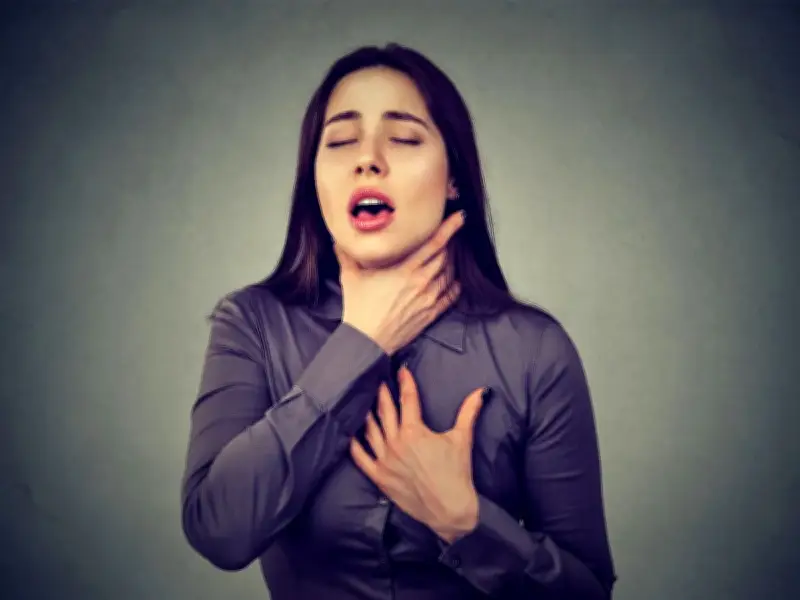
Around 300 people die in England every year due to a choking incident, St John Ambulance has said, as it warns that lives are being lost because bystanders “do not have the knowledge or confidence to intervene”.
A poll commissioned by the charity found that only 42% of people know how to stop someone choking by giving back blows and abdominal thrusts. The survey of 2,000 UK adults, conducted by Censuswide on behalf of St John Ambulance, also revealed that 19% have never heard of an abdominal thrust, previously referred to as the Heimlich Manoeuvre.
In addition, 32% of respondents said they did not know that choking can become life-threatening in minutes without first aid, according to the survey.

Survivor’s story
The warning comes as a woman described how her best friend saved her life after she choked on a fish bone in a gastropub in Totnes, Devon. Leslie Sinoway, 54, from St Leonards-on-Sea in East Sussex, began choking on a fish bone which had lodged in her throat. Her friend Lucy Rhoades recognised something was wrong and delivered back blows, dislodging the bone.
Ms Sinoway said: “I ordered the sea bass. We were all chatting when, all of a sudden, I felt something get caught in my throat and I started coughing. I got up and kept coughing, becoming more and more scared. Lucy noticed and got up. She asked me if I was OK and I gestured that I wasn’t. That’s when she started giving me firm back blows. A fish bone flew out. I genuinely thought I was going to die. It was horrible. If anyone would stay calm in a crisis, it would be Lucy.”
Ms Rhoades, 55, from Totnes, said: “It took me a couple of seconds to realise what was happening. She was unable to speak and was clearly struggling to breathe. I leaned her forward and gave her several back blows between her shoulder blades, and she coughed up a fish bone.”
Restaurant rescue
Another man was thanked for saving the life of a stranger in a busy London restaurant. Marine engineer Calum Glen, from Walthamstow, was enjoying dinner with his family when he noticed a woman at a neighbouring table choking. Following his first aid training at work, the 31-year-old gave the woman five back blows before moving on to abdominal thrusts, when a piece of steak flew out and her airway was cleared.
“The woman was clutching at her throat. She wasn’t coughing or speaking - she was choking,” he said. “I stepped in to help - about a year earlier, I’d completed a first aid course through my work. One of the biggest lessons that stayed with me was that people often forget to start with back blows before moving on to abdominal thrusts - thanks to Mrs Doubtfire. I gave her five firm back blows using the heel of my hand between her shoulder blades. When the back blows didn’t dislodge the obstruction, I moved on to abdominal thrusts. Thankfully they worked - a piece of steak flew out of her mouth and she was finally able to breathe again. Everyone should have first aid training. I hope I never have to use those skills again, but you never know when someone’s life could depend on you knowing what to do.”
Campaign to teach life-saving skills
The charity has launched its Save a Life September campaign, which aims to teach half a million people life-saving skills through free demonstrations and online guidance.
Jordan Davison, community education partner at St John Ambulance, said: “Choking is often dismissed as a minor incident, but the consequences can be devastating. Tragically too many people die because those around them do not have the knowledge or confidence to intervene. This September, we’re urging people to take a few minutes to learn these essential first aid skills. Through St John Ambulance’s videos and public demonstrations, people can learn simple, life-saving skills that could help them save a loved one, friend, colleague or even a stranger. Our volunteers will be out in communities across the country, putting the power of first aid into more people’s hands.”