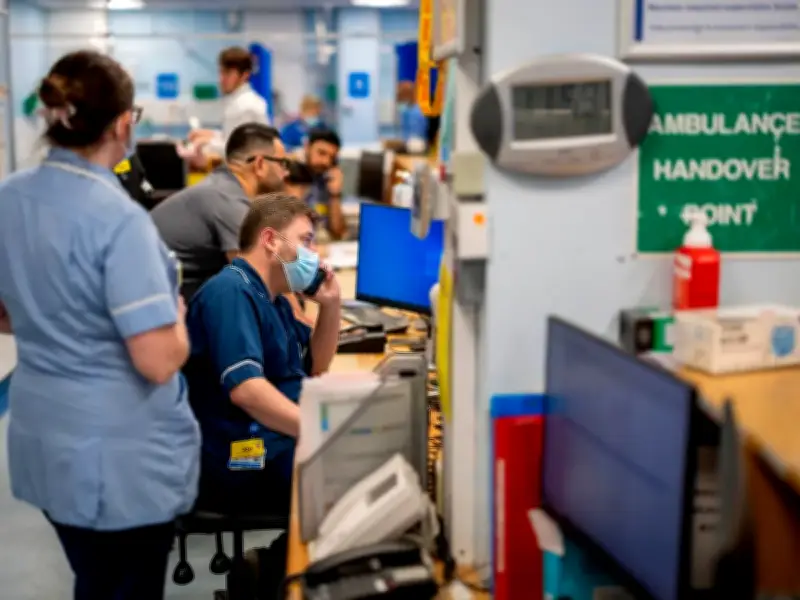
Overcrowded A&E departments may be causing more than 1,000 deaths a week, according to a review of NHS hospitals. The study of more than 19,000 adult patients found that for every 10% increase in emergency department occupancy, the chance of dying in the following 28 days rose by 1%.
The research was carried out at 134 A&Es in Wales, Northern Ireland and England last year, representing 70% of emergency departments in these countries. Lead author Dr Ryan McHenry, of Glasgow University, said around 550 deaths every week across all of England, Wales and Northern Ireland could be caused by overcrowding.
Study findings and excess deaths
Dr McHenry, who is an emergency medicine doctor in the west of Scotland, said: "The possible range of expected deaths is large [so] we estimate anywhere between 33 and 1,083 excess deaths are plausible. This is important because we know that emergency departments are now often very crowded, and reducing that crowding has the real potential to save lives."
The study looked at how corridor care has become widespread in the NHS, with patients treated in non-clinical spaces such as corridors, offices and walk-in cupboards. Researchers examined A&E occupancy levels during a two-week period in March 2025 and presented their findings at the European Emergency Medicine Congress (EEMC) in France.
Occupancy levels and patient risks
Occupancy was calculated by comparing the number of spaces, such as cubicles, an A&E department had with how many patients were being treated. A&Es were operating at 175% occupancy on average, which is a marker of overcrowding. NHS data shows patients who spent more than 12 hours in A&E are more than twice as likely to die within 30 days than those seen within two hours. The most elderly with multiple complex health conditions are more likely to endure such waits.
The Mirror previously revealed corridor care was quietly rolled out in 2022 to get ambulances queuing outside A&E back on the road quicker. The study follows a Royal College of Nursing (RCN) report in 2024 which told of patients dying "under a pile of coats" in packed waiting rooms. One nurse told the Mirror that elderly patients regularly spent 24 hours in corridors on trolleys and as a result develop incontinence and pick up respiratory viruses which have led to "extreme critical incidents including death".
BMA and RCN response
The doctors' union said the crisis was leaving A&E workers living with "moral injury" when they cannot give the standards of care they know patients need. Dr Den Langhor, emergency medicine lead at the British Medical Association, said: "More than five hundred people dying each week because of overcrowding in our emergency departments is an absolute scandal. That is the equivalent of a fatal jumbo jet crash every single week in the UK."
RCN General Secretary Professor Nicola Ranger said: "Overcrowding and corridor care pose a severe threat to the lives of patients. The reality is that staff simply can't deliver the standard of care that patients deserve in these conditions. The appalling situation must be met head on with immediate and significant investment in beds and nursing staff in hospitals but also more capacity in community services and social care to treat people closer to home and speed up discharge. Nothing else will match the scale of this crisis."
Long-term trends and official response
A&E waits got steadily longer during over a decade of Conservative governments, before which waits over 12 hours were unheard of. By December 2019 some 2,356 patients waited longer than 12 hours on a trolley until a proper bed became available, and by December 2025 it was 50,775 patients.
A Department of Health and Social Care spokeswoman said: "The NHS faced the busiest summer in its history this year, but thanks to the incredible work of NHS staff, 75% of people in A&E were seen in four hours in August. We know there is much more to do to reduce pressures on A&E departments, which is why we're going further and faster to improve emergency care, deploying expert teams into the most challenged trusts and investing more than £1.5 billion in hospital buildings and facilities to help them withstand year-round pressure. And by shifting more care into the community, we are helping people to get the care they need closer to home."