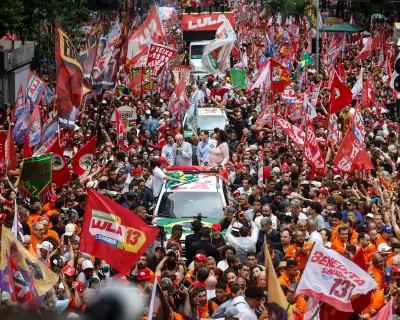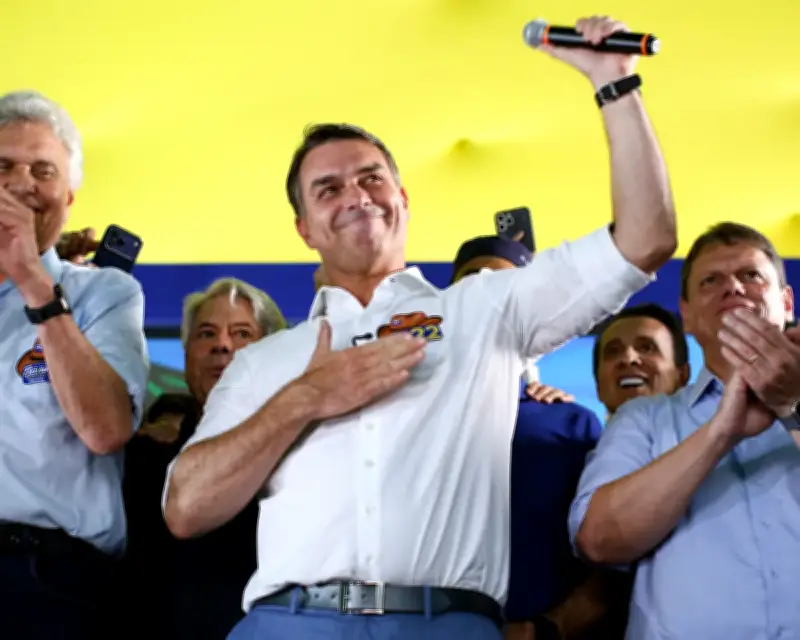
Flávio Bolsonaro, the far-right son of former president Jair Bolsonaro, has taken a commanding lead in Brazil's presidential election, securing 47% of the first-round vote and positioning himself as the favourite for the 25 October runoff against incumbent President Luiz Inácio Lula da Silva, who received 44.2%.
This outcome has sent an unnerving jolt through climate and nature campaigners, as it appears to be a vote against the Amazon rainforest. The current administration under Lula has reduced deforestation in the Amazon by almost 50%, yet this success yielded little electoral traction for either Lula or pro-forest candidates in the same day's polls. Former environment minister Marina Silva lost a Senate bid, and Joenia Wapichana, a former head of Brazil's Indigenous affairs agency Funai, failed to secure a congressional seat. Of 57 Indigenous candidates, only two won.
Bolsonaro's Environmental Record
Flávio Bolsonaro is the heir to his father's political legacy, a former army captain whose four-year presidency resulted in a 59.5% increase in Amazon deforestation, roughly equivalent to destroying 2 billion trees. If elected, Flávio has promised to free his father, who is imprisoned for plotting a military coup, and has said his father could hold any position in his administration.
As a lawmaker, Flávio backed a 2019 bill to eliminate requirements for landowners in the Amazon to conserve native vegetation. His manifesto completely ignored climate change, and he has courted support from some of the most predatory landowners in the rainforest. He is part of the Bolsonarism movement, aimed at maximising profits for extractive industries regardless of environmental cost. Its victorious candidate for the Amazonian state of Pará, Daniel Santos, was fined $275,000 for deforesting 280 hectares without authorisation and now promises to waive such penalties.
Bolsonarist Gains and Legislative Power
Following Sunday's election, Bolsonarists now control seven of the nine states in the Brazilian Amazon and could win an eighth in the runoffs. Their influence in the legislature, already dominated by agribusiness interests, is growing. Jair's brother Eduardo and mother-in-law Michelle were elected to the Senate, while an uncle and brother won seats in the lower house. Even before the election, Congress pushed to weaken environmental protections, and now it will be almost impossible to stop, particularly given the chaos in the supreme court, which has been a partial check on expansion by miners, ranchers, and monoculturalists.
Against these forces, Lula would struggle to govern even if he wins the runoff. The peril extends beyond the Amazon to all of Brazil's biomes, its traditional peoples, and the stability of the global climate. The question is why voters paid so little heed to these concerns.
Drivers of Bolsonaro's Surge
The inquest into the vote is already under way. Many focus on the influence of social media, more effectively utilised by the far right. During the Bolsonaro administration, his sons were part of a so-called hate cabinet that spread fear and disinformation via WhatsApp groups and other online channels; his second son Carlos was indicted by federal police for leading the group, with environmentalists often targeted.
Another factor is the expansion of US-style Pentecostalism, which is steadily supplanting Catholicism across Brazil, particularly in the Amazon. Comparing the pro-nature treatises of the past two popes with the sermons of many evangelical preachers reveals the political and environmental consequences of this religious shift, as preachers encourage followers to seek wealth today as much as moral creeds.
Lula, 80, has been slow to adapt. Though arguably the most iconic Latin American politician of the 21st century, his messaging seems less attuned to the people than in his heyday. The Workers' Party has struggled in an era of weaker unions and been a victim of its own success—raising millions out of poverty, creating greater expectations for consumption and entrepreneurism, and providing huge subsidies to farmers who now support the right wing due to environmental limits.
Geopolitical Context and Election Prospects
These explanations tie into the geopolitics of the climate crisis, which exacerbates rivalry between the US and China and amplifies extreme ideologies. The Brazil election is the latest in a pattern of far-right takeovers expanding extractivism despite evidence that the capitalist economy is breaking planetary boundaries. In the past two years, Donald Trump has ripped apart environmental regulations in the US, treating the Americas as his sphere of influence. Argentina was already onboard, Venezuela has been invaded for its resources, and Colombia, Peru, and Chile have shifted sharply to the right.
The Bolsonaro family hope Brazil will be the next domino to fall to Trumpism. Jair went so far as to salute the US flag, while his son Eduardo urged the US to apply tariffs on Brazilian people to punish the government for imprisoning his father. Brazil's intelligence agency has warned the US was trying to interfere in the election.
That election isn't over yet. Lula stands a small chance if he can win over the millions of voters who chose not to mark their ballots for either candidate, but the odds are stacked against him. Most eliminated candidates were on the right, so their supporters are more likely to switch to Bolsonaro. No first-round leader has ever failed to win the runoff of a Brazilian presidential election.
Voters are allowed to change their minds, either on 25 October or constitutionally in four years' time. But for how much longer will that be possible? If Bolsonaro wins, it won't just be Lula that is finished; it could also be the Amazon and democracy itself.