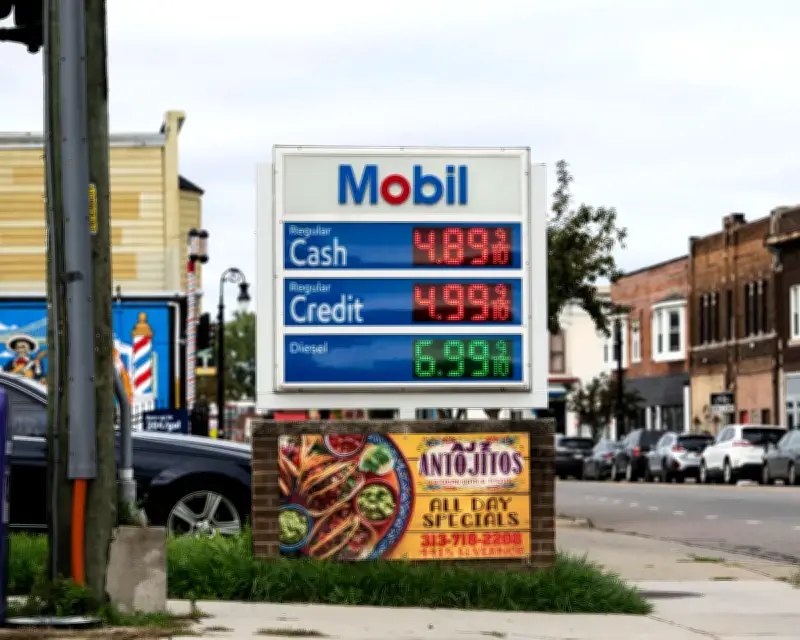
Record-high diesel prices are taking a heavy toll on crop growers, trucking companies and other industries across the US midwest as the war with Iran and regional supply disruptions drive up fuel costs.
Joe Hamilton, who farms corn and soybeans on 2,500 acres in Indiana’s Delaware county, faces a record bill for about 9,000 gallons of diesel when his soybean harvest begins next week, with four tractors, two combine harvesters and five semi-trucks set to be used.
“During harvest, we use about 300 gallons of diesel fuel per day, and we have around 30 harvest days in a typical fall,” he says.
Harvest season begins amid record fuel costs
As diesel-guzzling combine machines enter fields across the eastern corn belt for the start of the soybean harvest, growers and other fuel-reliant industries are dealing with record prices. An estimated 20bn bushels of soybeans and corn (522m metric tons) are set to be harvested in the midwest between now and the end of November.
Estimates suggest that the war with Iran, damaged refineries in Russia and regional diesel supply disruptions could add an additional $12,500 in fuel costs for every 1,000 acres of crops harvested.
“Farmers are price takers. It’s not just fuel – it’s chemicals, it’s seed, it’s the cost of equipment,” laments Hamilton. “Everything has increased along with the commodity prices.”
Regional issues fuel price surge
Four of the five states with the highest weekly diesel price increases in the country in September were in the midwest (Illinois, Michigan, Ohio and Indiana), with the fuel jumping by more than $3 per gallon compared with a year ago.
On top of the war on Iran, regional issues are playing a role. A power outage and flooding last month at an ExxonMobil refinery in Joliet, Illinois, shut it down for more than a week, taking more than 80m gallons of diesel and gas offline. An ongoing six-month dispute between union members and BP at one of the largest refineries in the country in Whiting, Indiana, has also fueled a surge in prices regionally.
“The midwest is different form the coasts or even the Gulf, primarily in the [lower] number of oil refineries and how it can respond in times of crisis. If you have water access you can bring tankers in with additional oil,” says Kurt Lykins, a lecturer at Otterbein University. “So, it’s hard for the midwest to respond.”
Strategic reserve concerns
Lykins adds that he’s concerned about the Strategic Oil Reserve – the 714m-barrel-capacity reserve held in salt caverns in Texas and Louisiana that today is lower than at any time in the past 43 years. “We’ve drawn down 172m barrels. Although the prices for gasoline and diesel have been rising, drawing down from the reserve has given some stability to prices,” he says.
But that could soon change, he notes. “The issue is when we are no longer able to do that, the stability will no longer be there. We’re getting ready to go into a high diesel demand season in winter.”
Schools and districts feel the pinch
Amid the rising prices, large consumers of diesel fuel across the region are moving to reduce expenses where they can. In Ohio, 15,000 school buses that overwhelmingly run on diesel are charged with getting about 800,000 grade school students to and from their homes every school day.
The Columbus school district, already facing a potential $157m financial deficit by 2031, has recently had to cut nearly 300 jobs, close four schools and limit bussing for students. The diesel issue, say administrators at the largest public school system in the state, is front of mind.
“I believe we are contracted through 2027, so no major changes [are being put in place] at this time,” says Michael S Brown of the Columbus school district. “That said, we are constantly looking at bussing as a budget issue, at more than $70m total cost per year. I expect there will be transportation changes to the system in the next budget.”
Almost 40% of school districts that participated in a national survey published in May say they are consolidating bus routes to help reduce diesel fuel expenses. But that means longer commutes and working hours for students and drivers alike, and 20% of those surveyed said they had cut “non-required trips” such as field trips.
“Any school district that’s using last year’s budget needs to refine that upwards,” warns Lykins. “The sad thing is that this increase is not the same across school districts – rural districts are going to be even more impacted because they transport more students over further distances.”
Farmers adapt but face uncertainty
Back on the farm, crop growers such as Hamilton are looking to cut down on fuel costs by using no-till and cover crop farming methods, which reduce the number of times he has to put diesel-guzzling machinery in the field. Now, he uses between two and four gallons per acre in a typical year. “It’s much less than we used when we were a full tillage operation,” he says.
But in order to get his crops to market this fall, there’s no getting around paying elevated prices for machinery fuel. Hamilton says that limited fuel storage capacity at his farm means he will be forced to buy more diesel in the coming weeks to cover the back end of the 2026 harvest, and with nearly half of his harvesting fleet consisting of semi-trucks that use the more expensive on-road diesel (by contrast, red dyed or agricultural diesel typically has no federal fuel tax), uncertainty remains.
“Fuel is $3 more expensive than it was 12 months ago. Soybeans right now are $12.88 per bushel, last year they were $10.14 but corn is $5.23 now versus $4.22 a year ago,” he says.
Observers say that the high prices aren’t going away anytime soon. “Let’s say everything goes back to normal – we still need to build up the [Strategic Oil] Reserve and that’s going to slow the drop in prices for consumers,” says Lykins. “That’s the best-case [scenario].”
What’s more, a report issued by the Government Accountability Office in May found that several of the Reserve caverns in Louisiana may see their capacity reduced due to stability concerns in a neighboring cavern that was recently decommissioned.