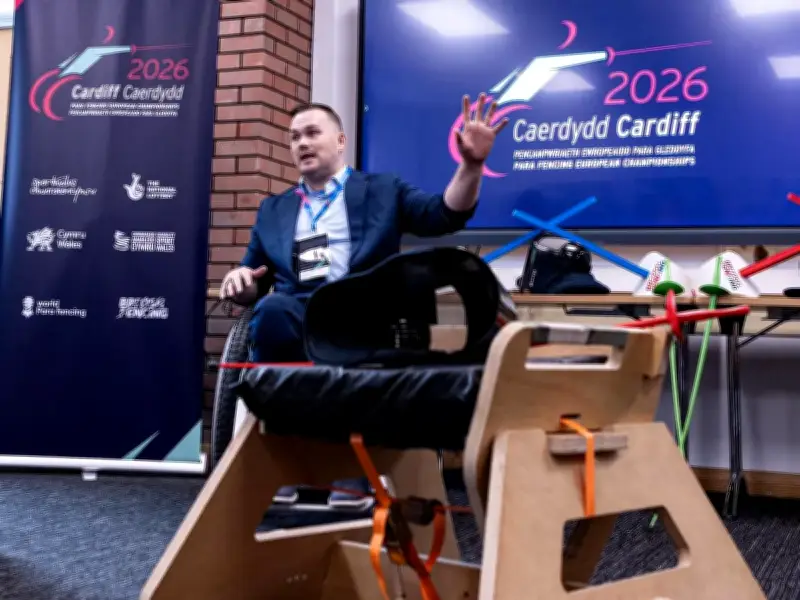
The SwordSeat, a new invention funded by the British Fencing Charity on behalf of British Fencing and directed by Rick Rodgers, is designed to make para fencing accessible to all by addressing the prohibitive cost and equipment requirements of wheelchair fencing.
The product was developed through a collaboration between British Fencing, University of Bath researchers, and disability fencing advocates, following the identification of significant equipment cost barriers.
A Gamechanger for Grassroots Participation
Rick Rodgers, Inclusion Manager (Disability) at British Fencing, believes the design is a gamechanger and hopes it can expand participation from a grassroots perspective.
“SwordSeat is our solution to the prohibitive costs of wheelchair fencing, which is highlighted as a barrier to participation at clubs,” he said. “Finding a solution for grassroots participation, which removes the wheels – a big cost barrier – and put the frame and chair together into one unit was the aim of this system.”
Rodgers emphasised that the project was not commercially motivated, stating: “This was never a commercial interest – we were never interested in that and wanted to give the community an opportunity to build participation, as well as providing an at cost option to clubs around the country.”
Reducing Costs by 95 Percent
Between 30 and 50 clubs in the UK are now using the chairs, with France, the USA, and Germany also signed up to the International SwordSeat Family. The system is aimed at beginner-level participation rather than international high-level sport, as it would not work with the movement patterns used at elite levels.
“It’s reduced cost by about 95% from frames and wheelchairs, down to something that’s really easy to provide,” Rodgers said. “There’s a wider offering in participation than there is in performance. It’s about everyone having the opportunity to see where they can go – I would love to see every club have a SwordSeat and that to form the start of a pathway for athletes.”
Versatile Design for Other Sports
The SwordSeat was designed and developed by Dr. Ed Elias, assisted by Integrated Design Engineering student Conor Roberts at the University of Bath. It is a portable, lower-cost, and open-source focused design intended to broaden access to seated and wheelchair fencing, reducing the cost from many thousand pounds to a few hundred and replacing bulky metal frames with a low-cost, DIY, adaptable, and transportable alternative.
Rodgers believes the design could be transferred to other sports and settings. “We’re very open to other national governing bodies and federations getting involved,” he added. “I think it could be used for other sports as well, but fencing is a start. Yoga is an obvious example – while we’re talking about taking it into care homes, so older people could use it. There’s a possibility it could be used an athletics throwing frame – for things like shot put, discus and javelin, which are static.”
British Fencing's Charitable Fund actively supports the development of fencing and aims to diversify participation by providing financial and other support to encourage and nurture the talent of the future.