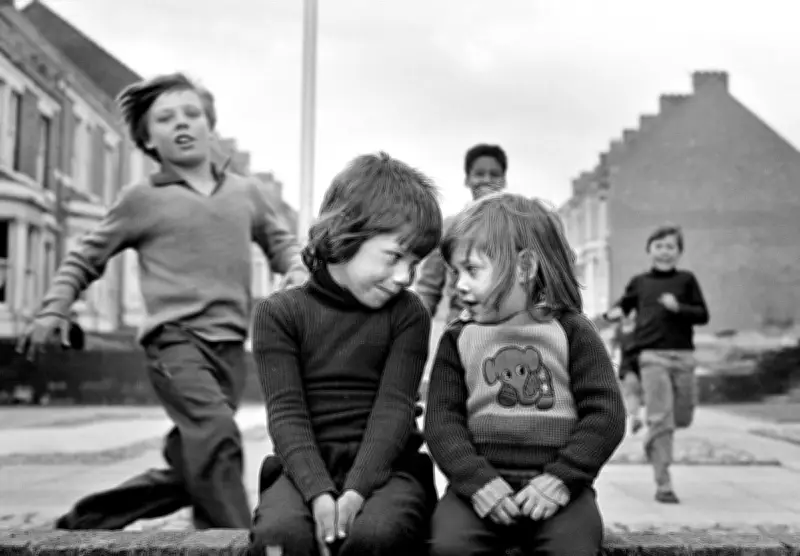
The Baltic Centre for Contemporary Art in Gateshead presents Close to Home, pairing photographer Tish Murtha's powerful 1970s-80s documentation of Newcastle with Kuba Ryniewicz's vibrant contemporary work. The exhibition runs until 4 April 2027.
Murtha's Striking Historical Record
Murtha's four major collections—Elswick Kids, Save Scotswood Works, Youth Unemployment, and Elswick Revisited—are exhibited together in the north-east for the first time. Her photographs capture working-class life during industrial decline, focusing on resilience and human connection amid economic hardship. The images are displayed salon-style in varied sizes, with one enlarged piece per series dominating a wall. For Save Scotswood Works, campaign materials and clips from Paul Sng's documentary Tish accompany the photos, highlighting Murtha's activism and critique of government policy.
Ryniewicz's Playful Contemporary Vision
Born in Poland, Ryniewicz moved to Newcastle in 2004 to study photography. His works from Daily Weeding, Cornered Study, and Good Eggs (all shot within the last six years) are vivid, colourful, and cheeky, depicting everyday life as magical. Subjects include weeds, buses, baby bumps, and suburban shadows. His Polaroids and prints are glued directly to the wall, scattered between Murtha's collections.
Lack of Coherence
The exhibition struggles to connect the two artists' contrasting approaches. Murtha's historical, documentary style focuses on protest and poverty, while Ryniewicz's staged, playful images celebrate ordinary joy. For instance, a protest procession against the closure of Scotswood Works sits opposite a guinea pig nestled on a man's chest. The wall text does little to bridge the gap, describing Murtha's work factually and Ryniewicz's conceptually. According to the review, Murtha's "stonking great chunks of history" dominate, forcing Ryniewicz's work to adapt rather than complement.
The reviewer concludes: "That Murtha and Ryniewicz are outstanding photographers is indisputable; that they cohere effectively in this exhibition is less convincing."