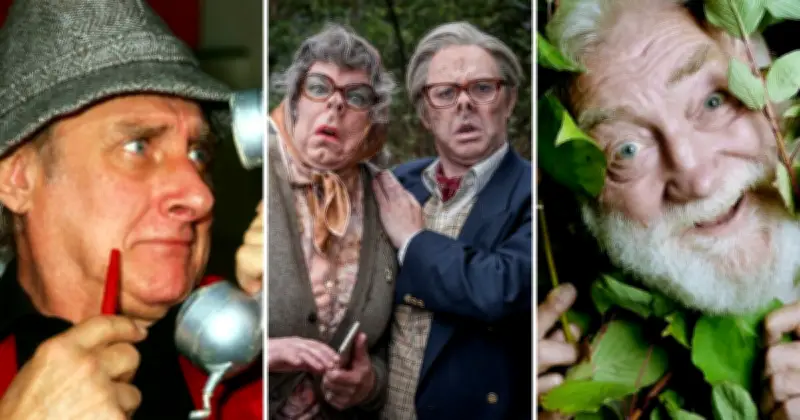
Several well-known TV personalities have seen their careers abruptly ended after allegations of improper behaviour or, in some cases, criminal convictions. Names such as Huw Edwards, Frank Bough, Angus Deayton, Jermaine Jenas, Justin Lee Collins, David Walliams, and Gregg Wallace have all fallen from grace. However, this list focuses on stars and shows that were dropped for holding opinions or making jokes deemed unacceptable by television executives, a phenomenon the article describes as being axed for "thought-crime."
David Bellamy's Climate Scepticism
Bafta-winning botanist David Bellamy was a popular TV figure in the 1970s and 80s with shows like Don't Ask Me, Botanic Man, and Bellamy's Britain. His career declined in 2004 when he publicly dismissed man-made global warming as "poppycock." In 2013, Bellamy said, "All of the work dried up after that. I was due to start another series with the BBC but that didn't go anywhere, and the other side [ITV] didn't want to know. I was shunned. They didn't want to hear the other side… if you get the idea that people's children will die because of CO2 they fall for it."
Bellamy also voiced strong opposition to wind turbines, calling wind farms "blots on the landscape" and "weapons of mass destruction" that harmed wildlife. He argued that wind power was intermittent and inefficient and that the concrete bases never paid back their carbon balance. Discovered by the BBC in 1967, Bellamy wrote and presented more than 400 TV series in Britain, the far east, and Australasia, as well as forty books. He also spent his 50th birthday in a Tasmanian prison for opposing a dam and stood as a Referendum party candidate in 1997.
Comedy Shows Deemed Unacceptable
It Ain't Half Hot Mum, created by Jimmy Perry and David Croft, was a huge success, peaking at 17 million viewers and producing a UK Number One hit single. Fifty-six episodes were shown on BBC1 from 1974 to 1981. Perry said, "It is without doubt the funniest series that David Croft and I wrote. Of course, it is also the show that we're not allowed to talk about any more." The show's alleged crimes were racism and homophobia, including a white actor playing an Indian character. Perry defended the language, saying, "People complain the language was homophobic, and it was, but it was exactly how people spoke."
Melvyn Hayes said the Indian characters "came out on top every time," adding, "None of the Indian people I've spoken to found it offensive. In fact, they thought of it as their sitcom because it was the only time they'd hear Urdu or Hindi spoken on British TV." Perry also said, "It was BBC executives who'd never been to India who thought it was racist."
Falling Out of Fashion and Opinion
The comedy duo Cannon and Ball, who routinely drew 18 million viewers in the 1980s, were dropped by ITV when new executives wanted to shift focus from blue-collar humour. Tommy Cannon said they were "dismissed without a word." He was also hurt that ITV excluded them from their 70th-anniversary celebrations, tweeting, "To be left out of the celebration? That hurts. Not for me—but for Bobby. For the fans. For the legacy. We made millions laugh. That should've counted."
Actor Laurence Fox, best known for playing Detective Sergeant James Hathaway in ITV's Lewis, saw his TV acting career end after expressing controversial opinions, including wearing a Donald Trump MAGA hat "as a social experiment" in 2019. He was signed by GB News in November 2022 but lasted just ten months before a remark about political journalist Ava Evans on Dan Wootton's show led to his contract being terminated. Fox argued his comments were part of a "critical challenge" to mainstream media norms, but he has not worked on mainstream TV since.
Kenny Everett, the maverick DJ and comedy star, was regularly dismissed by broadcasters for his misunderstood jokes. In 1970, he upset BBC Radio 1 bosses with a quip about the wife of Conservative Transport Minister John Peyton. He was sacked by BBC Radio a second time in 1984 for a joke about Prime Minister Margaret Thatcher. The Kenny Everett Television Show ran for five series from 1981 to 1988, but no complete episode has ever been repeated on the BBC since the last show was broadcast in January 1988.