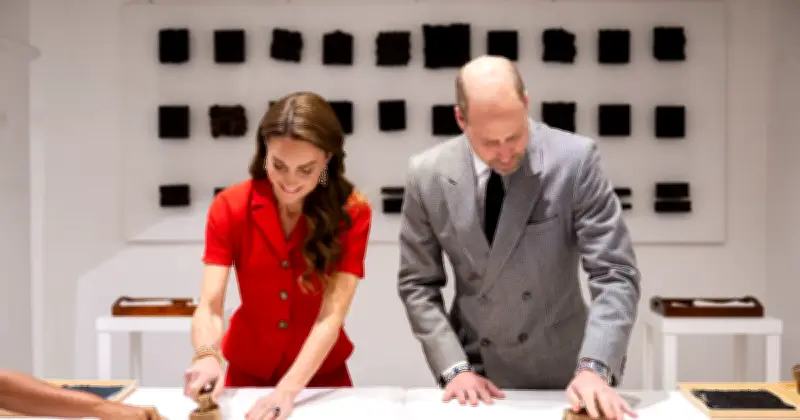
The Prince and Princess of Wales spent their final day in India at the Chanakya School of Craft in Mumbai, where they tried block painting and examined traditional Indian textiles.
The royal couple received a traditional welcome, with hand-embroidered shawls placed around their necks and beaded bracelets gifted to them, which they wore throughout the visit. Catherine, wearing a bright red two-piece skirt suit, noted that her pashmina matched her outfit and, while admiring the stitchwork, said: "It is lovely, thank you very much."
Exploring Craft Techniques
In the classrooms, women were practising hand embroidery and textile techniques. Catherine was drawn to a gallery wall showcasing different textures of Indian craftsmanship and asked host Karishma Swali, Managing and Creative Director of the School: "Are a lot of these crafts and techniques sadly dying out?"
Approaching groups working on colourful pieces featuring ceramic beads, Catherine asked one woman, "How long have you been working on this?" and appeared shocked when told it had been two months. She also asked another, "It is very therapeutic, isn't it?"
William, standing at a nearby table, remarked, "These are incredibly delicate," and asked the crafters, "Does it hurt your eyes after a while? The beads are very small."
School's Mission and History
Chanakya was founded in 2016 and trains women in hundreds of traditional Indian hand embroidery and textile techniques. Some graduates of the 18-month course create runway pieces for luxury fashion houses such as Dior, Fendi, and Valentino. The school has educated over 1,400 women artisans, with a goal to reach 14,000 women in the coming decade.
In the school's museum, artists worked on historical techniques, including a man doing Zardozi embroidery with metal bullion, a technique unchanged for 6,000 years. Catherine said, "You must need a lot of time and patience!" while William remarked, "It's a lot of hard work!"
Block Printing and Sustainable Fashion
The couple viewed projects supported through New Landscapes, a partnership between the British Council and University of the Arts London, connecting creative enterprises in the UK and India to develop sustainable textiles and design. Participants are developing solutions focused on indigenous wool, regenerative cotton, biodegradable materials, circular fashion and textile repair.
At the block-printing stand, they learned about alternatives to synthetic dyes and were invited to try the technique on a white napkin using natural colourants. Catherine asked Narmada Bhutonia from the Color Ashram Foundation how firmly to press the stamp, telling William, "Not too much pressure." They both pressed their stamps onto the napkin.
Speaking afterwards, Ms Bhutonia said the couple "were very concerned" about the environmental cost of synthetic dyes. "I told them that the true cost of colour in fashion is paid by the rivers. They were actually very concerned, and I told them how in one town 700 units were shut down to save one river."
Before leaving, Catherine spoke with Alison Barrett, Director of the British Council in India, about sustainable fashion. Ms Barrett told her that the skirt she was wearing was a zero-waste design made from 2.5 tonnes of recycled textiles. Catherine held up her handbag, a specially made DeMellier bag made from SurpRice, a material resembling leather but made from rice straw. Ms Barrett said they spoke about how "traditional doesn't have to be old-fashioned."
Both William and Catherine thanked their hosts and left for separate engagements.