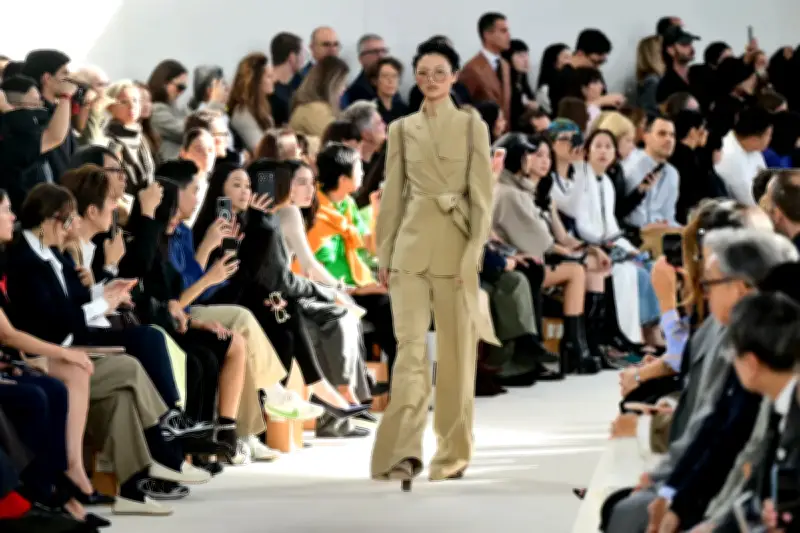
Max Mara's catwalk at Milan fashion week showcased well-cut coats, sturdy block-heeled boots, crisp white shirts, and capacious suede handbags. What it deliberately avoided was shock value.
Designer Ian Griffiths, who has been at the Italian house since 1987, said: "I hope everyone watching this show can recognise something of themselves in what they see. I think that's really important. Without being critical of other brands or designers, so much of fashion alienates people and makes them feel that they aren't good enough or thin enough or young enough to wear what's being represented."
Practical elegance for grown-ups
Trousers were pleated and roomy, skirts long enough to be elegant but not long enough to trip you up. In shades of sand and chalk, grey and black, every piece was designed to work with everything else and blend into an existing wardrobe. Styling gestures, such as popped collars and knotted belts, stopped short of gimmick.
The models could have walked off the runway and onto the Milan street, which Griffiths said backstage was the point: "The catwalk show is only the prelude to what to me is the real presentation, which is when I see women walking down the street in my clothes."
Inspired by audacious pioneers
Recently, even this most adult and sensible of brands has sometimes chased the youth vote. This season, Max Mara returned to its core focus on fashion for grown-ups. Griffiths said: "We were founded on the simple mantra of real clothes for real women, back in the 1960s, and when we stick to that idea, we never go wrong. So more than ever, I wanted to focus on real life chic."
On Griffiths's moodboard were portraits of aviators Amelia Earhart and Beryl Markham, explorer Freya Stark, wildlife photographer Osa Johnson, and cross-continental driver Eva Dickson, audacious women of the 1930s and 1940s whose "nonconformist glamour" he wanted to channel. Some models wore their hair swept up and away at the temples, a tousled take on the victory roll, but nothing looked twee or retro.
Griffiths said: "I'm not suggesting for a minute that women fill the pockets of their organza cargo vests with notepads and compasses and explorer's instruments. It's the idea of getting up in the morning and going places with a certain amount of panache."
Chore jackets, loose-fit trousers, cross-body bags, and shirting are a modern uniform in cities worldwide. This collection was a glossy, Milanese take on how many women already dress. Overshirts with four patch pockets took the chore jacket principle and added a dash of safari-jacket exoticism. Stretchy halter tops were cinched with D-rings, while double-breasted silhouettes made for dashing blazers.