The new French thriller Jupiter, which premiered at the Venice Film Festival on Friday, imagines a nuclear standoff with Russia and has already drawn criticism from the far right in France, while its director insists the scenario is far from unrealistic.
The film, directed by Alexandre Smia, opens with Russia detonating a nuclear warhead over the Black Sea in revenge for an assassination attempt on its president. Germany and Italy urge restraint, while the American president opts out of the standoff and suggests taking out Ukraine's leader to appease Moscow.
A fictional French president takes centre stage
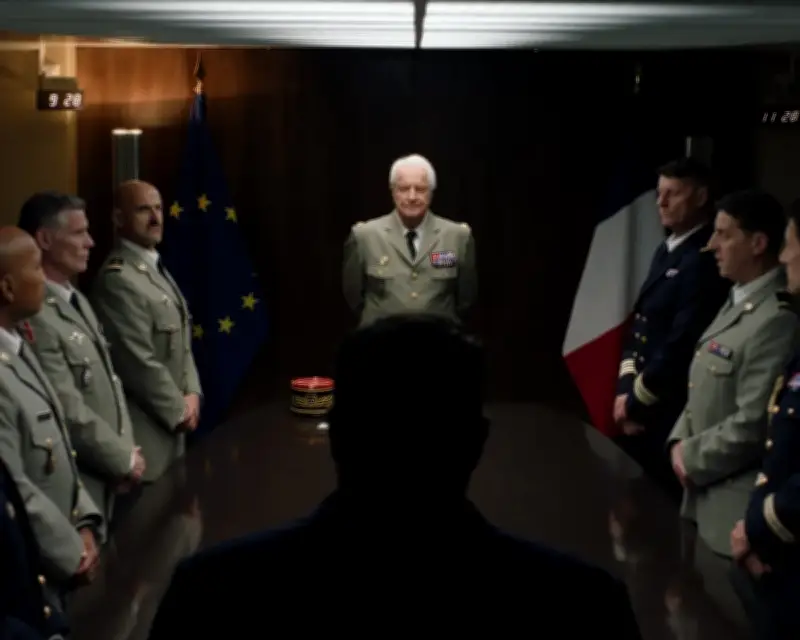
The duty to confront the Kremlin falls on fictional French president Paul Archambault, played by Denis Ménochet, who is backed by the British prime minister. Much of the action takes place in a situation room in a bunker beneath the Palais d'Élysée.

Speaking on the eve of the premiere, Smia said the scenario was far from unrealistic. "Even if the US disengagement from Nato is not official, we have reason to doubt that the US would offer its nuclear umbrella if one European city were to be attacked nowadays," he said. "And considering that France is the only country in Europe that is both a member of the European community, of the security council of the United Nations and of Nato, it naturally becomes actually the country where the responsibility of making decisions lies."
He added: "Filling the void when faced by a threat is not even a choice any more, it becomes almost an obligation."
Political reactions and historical echoes
Released in France in November, Jupiter is expected to divide opinion before presidential elections next April. After the release of a trailer, some voices on the far right have dismissed the production as a "propaganda film" intended to shore up support for a centrist candidate against Marine Le Pen's National Rally.
The film's title is not a straightforward reference to President Emmanuel Macron, who called for a "Jupiterian" head of state. François Mitterrand was also nicknamed Jupiter by the national press, and the command room inside the bunker beneath the Palais d'Élysée was named after the Roman king of the gods under Valéry Giscard d'Estaing.
In the film, the French president enters the nuclear standoff still reeling from the loss of his daughter, a biographical note that evokes Charles de Gaulle and Jacques Chirac. Former socialist president François Hollande advised the makers during their research, and Smia said he picked Ménochet precisely because he did not physically resemble any previous president.
A test of French leadership
While Jupiter is unequivocal about the need for French leadership, the film does not necessarily show that France is up to the job. To be taken seriously by the film's Putin-equivalent character, the French president is forced to engage with Richard Nixon's madman theory, giving off an appearance of irrationality to make otherwise non-credible threats seem credible.
It is a move that risks incensing the French public and alienating the president's political allies in Europe and within his own cabinet. "Would any European leader be able to play the madman?" asked Smia. "The theory of the madman is indeed dangerous and I don't think that any European leader would do that."
Ménochet, who previously played a French president in Guy Maddin's comedy Rumours, is best known as the French farmer who crumbles under interrogation in the opening scene of Quentin Tarantino's Inglourious Basterds. In Jupiter, his character must display the utmost mental robustness, especially in the face of personal insults by the film's Russian president Chernov, who implies that Archambault's daughter lost her life because of western "decadence".
At screenings on the Lido, French journalists left the auditorium fiercely debating whether the film was an advert for a more aggressive French stance or a warning against it. The sustained ambiguity puts it in a line with recent French courtroom dramas such as Anatomy of a Fall by Justine Triet and The Goldman Case by Cédric Kahn, who also plays a supporting role in Jupiter.

"This trend is very important and I hope it will become a movement," said Smia. "In a time of simplification, films about moral ambiguities, about the difficulty of finding your own path and direction, are very, very important."