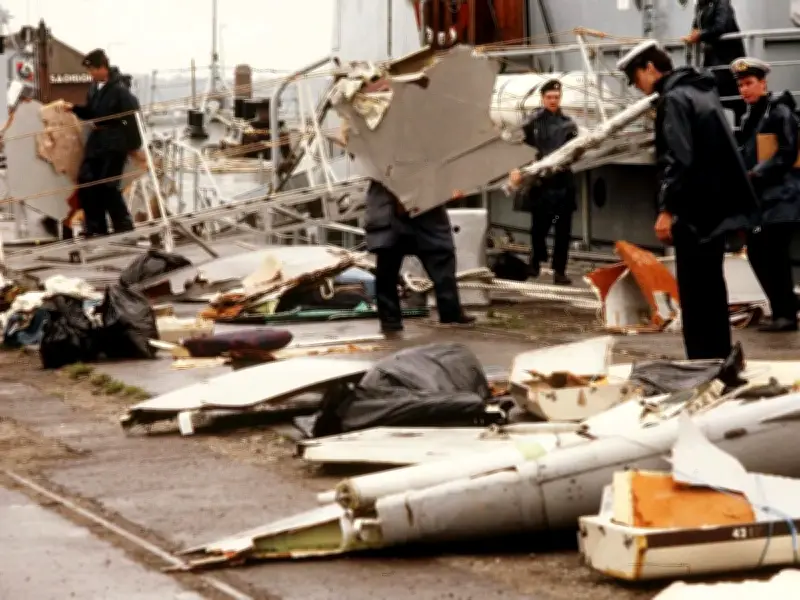
In 1985, a Boeing 747 jetliner crashed into a mountain range just northwest of Tokyo, in Ueno, Gunma, Japan. The crash remains the single deadliest air crash in aviation history. The cockpit voice recorder (CVR) was recovered from the wreckage, revealing the pilot's final words.
The Cockpit Voice Recording
Aviation journalist David Learmount, who has investigated and reported on air incidents for almost five decades, told The Mirror that reading the CVR transcript was so upsetting it left him in tears. He said: "I've lost count of the number of CVRs I've listened to and transcripts I've read from accidents - and the Japan Airlines 123 remains the only one that ever made me cry."
"The transcript was so harrowing I could not listen to the CVR. The pilots were talking to each other in a state of deep distress because they didn't know what was going on and what they could do," he added. "It wasn't just fear. They wanted to save their airplane, to save their own lives and the lives of everybody on board, and they didn't know what to do. You've never heard that kind of distress."

The Flight and the Failure
The doomed plane took off on August 12 from Tokyo's Haneda Airport, crowded with thousands trying to get home as it was the eve of Obon, a Japanese Buddhist custom. At 6:12 pm, Japan Airlines 123 took off heading to Osaka, 400 kilometres to the west. It carried 509 passengers and a crew of 15. The most senior pilot on board was Captain Masami Takahama, 49, a senior training captain supporting First Officer Yutaka Sasaki, 39, who was captaining the flight. Flight Engineer Hiroshi Fukuda was also on board.
Approximately 12 minutes after takeoff, the aircraft experienced a loud explosion. The crew radioed an emergency to air traffic control. Captain Takahama requested a turn back to Haneda, now 70 miles behind them. The bang was due to a hole at the rear of the plane that had blasted off a huge section of the tail, including the rudder, the auxiliary power unit, and several other critical control systems. The plane had a complete hydraulics failure.
Flight 123 began to swing from side to side. Without hydraulic power, the pilots could no longer control the pitch of the aircraft. Using engine power, they were able to slow the erratic movements. "By increasing engine power on the left side, the plane would turn to the right. Increasing power on the right side, the airplane would turn to the left. So that helped. However, they still thought they could attempt to control the plane manually, which they couldn't," said Learmount.
Final Words and Impact
"Raise nose, raise nose.... power" were the captain's last words as the ground proximity alarm buzzed before the CVR cut out on impact. The pilots fought for almost 30 minutes before the plane hit the Mount Takamagahara area, close to Mount Fuji. The right wing tip and its outermost engine hit the mountain ridge and were ripped off. The plane spun onto its back and careened into the mountainside, igniting into a fireball.
There were some survivors, including a 12-year-old girl whose parents and sister were killed. Her family were seated at the back of the plane, where impact forces were not as great.
Cause and Aftermath
The investigation concluded that a faulty repair on the aircraft seven years earlier had caused the fatal malfunction. During a landing in Osaka in 1978, the pilot had slammed the tail into the runway, severely damaging the rear pressure bulkhead. Boeing engineers performed a botched repair. Learmount said: "It was a patch-up job, not a repair. They took a shortcut trying to fix it and put the plane back in action."
By August 12, 1985, the plane had flown more than 12,000 times since the repair. The rapid decompression ruptured hydraulic systems, rendering the aircraft uncontrollable. Boeing redesigned the tail of the 747 and the plane's hydraulic systems. Japan Airlines changed its maintenance procedures, putting in place stricter supervision and more thorough inspections. Japan Airlines paid 780 million yen ($7.6 million) to the victims' families as "condolence money." The company decided against taking criminal action against Boeing. Japan Airlines president Yasumoto Takagi resigned, and the company's maintenance manager, Hiroo Tominaga, and the engineer who checked the plane before its final flight, Susumu Tajima, both died by suicide.