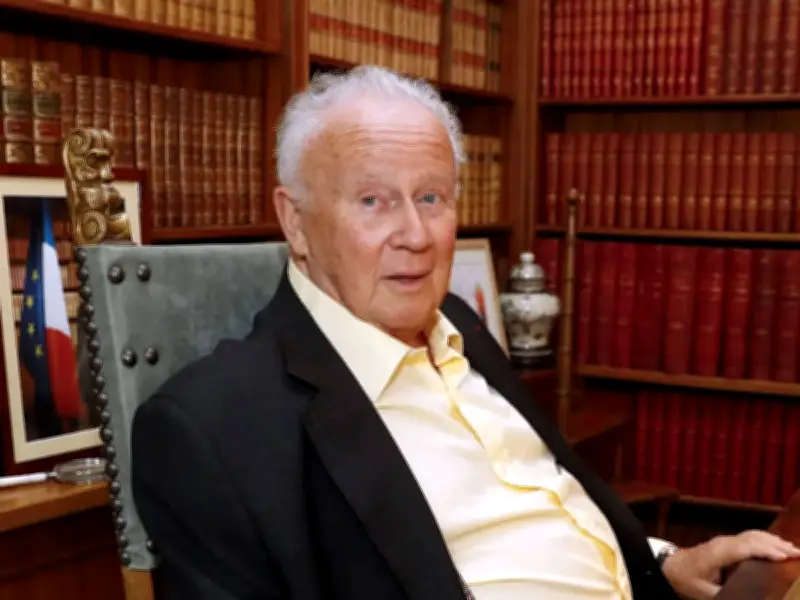
French TV and radio presenter Philippe Bouvard has died at the age of 96. The legendary broadcaster, who stepped down in January last year, died at his home in Cannes on Monday (24 August). He leaves behind his wife, Colette, their two daughters, and grandchildren.
Career highlights
Bouvard was renowned for presenting the French radio programme Les Grosses Têtes (The Big Heads) on RTL from 1977 to 2014. He later hosted the comedy series Le Petit Théâtre de Bouvard from 1982 to 1986. Prior to his retirement, he had been at the helm of another radio show, Allo, Ici Bouvard (Hello, Bouvard here), on RTL from 2014 to early 2025, reports the Express.
Tributes from President Macron and Cannes mayor
In the wake of news regarding his death, tributes have flooded in for the broadcaster across social media. Describing Bouvard as a “free spirit,” President Emmanuel Macron wrote: “Philippe Bouvard will have accompanied generations of French people with his voice, his wit, his freedom of tone, and his humor - this quintessentially French taste for the witty remark. France loses a free spirit, a Grosse Tête. Thoughts to his family, his loved ones, and all those who listened to him and loved him.”

Reflecting this feeling, David Lisnard, Mayor of Cannes and a close companion of Bouvard’s, issued an official statement. “Today, Cannes loses one of its most illustrious residents, and France loses one of its greatest voices-demanding, mischievous, and talented-the voice of an extraordinary personality who spanned the last few decades to naturally establish himself as a leading figure in French broadcasting,” he began.
“Philippe Bouvard, the creator of 'Les Grosses Têtes' in 1977, is no longer with us. I have also lost someone who had become a friend. Philippe Bouvard entered the profession as a messenger at Le Figaro. He emerged as a master of the French spirit. This culture was not given to him; he went out and acquired it. Hard work and books, nothing else. This is what gave his language a precision that diplomas cannot teach. From it, he drew a rare audacity, because it was without malice. He proved that one could say anything, from the most trivial to the most serious, without ever succumbing to either ponderousness or self-censorship. For him, laughter was a form of freedom.”
Lisnard concluded: “He had loved Cannes since he was eight years old, when his parents gave him his first trip here. He promised himself he would live here. He kept his word fifty years later. 'When you live in Cannes, there's no need to die to know paradise,' he used to say of our city. I had the honor of presenting him with the City's Gold Medal in 2018 and organising his last public appearance. To Colette, to Dominique and Nathalie, to his family and loved ones, I offer my heartfelt condolences and my deepest affection.”