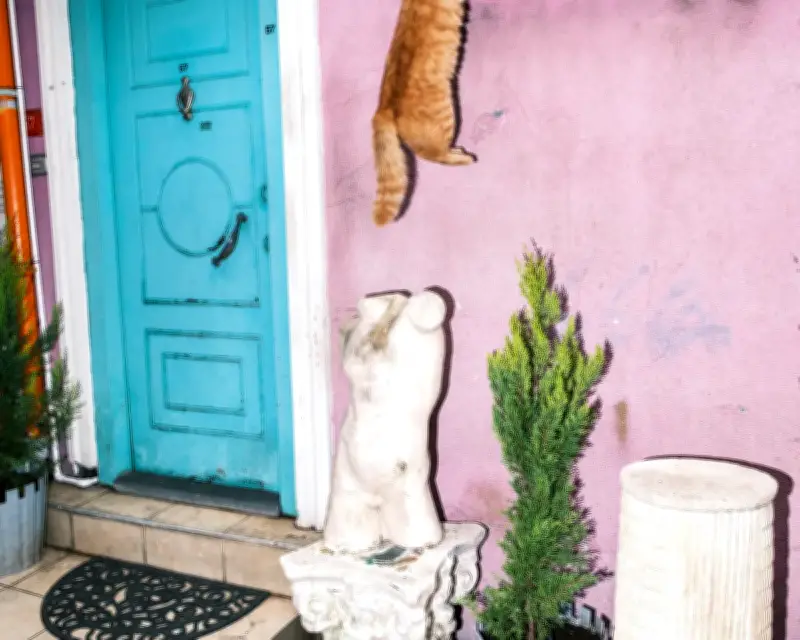
The winners of the LensCulture Street Photography Awards 2026 have been announced, with prize-winning photographs capturing scenes from pre-dawn Vietnam to cats scaling walls. The images show how the everyday can become mysterious, poetic and surreal.
Series category winners
Vica Bogaerts took first place in the Series category with Until Dawn Comes. Bogaerts said: “When Hanoi goes to sleep, Long Biên market awakens, alive in the hours between night and first light. The market is loud, busy, chaotic. But along its quieter edges I found something else. Ordinary moments of stillness; people at work, sometimes silent, often in sync. When dawn rose over the bridge, the day’s work was done. I went home, still thinking about the market and its people. They would return the next night. Maybe I would too.”
Bouwe Brouwer took second place with The Great Escape, describing it as “my personal handbook for escaping reality? Charles Bukowski’s poem The Great Escape”. Adam Vincent took third place with Venice Unseen, saying: “I am always trying to capture intensity and emotion through my candid street photography. Venice has been a place I’ve wanted to visit for a decade. All I had seen before were postcard photos that sell it as a holiday destination, so it was more satisfying than anywhere I’ve ever visited to dig into its reality and fill in the gaps.”

Single category winners
Colin Helie-Harvey took first place in the Single category with Sublime Porte. Helie-Harvey said: “When we went to Istanbul to introduce our son to my wife’s family, I had the opportunity to walk around the city once again, but this time with a camera. It was an amazing experience discovering new neighbourhoods and talking with people on the street. I’ve always done this when I’m in Istanbul, but it was the first time I did it with a camera. It was a really nice experience.”
Marina Koryakin took second place with Sea Story, saying: “The sea for me is an endless journey to another world. A world where reality is surreal. A world where I can escape.” Wenpeng Lu took third place with Street Scenes, saying: “Guiding my gaze is a search for fleeting moments through which I manage to reconcile the virtual and the real. My street photography aspires neither to journalism nor documentary. The result of my quest leads to resolutely graphic images, sometimes bordering on the abstract. The people I photograph are the main characters of their everyday lives, strong enough to leave their mark on the urban geometry of their environment. The street is a movie set where ordinary people become stars. I am just a spectator walking around with my camera.”
Juror picks
Juror picks included Levi Goldbaum’s No Body Was Cast for This, with Goldbaum saying: “Even though the photographs were taken in very different places, they seem to belong to the same strange world. Public space started to feel less like everyday reality and more like a stage: a place of entrances, pauses, gestures and silent tension.”
Rattanun Rungpittaryaton’s I love water, I love fish, I love cherry blossoms was also selected, inspired by Barry Schwartz’s The Paradox of Choice. Rungpittaryaton said: “This series explores the paradox of having too many possibilities – where more choices do not always lead to greater happiness. As children, our world was smaller. We knew less, imagined more, and did not worry about all the possibilities we might be missing. Perhaps, sometimes, we do not need more choices. Perhaps we simply need a smaller world to pause, forget our worries, and find peace in what is already in front of us.”
Jirayut Thongwatcharapaiboon’s After the Celebration focuses on spaces suspended between presence and disappearance. Thongwatcharapaiboon said: “Ordinary environments where traces of human activity remain, though the events that preceded them are now long gone; empty parking lots, isolated urban edges, artificial landscapes, littered with abandoned decorations. Rather than documenting celebration itself, this series lingers on its aftermath.”

Krishna Goswami’s Caged Chaos, Layered Lives was drawn from the alleys of Kolkata. Goswami said: “These short stories, made with love, are from the alleys of Kolkata. It is an amazing experience to discover magic in the everyday, awe in the ordinary and divinity in the earthly. Kolkata is known as the ‘city of joy’. Its colours reflect the appreciation of happiness and simplicity of its people. Here, I have tried to create a narrative that infuses reality with fiction, dreams, memories, fantasies and anxieties.”
Asako Naruto’s Untold Signs was created on the suburban platforms of Madrid’s Atocha station, where a narrow shaft of sunlight appears only briefly each day. Naruto said: “I followed not the people, but the light itself. When it touched someone in transit, a fragment emerged – a stride, a posture, a gesture – suspended between appearance and disappearance.”
Yusuf Eminoğlu’s The Aquatic Ceremony documents children in Anatolia bathing their horses and buffaloes in natural thermal waters during harsh winters. Eminoğlu said: “During the harsh winters of Anatolia, local children turn cold January days into a ritual, seeking warmth and joy in natural thermal waters. As they bathe their horses and buffaloes, the striking contrast between the freezing air and soothing warmth creates moments of playful delight. For these children, this place is more than a washing spot; it becomes a stage filled with fun and excitement. The series offers a glimpse into a lifestyle that thrives outside the bounds of the modern world, rooted deeply in the heart of nature.”