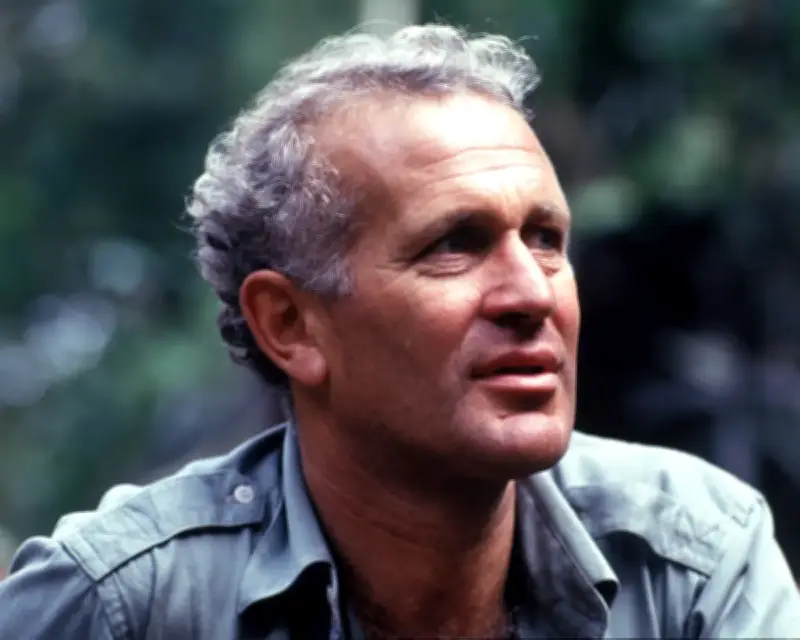
John Irvin, the British film-maker who directed the acclaimed BBC mini-series Tinker Tailor Soldier Spy, has died aged 86. His career spanned war zone reportage, cold war espionage, Hollywood horror and a Sherwood Forest swashbuckler, working with writers such as Harold Pinter and stars including Arnold Schwarzenegger.
Irvin said of his varied output: “I’m a bit split. I like playing with expensive toys, yet I also like the miniatures. I hate being pigeonholed, and I like to do the unexpected.”
Tinker Tailor Soldier Spy and Alec Guinness
His greatest success was Tinker Tailor Soldier Spy (1979), adapted from John le Carré’s novel about intelligence officer George Smiley’s efforts to uncover a Russian mole. Alec Guinness played Smiley with clenched elegance and economy, often striking out lines from the script when he felt he could convey the information by expression alone.

Irvin told Guinness’s biographer Piers Paul Read: “I was terrified, knowing I had to spend a year with him.” After an initial suggestion was rejected, Irvin persuaded Guinness to try the scene his way and was vindicated, with the actor saying: “Very good, John. Ten out of ten.” During filming, Guinness phoned Irvin at 3am, fretting that he “hadn’t found Smiley” and recommending the part be recast. On set hours later, Guinness walked off mid-filming, but Irvin brought him back and insisted: “We’re going to do it in one take. Do you understand?” When asked what he liked about Irvin’s directing style, Guinness said: “Balls behind the camera.”
The series, described by producer Jonathan Powell as “a sort of elegy for empire”, was seen at its peak by more than 8 million viewers (over 15% of the UK population) and won several prizes, including best drama series in the Broadcasting Press Guild awards. Irvin was unavailable for the follow-up, Smiley’s People, having been courted by Hollywood since before Tinker Tailor Soldier Spy.
From The Dogs of War to Hamburger Hill
Irvin moved from moles to dogs with The Dogs of War (1980), adapted from Frederick Forsyth’s novel, starring Christopher Walken as a mercenary helping to overthrow a west African dictator. The film was hated by Forsyth. Ghost Story (1981) featured Fred Astaire, Melvyn Douglas, John Houseman and Douglas Fairbanks Jr as friends harbouring a nasty secret. Irvin recalled telling Astaire at the end of filming: “It’s all over. You can go home to Beverly Hills.” Astaire replied: “Oh John, I’m so happy. I thought I was going to go home in a box.”
Champions (1984) told the story of cancer-stricken jockey Bob Champion (John Hurt), and Turtle Diary (1985), adapted by Pinter from Russell Hoban’s novel, starred Glenda Jackson and Ben Kingsley as shy naturalists who plot to liberate giant sea turtles. Irvin compared working with that cast to “driving a Ford Mustang and trading up to a Ferrari”. Directing Schwarzenegger in Raw Deal (1986), he admitted the film was “not dealing with the great mysteries of life”.
Irvin had long hoped to make a Vietnam film, having spent time there making a BBC Omnibus documentary about war photographers. Hamburger Hill (1987) focused on the real-life 10-day battle to capture Dong Ap Bia in the A Shau Valley in 1969. He aimed to “[get] as close as possible to the experience of combat without thrills or moralising. I wanted the audience to be there.” The film was overshadowed by Oliver Stone’s Platoon and Stanley Kubrick’s Full Metal Jacket, though critic Pauline Kael considered it superior to both, writing that Irvin “has the pride of a director who knows what he’s doing”.
Early life and later career
John and his twin brother, David, were born in Wallasey, then part of Cheshire, to Elsie (nee Bending) and Charles Irvin, a mechanical engineer. The family moved to South Shields, and the brothers were educated at Durham school. Irvin enrolled at the London School of Film Technique (now the London Film School), then housed above a butcher’s shop in Brixton. His mother cried for two days when she learned he would not pursue architecture.

After working as an apprentice editor at Rank, he received a British Film Institute grant to make Gala Day (1963), a documentary about the Durham miners’ gala, bought by the BBC. He made other documentaries for the corporation and his own company, Mithras Films, formed in 1962 with Maurice Hatton. These included The 26 (1966), about ex-miners in the General Strike of 1926, and the Bafta-nominated Mafia No! (1967), documenting a protest march across western Sicily against organised crime. While making a film about the civil war in Yemen, he lived with Bedouin tribespeople for four months. He was also a film adviser to the Jamaican government in 1963-64. By the end of the 1960s, he decided to leave documentaries, saying: “I reached the point in Vietnam where I had simply seen too much suffering.”
His later films included Next of Kin (1989), with Patrick Swayze and Liam Neeson, and Robin Hood (1991), with Patrick Bergin and Uma Thurman, overshadowed by Robin Hood: Prince of Thieves. Irvin said Robin and his men “must have terrorised Nottingham like a motorbike gang”. When Bergin fell ill, forcing reliance on stand-ins, Irvin said: “We had to hide the problem from the studio, because otherwise they would have stopped the production.” He continued with Widows’ Peak (1994), A Month By the Lake (1995), City of Industry (1997), Shiner (2000), the TV movie When Trumpets Fade (1998), and Mandela’s Gun (2016). At his death, he was working on Water from an Ancient Well, a documentary about his friend, the South African musician Abdullah Ibrahim, who died in June.
Irvin is survived by Emilie, Luke and Amy, children from his marriage to Sophie (nee Litchfield), who died in 1991, and by two grandchildren, Finn and Isla. John Charles Greenway Irvin, film director, born 7 May 1940, died 11 August 2026.