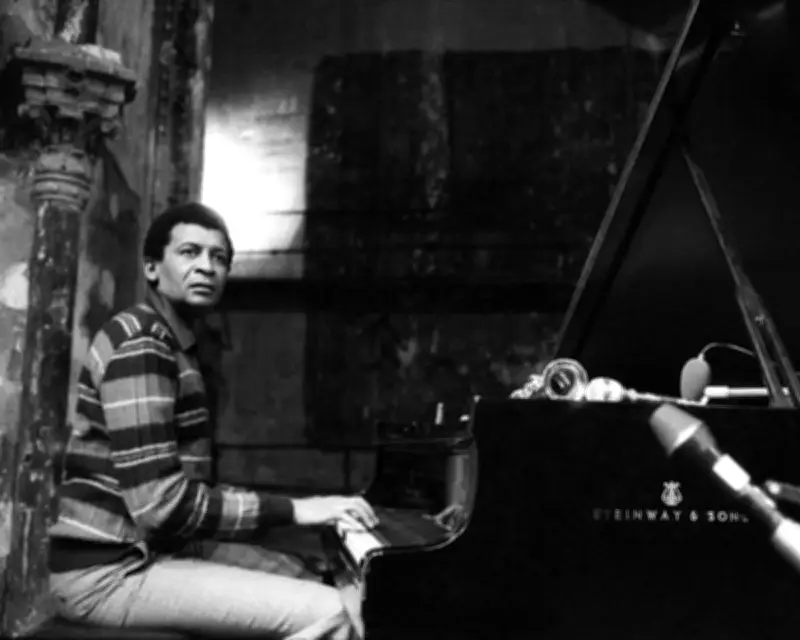
Abdullah Ibrahim, the renowned South African jazz pianist, composer, and improviser, has died at the age of 91. He was among the first musicians from South Africa to achieve and sustain a major reputation with the international jazz audience. Listeners around the world, from small clubs to grand concert halls, fell under the spell of his compositions and improvisations, which took a sophisticated idiom originally created by the descendants of enslaved Africans and reinfused it with a primal warmth.
Ibrahim was still known as Dollar Brand, a combination of his nickname and his family surname, when he and his wife-to-be, the singer Bea Benjamin, arrived in Europe in 1962 as refugees from the apartheid state. In Zurich, he was heard by Duke Ellington, his idol, who became an early patron. During subsequent spells in New York, he played with many important American musicians, quickly convincing them that an African voice could add something different, at once ancient and brand new, to their music.
Role in the Freedom Struggle
Back home, his music played a part in the freedom struggle. His tune Mannenberg, recorded during a return visit in 1974, became an anthem of the movement. Its title refers to a Cape Flats township created under the Group Areas Act to house black South African people evicted when Cape Town's District Six was designated a whites-only area. After the Soweto uprising of 1976, he left South Africa again, declaring his support for the African National Congress. Nelson Mandela was said to have described him as "our Mozart."
Early Life and Career
He was born Adolph Johannes Brand and grew up in Kensington, a suburb of Cape Town largely inhabited by the group known as "Cape coloureds," or people of mixed race. His father, a black housepainter named Sentso, was killed in an unexplained shooting when he was four. He was raised by his "coloured" grandmother, Margaret, alongside his mother, Rachel, whom he believed was his sister. Both women played the piano, and he began lessons at the age of seven, absorbing music from the church, local dances, and the neighbouring black township. He also mastered the cello and the saxophone.
At 17, he left home and began playing the piano professionally, first with a swing band, the Tuxedo Slickers. Turned down by Cape Town University, probably on racial grounds, he moved to Johannesburg, where he met the trumpeter Hugh Masekela, the alto saxophonist Kippie Moeketsi, and the trombonist Jonas Gwangwa. In 1959, the four of them recruited the bassist Johnny Gertze and the drummer Makaya Ntshoko to become a sextet called the Jazz Epistles. Their album, Verse 1, released the following year, became the first South African modern jazz record.
International Success
In 1965, after the move to Europe, he and Benjamin were married; they would have a son, Tsakwe, and a daughter, Tsidi (now the rap artist known as Jean Grae). Under Ellington's patronage, they both recorded albums for Frank Sinatra's Reprise label, but only Ibrahim's was released at the time, titled Duke Ellington Presents the Dollar Brand Trio. Ellington invited both of them to perform with his band and convinced the promoter George Wein to include them in the programme of the 1965 Newport jazz festival.
Following a conversion to Islam in 1968, Dollar Brand became Abdullah Ibrahim, while his wife was now known as Sathima Bea Benjamin. A pilgrimage to Mecca in 1970 was later reflected in one of his major compositions, Hajj (The Journey). Moving between New York, Europe and Cape Town, he recorded frequently for various labels. His early repertoire, which included tunes by Ellington and Thelonious Monk, began to incorporate more original compositions that increasingly emphasised African elements.
Later Years and Legacy
In the 1980s, Ibrahim put together a band called Ekaya, which would take various forms over the next four decades. Based largely in Germany, he recorded with the Munich Symphony Orchestra (African Symphony, 2001) and the orchestras of the German radio stations NDR in Hamburg and WDR in Cologne. He composed soundtracks for films by French director Claire Denis (Chocolat, 1988, and S'en Fout la Mort, 1990) and one by Burkina Faso director Idrissa Ouédraogo (Tilaï, 1990).
As he reached his 80s, audiences primed for the surging energy of his earlier years could be disconcerted when confronted by the far gentler and more reflective music of Ekaya, which had become a chamber-jazz trio completed by the flautist Cleave Guyton and the cellist Noah Jackson. They were usually won over. His final appearance in London, at a sold-out Barbican in 2023, was recorded and released a year later by the Gearbox label.
His marriage to Benjamin ended in divorce; she died in 2013. He is survived by his partner, Marina Umari, and his son and daughter.