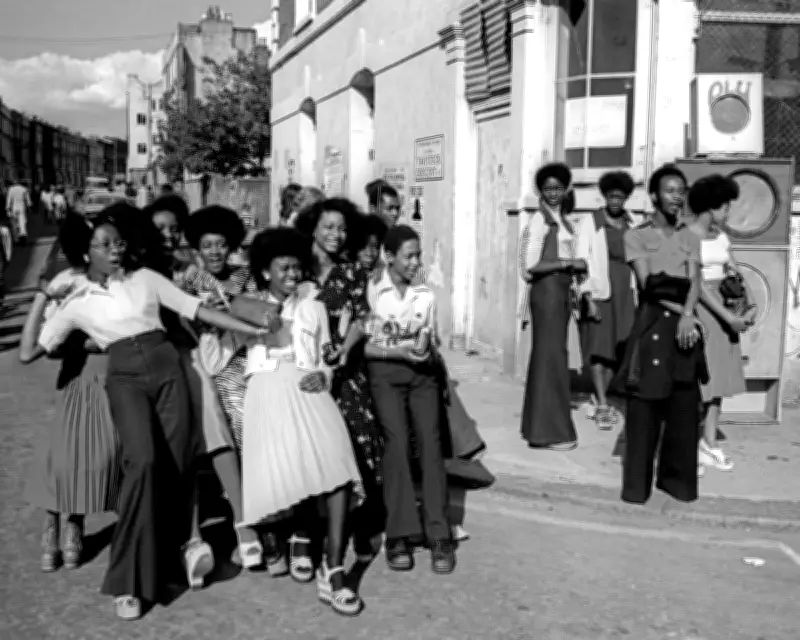
Lloyd Bradley's earliest memories of Notting Hill carnival are of being mildly irritated. In its 1960s infancy, the event was strictly a Caribbean affair, transplanted to Ladbroke Grove as authentically as was practical. Its purpose was as obvious as its origins: giving Caribbean arrivals a chance to celebrate themselves by bringing the vibrancy of the home they left behind to these drab streets for a couple of days.
Vital as this was, it didn't cut much ice with surly 10- or 11-year-olds like him, being dragged around behind parading steelbands. It was great to see so many Black people out in the open together and parents laughing and having a good time, but did they need to be there? There was football to be played and bikes to be ridden, yet so many were being forced to walk for what seemed like miles following “old people music”.
Sound systems change everything
Then as the 1970s got under way, everything changed. The London sound systems that had been establishing themselves over the previous few years – Coxsone Outernational, Jah Shaka, 6X6, Sufferah HiFi, TWJ and so on – assumed a growing presence at carnival, under the flyover or on the street. They were operated by men and women not much older than the youngsters, who understood how the post-Windrush generation defined their Blackness as they came of age in London and how, although roots and heritage were always important, they didn't need to simply recreate the Caribbean.

The sound systems played the same choice of music heard at dances and parties or in their own record collections, so they could find the reggae, the lovers rock, the soul and funk that soundtracked their lives right there set up outside accommodating pubs, caffs or people's front doors. The big plus point was the sound systems were static, meaning if you weren't dropping some foot you could stand around with your hands in your pockets, always a teenager's default setting. Indeed the only walking you were obliged to do would be if the music wasn't up to it or there weren't enough people – ie women – at that particular sound, so you'd find another one.
Refreshment and freedom
Refreshment was never a problem. Some Kentucky or a kebab when gathering at Turnpike Lane station, then load up with “supplies” before leaving, thus avoiding the so-called “carnival tax” temporarily inflating prices in Notting Hill off-licences. Their drinks of choice usually involved pre-mixing dark rum or Bacardi with Coca-Cola, or vodka with orange juice; beer was too heavy to lug around until they started selling it in those four packs held together with plastic rings. You'd drink a can, undo your belt, thread it through the empty ring and you were away. Some guys, more hardcore, would hang a pack off each hip then swagger round like a western gunslinger.
Suddenly, the Notting Hill carnival made sense. Youngsters came down in droves because this was their carnival now, and while they appreciated what it stood for historically, they wanted to enjoy themselves, too. You wouldn't dream of missing it. Carnival was the place to run into familiar faces who you probably didn't know by name and might not have seen since last year's event but you were glad to have a quick chat with.
Just as the crowds swelled so did the area the event occupied. Sound systems would mostly set up outside the parade route, and by renting front gardens for the weekend there were smaller rigs as far as the canal up by Harrow Road to the north and Colville Terrace to the south – gentrification hadn't been invented at that point – in between Ladbroke Grove and Chepstow Road. There were street dances of varying sizes everywhere, many doing a roaring trade selling drink or barbecue to the foolishly unprepared, and this takeover created one of the most attractive features of the weekend.

In the early 1970s, when police harassment was commonplace, racist microaggressions were a part of everyday life and the hospitality industry wasn't living up to its name, just being able to walk about such a large area of London seeing far more people that looked like you than didn't, enjoying a drink and a dance or just pissing about and not being bothered by anybody was simply brilliant. It was as if they owned those streets for four days. Everybody he knew went to work the following week with a bit of a spring in their step. And most likely exhausted: back in such unregulated times, revelry tended to kick off on Friday evening and go through to Monday night and Tuesday morning, with sound systems playing until the J'ouvert celebrations welcomed the sunrise.
Change after the 1976 riot
His peak carnival years were the early 1970s through to the early 1980s; the riot of 1976 changed things. How and why it kicked off is a different conversation, but the aftermath of overpolicing, increasing regulation and media that used violence and criminality as the starting point for reporting: all of this squeezed out a degree of the joyful anarchy and spontaneity that had made it so beautiful. Many people, especially out-of-towners, became scared to go and the tens of thousands that did were aware of a palpable tension, especially around 7pm when the police moved to shut down the sound systems.
Naturally this changed the way they approached it, and perhaps the most dispiriting aspect of the shift was that an essentially self-regulating event was becoming subject to decisions being made elsewhere, giving the carnival the flavour of something being done to them rather than by them. It didn't really matter how the content carried on evolving; the whole affair had become far too orderly. It doused the spark one bank holiday at a time, far from that untidy, magnificent era of mass-participation when anybody, just by showing up, knew they were genuinely contributing to the true essence of carnival.
But of course the Notting Hill carnival kept going. And as it reaches its 60th anniversary it seems to have been regenerating in size and spontaneity again as the next generation bring back that joyful anarchy. May the streets feel like theirs.