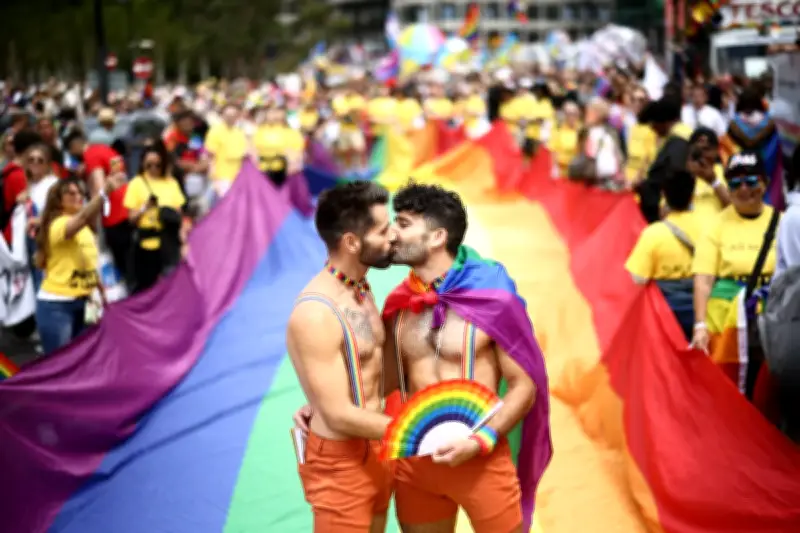
Fifty years on from the UK's first Gay Pride march in London, six LGBTQ+ figures share what Pride means to them and why the fight for equality continues. From Peter Tatchell's account of the inaugural 1972 protest to Crystal's experience of corporate backlash, their stories reveal Pride as both a celebration and a political act.
Peter Tatchell: The First Pride in 1972
Peter Tatchell, a veteran LGBTQ+ and human rights campaigner, recalls being a member of the Gay Liberation Front (GLF) in the early 1970s. 'It was Britain's first freedom movement of openly LGBT+ people,' he says. At the time, homosexuality was condemned by every social institution: government, police, media, church and the medical profession. 'The opposite of shame is pride.'
On 1 July 1972, GLF held the UK's first 'Gay Pride' march in London. Only 700 people attended. 'Most of my friends were too scared to march,' Tatchell explains. 'They feared that if they were seen at Pride they might be sacked from their job or evicted. That was lawful in those days.' The marchers faced a heavy police presence, but no arrests were made. 'We saw the Pride parade as the LGBT+ equivalent of the black civil rights marches in America. Our slogan was “Gay Is Good”.'

Unlike today, there was no commercial sponsorship or council support. 'No business wanted to be associated with queers,' Tatchell notes. The event culminated in a DIY party in Hyde Park, where same-sex kissing in public could still lead to arrest. 'Our games were a gesture of defiance.'
Progress and Persistent Challenges
Five decades on, London Pride attracts over a million people. Since 1999, key legal reforms have been won: equalising the age of consent to 16, repealing Section 28, and legalising same-sex marriage. However, Tatchell warns that nearly half of all LGBT+ pupils are bullied at school, there are thousands of homophobic hate crimes each year, and about 12 per cent of the public still believe homosexuality is 'always or mostly wrong'. Trans people face new exclusions after a Supreme Court ruling. 'This is why the campaign for our rights must continue,' he says. 'The battle for acceptance and rights ain’t over yet.'
Lotte Jeffs: Pride in Schools
Author Lotte Jeffs describes the emotional moment she hung rainbow bunting at her daughter's state primary in south-east London. The school celebrates Pride every July with a big playtime, lessons on diversity, and LGBT speakers. Jeffs reads her picture book My Magic Family to young children. 'I love answering the four and five-year-old’s questions,' she says. 'But I’ve never once, in the four years I’ve been doing this, had my queer family questioned or challenged — the kids just get it.'
Jeffs contrasts this with other schools that avoid mentioning 'gay' or 'lesbian' even during Pride Month. 'How damaging it is to be told, even subtly, that this is not OK,' she says. Growing up under Section 28, which banned 'promotion' of homosexuality in schools, she feels 'overwhelmed with relief and gratitude' that her daughter's school celebrates Pride. 'Watching the kids run out into the playground to a soundtrack of gay anthems... fills my heart with joy every year.'
Jack Guinness: The Power of Music at Pride
Presenter and author Jack Guinness recalls his favourite London Pride memory: being the face of Levi's for its Pride campaign. 'As soon as the parade got moving, whistles, cheers and music created a cacophony of queer joy,' he says. Seeing an older gay couple holding hands, he imagined all they endured: the Aids epidemic, repressive laws, a hostile world. 'I cried… with joy for all we’ve achieved, but with sadness for all they had to fight against.'
Guinness explains that queer people often move through the world in a state of high alert. 'But at Pride, en masse, we are offered a level of temporary security. For just a day, we can be impulsive, freeing ourselves from the checks that society puts on us.' He climbed onto the float and dropped Madonna's 'Vogue' as the parade turned onto Oxford Street. 'The crowd erupted. As one, connected through music, through shared history and, most importantly, through love… we danced.'

Crystal: Corporate Backlash and Grassroots Resilience
Drag queen Crystal recounts a Pride that changed her life in Southend-on-Sea in 2023. She was booked to perform at Adventure Island amusement park for the third year in a row. 'Someone who hadn’t attended the event clipped a few seconds of video, Right-wing outrage accounts amplified it, and the Daily Mail did a hit piece on me, saying parents were “horrified”,' she says. She received hundreds of abusive comments, and MP Lee Anderson called her an 'it' on GB News.
Adventure Island cancelled all future Pride events, claiming it had no idea about the nature of her performance and that its attempt at inclusivity had 'backfired'. Crystal notes this illustrates pinkwashing: 'Companies are very happy to use queer people when convenient... but we can’t count on them when the chips are down.' She points to Reform-led councils cutting Pride funding. 'Pride was never meant to be free from controversy. It was born out of protest, designed to disrupt the status quo.'
The following year, Crystal volunteered at the grassroots local Pride. 'While the corporate version of Pride folded under pressure, the real one didn’t. The event was joyful and couldn’t be cancelled on a panicked CEO’s whim.' She warns that as anti-trans panic intensifies, more companies and councils will pull back. 'If we are united, no one can stop us.'
Lady Phyll: Pride as Celebration and Call to Action
Political activist Lady Phyll, co-founder of UK Black Pride, reflects on the meaning of Pride. 'Pride feels as though, for just a few precious hours, we have given each other permission to exist fully,' she says. At UK Black Pride, she sees 'generations' — elders who fought battles, young people discovering they are not alone, families celebrating together. 'I see joy sitting alongside protest, because our liberation has always demanded both.'
When asked if Pride is still needed, she answers: 'As long as there is a young queer person wondering if there is a place for them, Pride matters; as long as Black, trans, disabled, migrant and other marginalised LGBTQIA+ communities are still fighting to be seen, Pride matters; and as long as our rights can be debated, rolled back or denied, Pride remains both a celebration and a call to action.'
Miss Jason: Safety and Community
DJ and presenter Miss Jason remembers her first Pride parade at age 24, newly out. She and friends took a coach to Brighton, drinking too much. 'But what I remember most has nothing to do with that. I just recall feeling an overwhelming sense of safety,' she says. 'I saw people of every age living unapologetically, celebrating who they were. I saw strangers looking out for one another, caring for each other like family.'
She recalls a Pride in Soho where a friend who was newly transitioning was approached by a woman with her child. 'She wanted her child to meet my friend, and to say “Happy Pride” and give her a hug — to really see her and make it clear she was supported.' Miss Jason says, 'For me Pride is safety. Pride is home. Pride is kindness. Pride is about being seen and seeing others.'