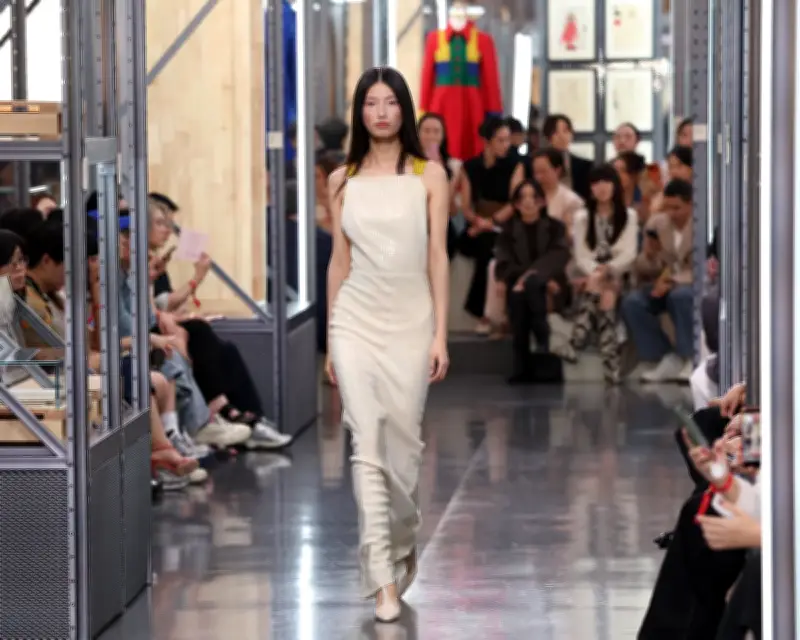
Max Mara has become a symbol of social status and professional success for Chinese women. The fashion house recently paid tribute to Chinese style with its 75th anniversary catwalk show in Shanghai.
Why Shanghai?
British designer Ian Griffiths noted, "New York may be the city that never sleeps, but Shanghai doesn't even sit down." He explained that Max Mara is a product for metropolitan women, and it would be patronising to assume a metropolitan wardrobe should be western-centric.
The show at the Long Museum featured knotted silk pankou buttons, cheongsam dresses, and side-fastening jackets with standing collars, translating Chinese aesthetic codes into Max Mara's language.
Cultural Sensitivity
Such tributes can be tricky, as nods to cultural heritage may tip into cliche or appropriation. Griffiths said, "We know that it isn't good enough just to say that we didn't intend to cause offence, so we had lots of conversations and consultations in advance." He hopes the homages are viewed in the context of Max Mara's long relationship with China.
Max Mara was one of the first western brands to take China seriously, with stores for 33 years—27 boutiques in Shanghai alone. It now symbolises social status and professional success for Chinese women.
Luxury Market Dynamics
Navigating this territory is big business. Chinese luxury consumption is rallying from a post-Covid slump, and European luxury brands are on a charm offensive. Chinese consumers account for about a quarter of global luxury spending.
However, the era of the Chinese consumer as a grateful recipient of western luxury is over. Brands that treat China's fashion appetite as an ATM fall out of favour.
Guochao Trend
The most significant trend in Chinese fashion is guochao, or "national wave," a new appetite for style with local resonance. Guochao is not nostalgic patriotism but a fashion-forward shift towards consumerism linked to cultural identity, reflecting Gen Z's instinct to centre their own experience.
Max Mara, aligned with the rise of Chinese female ambition, hopes to channel the spirit of self-confidence at guochao's core. The show's casting was almost exclusively local models.
Star of the front row was Chinese-American Olympic skier Eileen Gu. The cheongsam was stripped of decorative detailing, with floral silk swapped for pale stretch wool—a sophisticated riff on the office staple shift dress.
Empowerment and Heritage
Max Mara recently provided wardrobing for a Chinese production of Prima Facie, positioning its visual language alongside Suzie Miller's one-woman play, supporting the story's exploration of gender and empowerment.
Recent Max Mara catwalk shows have formed an esoteric feminist history syllabus, with muses including 18th-century mathematician Émilie du Châtelet, medieval military strategist Matilde di Canossa, and Selma Lagerlöf, the first woman to win the Nobel Prize for Literature.
Griffiths said, "There was a moment when people might have said Max Mara is safe and dependable, but maybe a bit dusty and boring. Hopefully we've left that behind."
Red as a Statement
Between the camel coats the brand is known for, the catwalk was spiked with red, which in China represents joy and luck. Griffiths said, "There is something so primal about red. I think of it as the pre-eminent non-neutral colour."
But he was not proposing red as the colour of the season. "There are no trends any more. Fashion doesn't dictate any more. Everyone chooses their own look."