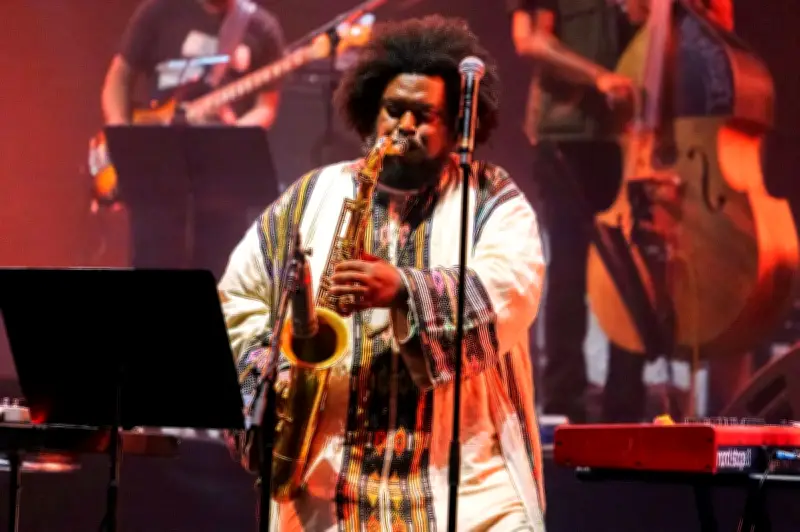
There's a buzz that accompanies a Kamasi Washington show: a sense that something big is about to happen. Yesterday afternoon, as improvising London collective Steam Down tore it up on the outdoor stage - its edges swarming with tweens hoping for a sighting of Meltdown's guest programmer ("Is H anywhere?") - the Los Angeles saxophonist and bandleader turned the Festival Hall into an avant-jazz cathedral.
Celebrating Jazz Giants
This is the centenary year of both John Coltrane, the high priest of spiritual jazz, and Miles Davis, the magus of fusion, and Washington had come to celebrate these two departed giants. The double Grammy winner sees both as two sides of the same Afro-futurist coin: Coltrane the blazing ascent toward the heavens, Davis the cool expansion across the earth. Their influence on his music is palpable.
In a late addition to the programme, Washington honoured the recently departed Sonny Rollins, as well as his childhood friend, the acclaimed Los Angeles jazz trombonist Roy Porter, who died in May following a car accident. "They are travelling the universe as ancestors," said Washington, a jazz colossus in white robes streaked with gold brocade.
A Journey Through Time
Seated between trumpet maestro Maurice Brown and his father, Ricky Washington, on flute and soprano saxophone, Washington and his eight-piece collective took us on a journey through time, stitching together classic works and pulling them into the present while keeping their essence intact. The opening mash-up saw the flamenco-inflected chords of Miles Mosley's double bass nodding to the Spanish roots of Coltrane's 'Olé' before the familiar contours of Davis' 'All Blues' emerged from the swirl.
Every musician got their moment. Like Coltrane and especially, like Davis, Washington understands that the strength of an ensemble lies in the brilliance of all its players. His delight at his bandmates' dazzling, inventive solos was evident as he watched, sometimes shaking his head in wonder, whether seated or standing side-stage.
Brown, perched beside an effects console, hard bopped so vigorously he almost fell off his stool, wielding his horn as if plugged into Davis's sonic voltage. Keyboardist Brandon Coleman was propulsive behind a fortress of equipment. Pianist Cameron Graves, also crazily dextrous, finished his wild workouts with a grin and a flash of devil's horns.
Washington himself was impossible to ignore. Shoulders hunched, his entire body reacting to the torrents pouring from his tenor sax, he built themes with incremental intensity, shifting from velvety warmth to screaming split-tone honks in his arrangement of Coltrane's 'A Love Supreme'. This was the show's spiritual heart: in which vocalist Patrice Quinn - previously dancing, making prayer hands, stretching her arms skyward - stepped up to sing Coltrane's sacred lyrics, the players meeting her words with motifs.
Washington smiled and closed his eyes, taking it all in. Then the crowd began chanting the famous refrain - "A love supreme, a love supreme" - back at the stage, and for a few glorious minutes we were all in our pews at the Church of Kamasi.
Cosmic Jazz Theatre
Sonny Rollins 'Airegin' - Nigeria, spelled backwards - was woven into Coltrane's 'Giant Steps'. Washington's hurricane force blasts gave way to a fiery soprano sax solo from the diminutive Rickey Washington - who twice wandered off to photograph his son during one of his feverish improvisations, like a proud dad at a school recital.
The mood softened with 'Round Midnight', that yearning, melancholic ballad written by Thelonious Monk and later embraced by Davis. Sung with tenderness by Quinn, it was a moment of calm before the closing stretch exploded into a vivid cosmic jazz theatre.
Wayne Shorter's 'Footprints', recorded by Davis, fused with Coltrane's 'Africa', creating an expansive Afro-diasporic suite full of trumpet squeals, space-age bleeps, and textures organic and synth-generated. Mosely delivered an otherworldly upright bass solo along the way, his plucking and bowing making the instrument groan, howl and - seemingly - orbit the earth. His raised fist, delivered to an ecstatic hall, was victorious.
Later Washington and the band would return to the stage for a second concert dedicated to Fearless Movement, his latest album, reaffirming his place in the future of jazz. Not that we needed reminding. The crowd's final wild standing ovation seemed to hail a modern jazz icon, an artist intent on carrying the torch, blazing, forward.