Federico Valdez, a chef at the School of Mexican Cuisine, declares, 'Today you're going to eat art.' With the word Queso tattooed on his forearm, Valdez presents a three-course feast inspired by Frida Kahlo, her life, her art, and her loves, including her first lesbian affair. The starter, inspired by her childhood fascination with revolution, is a lightly spiced Mexican take on pirozhki. The main dish, served with pulque, taps into her rebellious spirit. 'It's called Frida Against the World,' says Valdez, as a giant stuffed chilli is served with a nutty, beany sauce similar to the one eaten at Kahlo's wedding to Diego Rivera. 'I wanted this to be hot and horny,' he adds, explaining that halved figs reference Kahlo's sexuality.
Following in Kahlo's Footsteps
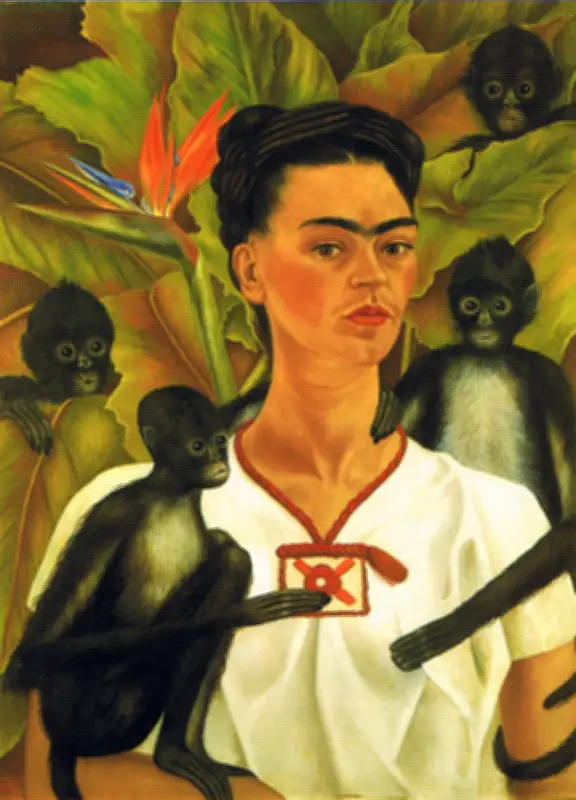
I am in Mexico City with a Tate delegation, following in Kahlo's footsteps ahead of Frida: The Making of an Icon at Tate Modern in London. The show features over 30 of her works and is expected to be a summer blockbuster. One work, Self Portrait With Thorn Necklace and Hummingbird, painted in 1940 after her divorce from Rivera, shows a spider monkey pulling on her thorn necklace, drawing blood. The couple soon remarried, and Kahlo inscribed the clocks in their house with the years of their separation and reunion.
'The exhibition is like a movie,' says curator Tobias Ostrander. 'Frida is the star but it's also about her life, her people, her impact.' The show will examine Kahlo's rise from unknown painter to global phenomenon, including merchandise like a Kahlo Barbie, and her influence on later artists. Many of her treasured possessions will be on display, including her tehuana dresses and Graciela Iturbide's ghostly photographs of her crutches, medical corsets, and prosthetic leg.
Casa Azul: A Place Full of Places
Casa Azul, the house in Coyoacán where Kahlo was born and spent most of her 47 years, is now a beautiful museum. Its smooth exterior walls are painted a gorgeous blue, bordering shiny red concrete paths that thread through fountains and lush gardens. 'We don't know exactly where the blue came from,' says museum director Perla Labarthe Álvarez. 'But in her diary, Frida expressed what the colour meant to her: purity, electricity and love.' Because of her health, she was at home a lot, so it had to be a comfortable place where she could rest. She called her home 'A Place Full of Places.'
Tours begin in the living room, with its hefty pyramid-style fireplace designed by Rivera. Opposite is Kahlo's mesmerising portrait of her father, painted 15 years after he died. On the walls, photos and texts detail the polio she contracted at age six and the trolley-bus crash at 18 that left her in pain for much of her life. She could never paint this accident, but her works were often deeply painful and personal, created at Casa Azul in her studio, where visitors can see the easel adapted to allow her to paint lying on her back or in her wheelchair.
Personal Artifacts and Final Works
In the next room is the four-poster bed with an overhead mirror, giving Kahlo both a distraction and a subject. 'I paint myself because I am so often alone and I am the subject I know best,' she once said. Her customised orthopaedic footwear, including a red boot embroidered with Mexican patterns, stands in its own case. Kahlo's ashes sit in a playful ancient urn shaped like a toad, a nod to her affectionate term for Rivera. Across the courtyard, her crutches and corsets are displayed, one decorated with a hammer and sickle. In Marxism Will Give Health to the Sick, a 1954 work, she throttles a bald eagle wearing an Uncle Sam hat while Marx's hands cradle her.
The most stunning work at Casa Azul is her last painting, Viva la Vida, completed eight days before her death in 1954. It portrays sun-drenched watermelons, with some flesh as red as blood. One has been cut in a crisscross pattern, echoing the Vs of the title. 'It's as if the fruit itself, life itself, is talking to you, imploring you. Live, live,' the article notes.
Exploring Kahlo's Mexico City
Walking the neighbouring streets, you sense Kahlo's talent and resilience. There's a park named after her with statues of Rivera and Kahlo, where she is ahead of him, purposeful. The bar they liked, La Guadalupana, still stands. Downtown, streets are barricaded in response to a recent march of 180,000 women furious at femicide rates. Kahlo addressed such outrage in Unos Cuantos Piquetitos (A Few Small Nips), recreating a story of a murdered woman.
Kahlo also painted in a studio in San Ángel, a beautiful three-storey building painted signature blue. A rooftop bridge links it to Rivera's studio, now part of a museum. Rivera's studio is magnificent, overflowing with ceramics and artefacts. Over the bridge, in Kahlo's studio toilet, a copy of What the Water Gave Me shows her feet as she bathed, with elements symbolising events in her life.
Helena Chávez Mac Gregor, author of The Ribbon and the Bomb, notes Kahlo's continuing relevance. 'There's the bomb of her illness,' she says. 'She's vulnerable yet strong and erotic, ahead of her time, making the personal political.' Kahlo's work set a new world record for a female artist when The Dream (The Bed) fetched $54.7m in 2025.
Xochimilco and Farewell
No visit to Mexico City is complete without a trip to the floating gardens of Xochimilco. Kahlo loved to come with her family to these canals. As I dangle my arm into the cool water, I remember Valdez's final course, a rice-pudding-like dish in watermelon sauce. 'This dessert is going to blow your mind,' he said. 'Frida died – but she didn't pass away. She was like a rocket. She just went up and up.'
Frida: The Making of an Icon is at Tate Modern, London, from 25 June to 3 January.