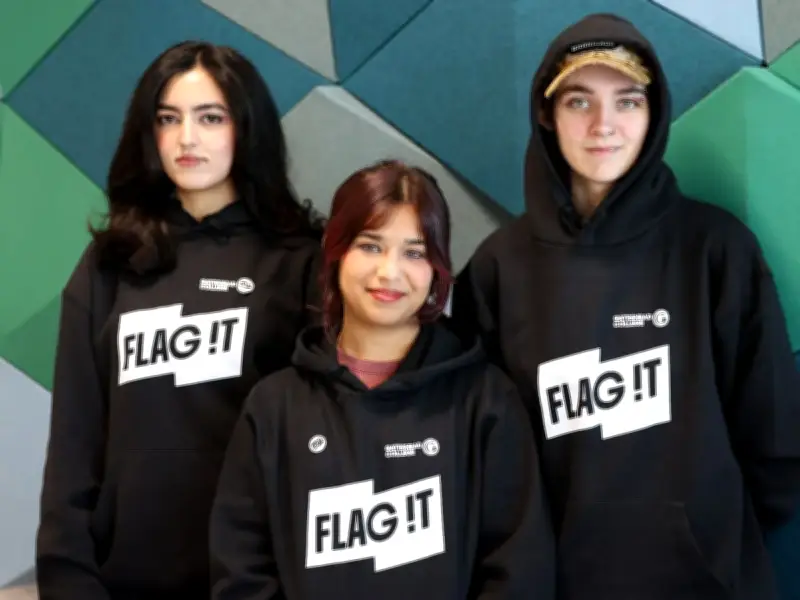
A student-led campaign to challenge sexism and toxic behaviour is expanding across the North East, with Gateshead College's Flag !t initiative being rolled out to Northumberland College, Sunderland College and Hartlepool Sixth Form.
The expansion was announced at Gateshead College's Baltic Campus on Monday morning, where a week-long programme of activities and workshops has begun, exploring sexism, healthy relationships and exploitation.
National recognition and funding
Flag !t, which started as a classroom project, has already gained national recognition. Its latest rollout follows a £15 million Government pledge to fund programmes tackling misogyny in schools, workplaces and wider communities.
Campaigner and Gateshead College health and social care student Amelia Lowry, 17, said: "Hopefully students will take this to the wider community, as it is a wider issue not to be misogynistic. It impacts more than one person, it impacts more than you think."
When asked what people should be aware of to spot the signs of toxic relationships, Amelia continued: "Red flags like control. Saying you can't go out with friends, arguments, or, for example, saying 'if you loved me you would do this'. These are major, major red flags that need to just stop."
Challenging online narratives
Another student said the campaign is about highlighting unrealistic expectations. Tahniat Bukhrani, 18, studying applied sciences, said: "Sometimes people will be nice, and then suddenly they are totally different. If you're being that 'nice woman' then we will be respectful and then they will think you're worthy, until you speak."
Challenging troubling online narratives was also a chief concern among the campaigners. Software engineering student Eman Massod, 21, said: "If you see one video and you like one video, the algorithm is designed so that it is going to push that in your face again. It can be harmful, especially for a teenager's brain that is not developed, and if they are told the same things over and over again, that's really harmful."
Ben Woodlan, 23, studying Access to Higher Education Medicine, added: "I have noticed more worrying trends; I might see a post and then not engage with it and carry on. But if someone is engaging with that, it will keep feeding that so it becomes normalised."
On spreading the campaign and how young people should be heard, Ben added: "It would be good if there were another place to go to, like their colleges, to get more support."
Resources and support
The campaign has received national recognition after students presented their work at the NAMSS (National Association for Managers of Student Service) Student Engagement Conference. Its resources have since been incorporated into a Relationships and Sex Education toolkit promoted through the Association of Colleges and made available to colleges across England.
Ruth Magnus, strategic lead for safeguarding and wellbeing at Education Partnership North East, said: "The students have been really proactive; it was a project close to the hearts of our students, and that's right across male and female students."
Ruth continued: "It is not just important to report the most serious issues; it's about recognising other behaviour, 'banter' or jokes that aren't okay. We are addressing the problem at its core before it escalates. It is everyone's responsibility to flag it and call it out, and that pupils have the voice and confidence to say when these things aren't okay."