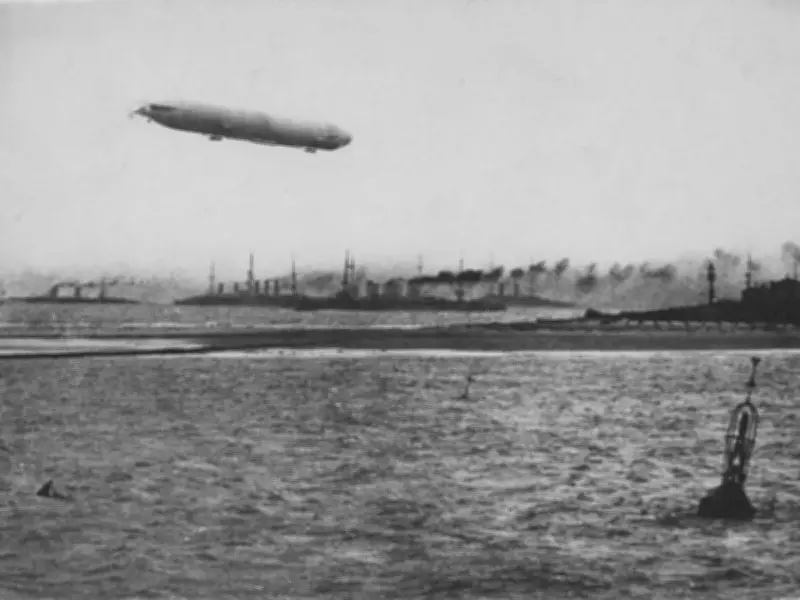
The first aerial bombing attack on what would become Greater Manchester took place on the night of September 25, 1916, when a German Zeppelin dropped bombs across the region, killing 13 people in Bolton. The raid, carried out by Zeppelin L21, predates the more famous Christmas Blitz of 1940 by more than two decades.
Airships over the North West
While fixed-wing German bombers would later become a more regular occurrence, the first raids on Britain were carried out by zeppelins – large, cigar-shaped airships with a metal frame powered by engines and filled with gas. German airships were described in British newspapers of the time as a 'cigar-shaped engine of death' and 'baby killers' due to their targeting of civilians.
The campaign to bomb Britain using zeppelins was approved by the Kaiser on January 7, 1915. Early raids targeted mainly the east coast, the home counties, and London, before expanding further inland with high explosives and incendiary bombs in early 1916.
The night of the raid
Zeppelin L21 crossed over South Lancashire shortly after midnight, dropping several bombs across the Rossendale Valley before targeting Ramsbottom and Holcombe. The Rossendale Free Press reported that schoolboy Jack Waddington, of Back Chapel Street, Haslingden, said: “As soon as I heard the zeppelin, I was under the bed in a flash. All the lights were out as was the custom in war but a lot of people went out into the streets.”
Detailed in records from the Ramsbottom Heritage Society, the airship dropped its first bomb near Giles Taylor's mineral water works on Regent Street. The blast destroyed two lorries, damaged machinery, and blew off roof slates and windows of neighbouring cottages, though no residents were injured.
Holcombe and Bolton hit
Moving south toward Holcombe, the zeppelin released six bombs within a 500-yard radius. As documented by the Holcombe Village Society, explosive devices landed near the Shoulder of Mutton Inn and the village Post Office, shattering windows and cracking stone masonry. Another bomb damaged the gable of Holcombe School and stopped the parish church clock. No human casualties were reported in Holcombe; the only recorded victim was a song thrush, which was later preserved in a glass display case at the local school.
The airship's deadliest raid was still to come as it moved on and circled over Bolton, dropping over twenty bombs and incendiary devices on the centre of the town. The deadliest strikes landed on Kirk Street off Deane Road, killing 13 people and seriously injuring nine others, with many houses destroyed.
The Zeppelin dropped more bombs behind Bolton Town Hall before striking Holy Trinity Church. According to the Imperial War Museums War Memorials Register, a high-explosive bomb crashed through the church roof. However, its fall was deflected by the roof timbers, preventing the bomb from exploding and saving the building from destruction.
Aftermath and censorship
Following the attack on Bolton, Zeppelin L21 turned northeast toward Yorkshire and returned across the North Sea to Germany. After landing, Commander Frankenburg incorrectly reported to the German High Command that he had carried out a successful bombing raid on the city of Derby, not knowing he had completely flown off course.
Due to censorship restrictions under the British Defence of the Realm Act, immediate wartime newspaper reports suppressed the exact location of the Zeppelin L21 raid, referring to the incident only as an attack on "a town in the north Midlands". The full extent of the Bolton and Greater Manchester damage was not officially published in local newspapers until after the Armistice in late 1918.
A novel inspired by the raid
One person inspired by the zeppelin raid in 1916 is the retired academic and novelist Trisha Phillips. Trisha, 78, who lives in Holcombe, has recently published a historical novel, Shadows in the Starry Air, featuring the airship attack. Trisha told the Manchester Evening News she became fascinated by the subject while interviewing a number of older women about their experiences in the Second World War.
Trisha said: "I did some pilot interviews and asked about childhood as well as the stuff going on in the war. One of the women was born in 1913, and she remembered being in a zeppelin raid when she was about four, and it was really frightening. It threw me because I was doing a lot of research about the Second World War, but had no idea the zeppelins got to this area. Then, shortly after, I discovered that basically the zeppelin was up the road from me on Holcombe, which was really fascinating."
Trisha tells her story, set during the 1916 zeppelin raid, through her main character, Annie, a postmistress in Holcombe. Trisha says the dramatic airship attack in her novel mirrors the terror people at the time would have felt at seeing a zeppelin raining explosives down overhead. "When you look at the zeppelins, they were about 600 feet long," said Trisha. "And Holcombe is a little village street really. So I have it where it looms over the hill and dwarfs the whole village as they're all trying to get out of the way. That must have been absolutely terrifying."
Trisha's novel Shadows in the Starry Air is available to buy on Amazon and other bookshops. Describing her intentions while writing the novel, Trisha adds: "I wanted to honour the story of our community, while exploring in fiction how the war both disrupted lives and created connections that rippled across the rest of Greater Manchester."