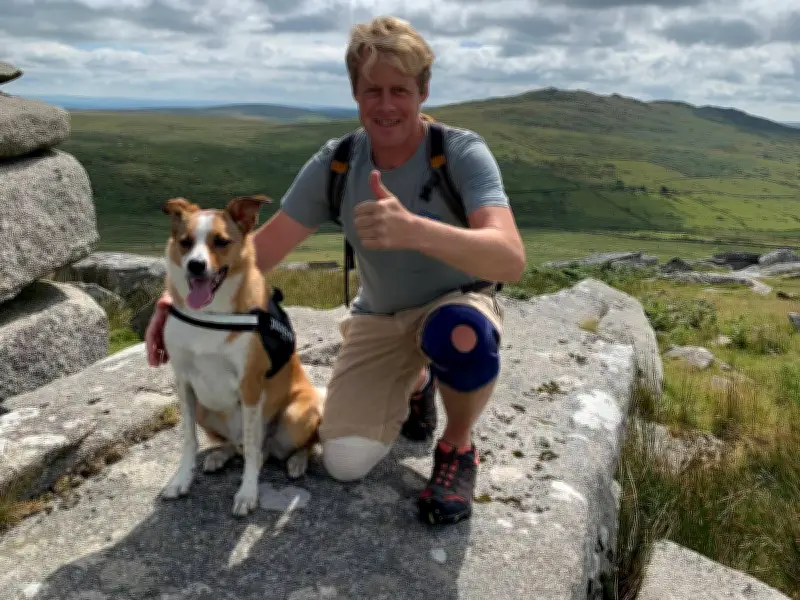
Daniel Case, 45, was bitten by an adder—the UK's only native venomous snake—at his remote cottage in Cornwall in late June. He described feeling a searing pain before looking down to see the snake hanging off his foot.
What Happened
The drama unfolded at Daniel's remote Cornish cottage, which is "very remote" and in a valley surrounded by gorse bushes—perfect terrain for adders. Daniel, from Tintagel, was getting up off the settee when he felt a "shooting pain" in his right foot on Thursday, June 25. He was shocked to see a "whopping great adder" clamped onto the side of his foot, roughly 3ft in length, meaning it was likely fully grown. The wild creature was fully mature and boasted "very solid black and green" scales.
"It took about three or four seconds to compute what had happened—and I looked down—and there was a whopping great adder," he said. "It was probably close to a few feet long, it was a big one. It was hanging off the side of my foot, essentially. And so I sort of flicked my foot, and it went off. It was incredibly painful. It's right on the side of my foot, you can still see it now. The two puncture wounds from the snake."
Daniel, who shared his ordeal via Talk to the Press, says the reptile then slithered beneath his sofa while he dashed upstairs to ring for an ambulance. "The whole time the snake's still in my front room somewhere under the sofa. I didn't know where it was," he said. Daniel, who runs bodyboarding and fishing enterprise Salty Fins Kernow, rang a lifeguard and paramedic friend of his, who rushed over. In the meantime, Daniel wrapped a shirt tightly around his leg in an attempt to stop the venom spreading. An off-duty paramedic also made his way to the cottage as no ambulances could attend at that moment. The off-duty paramedic said he needed to go to hospital urgently, and they then came across a hospital heading for Derriford Hospital in Plymouth which transferred him. He then faced a wait in A&E as his pain became worse and worse.
Treatment
Six hours following the adder attack, he received antivenom via a cannula at 8.30pm, only to suffer a seizure when the medication ended. He also had blood tests and an x-ray to make sure the snake's fang had not broken off during the bite. "Considering I'd been bitten by a wild animal, it was a fairly clean wound," Daniel said. He was discharged at 1pm the following day, but returned to A&E a couple of days later due to persistent heart palpitations and chest pains. Daniel said: "My foot was massive, it was like elephant man." By Monday, his doctor grew concerned that he may have developed compartment syndrome—a condition where mounting pressure restricts blood flow—as his foot was "turning purple" whenever he stood up. Left untreated, the condition can lead to permanent damage.
Fortunately, Daniel had neither compartment syndrome nor a blood clot, as a separate doctor had suggested, though he continues to battle pain and swelling in his foot and leg. He has since thoroughly searched the property for adder eggs, concerned the reptile may have laid a nest during its stay, but was relieved to find nothing. The snake itself was removed by the seal rescue service. "It had gone up onto my sofa and made itself comfy along the back wall between the sofa and the cool walls of the cottage," Daniel said. "It makes me wonder, how long had it actually been in here. I could have been sitting on the sofa with it."
Adders
The adder, or Vipera berus, is the UK's only native venomous snake. They tend to be most active from March to October, when the weather is warmer. They hibernate over winter. Despite the venomous bite, they are protected in the UK under the Wildlife and Countryside Act, 1981 and are a priority species under the UK Post-2010 Biodiversity Framework, according to the Wildlife Trusts. They usually measure 60-80cm in length, weigh around 50-100g, and usually live for around 15 years. The adder prefers woodland, heathland and moorland habitats, and hunts lizards and small mammals, as well as ground-nesting birds, such as skylark and meadow pipit.
The adder is a greyish snake, with a dark and very distinct zig-zag pattern down its back, and a red eye. Males tend to be more silvery-grey in colour, while females are more light or reddish-brown. Black (melanistic) forms are sometimes spotted. Its venom is generally of little danger to humans, but a bite can be painful and cause inflammation. It is really only dangerous to the very young, ill, or old. Adders are secretive animals and prefer to slither off into the undergrowth rather than confront and bite humans and domestic animals. Most attacks happen when they are trodden on or picked up. If you are bitten, seek medical help immediately.