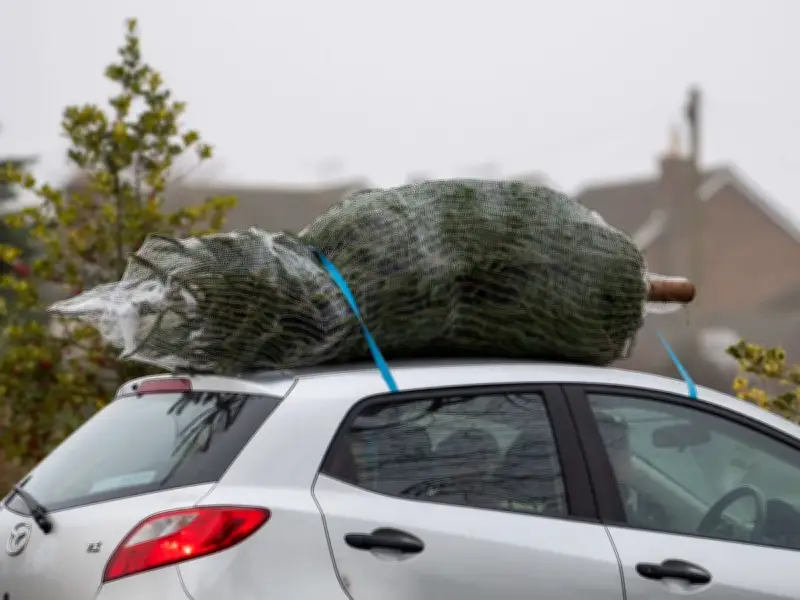
The AA has issued a warning to motorists that carrying a poorly secured Christmas tree could result in penalty points and fines of up to £5,000.
A tree that is too large for the vehicle, loosely tied to a roof rack, or sticking out of an open boot can shift, fall from the vehicle, and block the driver's view, potentially leading to driving without due care and attention. This can put other road users at risk.
Highway Code Rule 98
Rule 98 of The Highway Code states: "You must secure your load and it must not stick out dangerously. Make sure any loads are properly fastened and that they do not obscure your view or vehicle lights." Despite this guidance, many motorists continue to make costly mistakes each Christmas, the AA says.
Lee Morley, AA Patrol of the Year, said: "Before setting off with your Christmas tree, make sure it fits securely in or on your vehicle and doesn't block your view. Use suitable straps or a roof rack, and check that the tree can't shift or come loose during the journey."
"A few minutes spent securing it properly can help protect you and other road users. You might think a short journey home from the garden centre is low risk, but cutting corners when securing your tree could have serious consequences - from hefty fines to a potentially dangerous collision."
The penalties
The motoring experts have also explained what the penalties could be for falling foul of the law:
- For insecure loads or obstructed vision (Highway Code Rule 98): £100 on-the-spot fine and 3 penalty points.
- For driving without due care and attention (Road Traffic Act 1988, Section 3): Fine of up to £5,000 and 3–9 penalty points.
- For dangerous driving (Road Traffic Act 1988, Section 2A): Driving ban, requirement to retake your test, and a potential custodial sentence.
- For causing injury or damage due to a loose load: Potential insurance invalidation and liability for damages.
Common mistakes to avoid
Common mistakes include tying a tree directly to the car roof without roof bars or proper straps, relying on flimsy string instead of suitable load restraints such as ratchet straps or bungee cords, and driving with the boot open and the tree protruding.
Other errors include allowing branches to obstruct mirrors or the driver's view, covering headlights, rear lights or the number plate, exceeding the vehicle manufacturer's roof-load limit, leaving a tree unsecured inside the vehicle where it could move or cause damage, and forgetting to check the route for low bridges or other overhead restrictions.
Lee added: "If your tree won't fit comfortably inside the vehicle, use suitable roof bars and secure it with strong, appropriate straps. Netting can help contain the branches, and positioning the trunk towards the front can help reduce wind resistance. Before moving off, check that the tree cannot shift and that your mirrors, lights and number plate remain clear. If you're unsure, ask the retailer to help secure it or look into delivery."