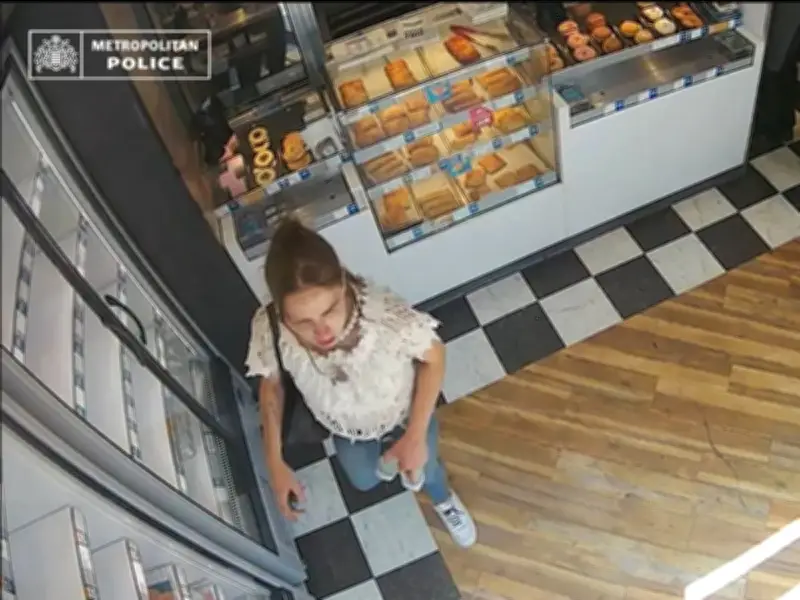
Tiffany O'Neill, 28, who stole £2,000 worth of soft drinks from a single Greggs branch, has been handed a suspended prison sentence, prompting disappointment from police. O'Neill has been arrested, charged and remanded to court 11 times since May, the Metropolitan Police confirmed.
Court sentencing and background
She appeared for sentencing at Croydon Magistrates' Court on Wednesday, having pleaded guilty to 80 offences, and received a 26-week sentence suspended for 12 months. Under new guidelines introduced to alleviate prison overcrowding, almost all sentences of less than a year are now suspended.
Sergeant Chris Wilkinson, who headed the investigation, said: "Our officers worked relentlessly over several months to build the evidence needed to bring this prolific offender before the courts."
"Despite multiple arrests and repeated offences, we remained focused on securing a positive outcome for our community. Her persistent offending caused repeated distress to staff, harmed the business and placed a significant demand on police resources."
"We recognise that courts are obliged to follow the guidelines on suspending sentences, but it's obviously a disappointment that someone who we know has reoffended so frequently is now back out in the community."
Repeated offences and bail breaches
O'Neill was repeatedly released on bail despite flouting her bail conditions and returning to the same Greggs branch on Electric Avenue, Brixton, the force stated, adding that officers had devoted 120 hours to the case. She was also prohibited from entering the borough of Lambeth and was required to wear a GPS tag, however this was never fitted, and she failed to appear in court on three separate occasions, having to be arrested each time.
Alongside the suspended sentence, a Criminal Behaviour Order was imposed, barring her from Brixton town centre and all Greggs outlets across the UK for two years.
It is understood that four attempts were made to fit a tag on O'Neill at her home address, though she was absent on each occasion. That information was subsequently passed to the Met for them to decide whether further action should be taken.
Wider context and official responses
Earlier this year, the Met called for fast-track courts to tackle serial shoplifters, revealing that 104 repeat offenders were responsible for more than 5,300 crimes over two years. Across all crime types nationally, 9% of offenders are responsible for 52% of all offences, according to the Home Office.
Assistant Commissioner Matt Twist said: "A small number of prolific offenders continue to be responsible for the majority of crime and harm in our communities."
"We are increasingly arresting the same people again and again when they ignored bail or licence conditions, not complied with their electronic tags, or in many cases all of the above. The cumulative impact on retailers and their staff is enormous."
"Our focus has to be on putting suspects before the courts. We need the CPS, courts, prisons and probation to work with us to break the cycle of continued release and reoffending. While we have made significant progress in tackling shoplifting, cases like this show why greater focus on prolific offenders remains essential and how police alone cannot fix this."
A Government spokesperson said: "Public protection is our top priority. That's why we are delivering the biggest expansion of tagging in British history, and this year funding to police forces has increased to its highest cash level of up to £18.5 billion."
"Tagging is just one tool we use to monitor offenders but the evidence is clear that they work, acting as a constant reminder to those on tags that we are watching their every move and will know if they violate their licence conditions."
"We are tagging more offenders before they leave the prison gate and continue to work closely with the police to manage offenders on court bail, with the protection of victims, witnesses and the public always a key consideration in bail decisions."
Retailer and charity perspectives
Roisin Currie, chief executive of Greggs, confirmed the retailer is investing in technology, including CCTV and a platform shared with law enforcement to track crime. She said: "We support efforts to apprehend repeat offenders, and we welcome calls for meaningful consequences for those who repeatedly target retailers."
"Importantly, we would like to see a renewed focus on positive interventions and services that prevent reoffending."
The Home Office unveiled fresh proposals on Wednesday to crack down on 500 of the most persistent shoplifters across the UK. Sixteen police forces are participating in the year-long initiative, which will see them concentrate on serial offenders within their respective areas.
A spokesman for charity Revolving Doors said repeat offending is frequently driven by addiction, mental health problems and homelessness. "The anger of retailers and shop workers is justified," they said. "Theft is not victimless, and abuse of staff is intolerable."
"But if we want fewer thefts rather than just more arrests, we have to ask a harder question: why does the same small group of people keep cycling through crisis and custody repeatedly?"
"The answer, again and again, is addiction, poor mental health and homelessness – frequently all three at once."
"The people we work with show that recovery and rebuilding lives are possible with the right support. Many have themselves been through the cycle of arrest, release and reoffending. With treatment, a roof and someone who sticks with them, they stop."
"Success should mean fewer repeat offences and safer communities, alongside more people able to recover, contribute and realise their potential."