A court ruling and a separate ombudsman decision show how blame is allocated when a driver in the wrong roundabout lane causes a crash. The key case, Grace v Tanner, set a precedent for a 50/50 split in many such incidents, though outcomes can differ based on specific circumstances.
Highway Code rules on roundabout exits
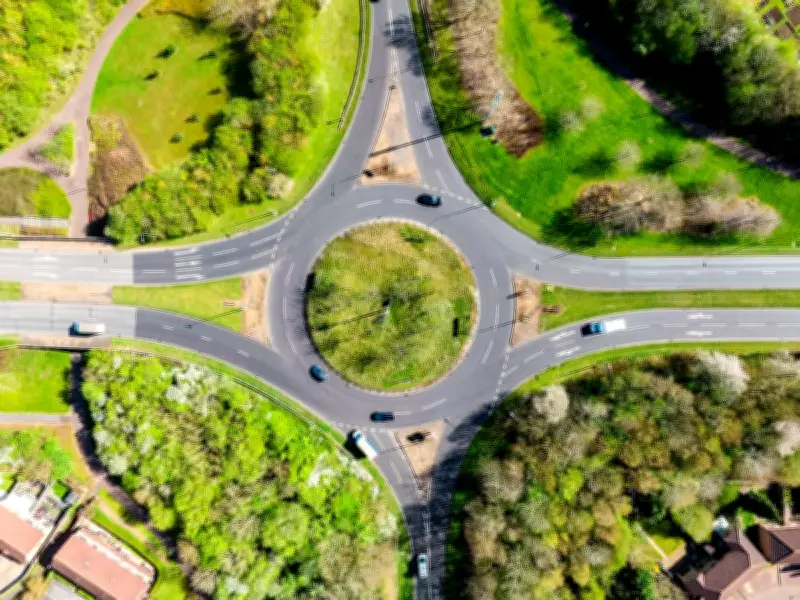
Highway Code rules 184-190 cover roundabouts, with Rule 186 detailing signalling and positioning. For the first exit to the left, drivers should signal left and approach in the left-hand lane, keep to the left on the roundabout, and continue signalling left to leave. For an exit to the right or going full circle, drivers should signal right and approach in the right-hand lane, keep to the right until needing to change lanes, and signal left after passing the exit before the one they want.
For intermediate exits, drivers should select the appropriate lane on approach, normally without signalling, stay in that lane until needing to alter course, and signal left after passing the exit before the one they want. The guidance does not account for a driver in the right-hand lane continuing through the roundabout into an intermediate exit.
Grace v Tanner: a 50/50 ruling
In Grace v Tanner, two drivers were travelling through a roundabout on the A23 dual carriageway from London to Crawley. Mrs Grace was on a motorcycle in the right-hand lane, and Mrs Tanner was in a car in the left-hand lane. Mrs Grace went to leave the roundabout in the right-hand lane, assuming Mrs Tanner would do the same, but she continued around and the two collided.
In the first court case, the judge held Mrs Tanner wholly free of blame, but Mrs Grace appealed, arguing it was a 50/50 case where each party was to blame. Her lawyers admitted negligence on her part in turning into the car but said Mrs Tanner was equally negligent. The appeal judges agreed. Lord Justice Schiemann said Mrs Tanner had not been negligent in missing her turn, which was merely an accident, but said she should have been aware that someone on the outside lane might want to go down that dual carriageway. He said she forgot to bear that possibility in mind, which was negligent, so a 50/50 division of responsibility was appropriate.
Different case, different outcome
In another case, the Financial Ombudsman Service decided between a driver, Miss A, and Admiral Insurance. Miss A was in a similar situation to Mrs Grace, with another driver in the incorrect lane who continued around the roundabout and crashed into her as she left. Admiral said it was a 50/50 liability case, but Miss A appealed. The ombudsman agreed she was not at fault, noting the circumstances differed because Miss A was further ahead and the other driver hit the rear of her vehicle.
Popular TikTok user Big Jobber, who gives road rule advice, said of the blue and white car scenario: "It's accepted that sometimes people will be in the wrong lane, people get lost and they make mistakes, especially on roundabouts. In continuing around the outer edge of the roundabout incorrectly, the blue car driver has not taken into consideration how their decision would affect other road users, namely those looking to exit the roundabout to go straight ahead at the second exit."
He added: "And as for the driver of the white car, they haven't taken into consideration what effect them exiting from the inner lane would have on a vehicle using the outer lane, either correctly or incorrectly. Ultimately the driver of the blue car, when realising that they were in the wrong lane for their intended exit, should have been checking that it was safe and OK to proceed around the roundabout to where they wanted to exit and be ready to take evasive action to avoid a collision. And as for the driver of the white car, they should be checking that it's safe and clear to exit from the inner lane and also be ready to avoid a collision."
Big Jobber suggested the blue car driver could take the exit they did not intend and turn around, while the white car driver could remain staggered on the roundabout and avoid overtaking, keeping a pocket of safe space. He agreed that, as in Grace v Tanner, this situation would likely be settled on a 50-50 split liability basis.