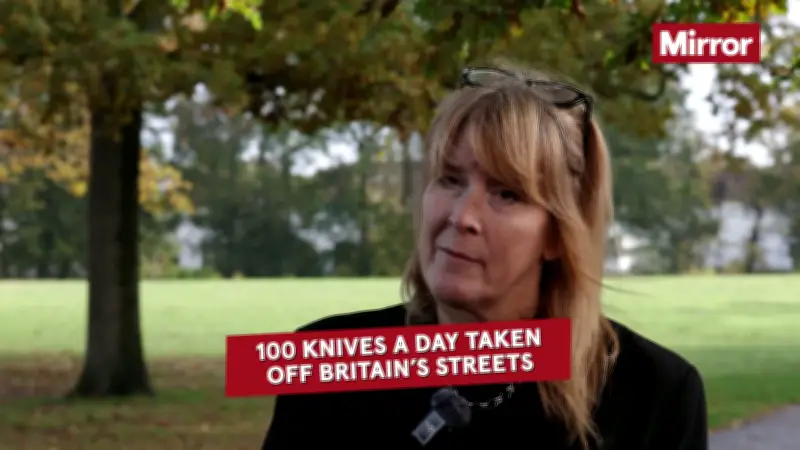
More than 80,000 knives and dangerous weapons, around 100 a day, have been taken off Britain's streets since summer 2024, in results hailed by bereaved parents.
Zombie-style knives, machetes and ninja swords are among the weapons dropped in surrender bins, seized by police and Border Force officers, taken from crackdowns in knife crime hotspots or from disrupting county lines gangs.
Record surrender figures
In August alone, 3,811 knives and weapons were handed in during a month of intensified action. Some 3,049 blades were deposited at the Home Office-funded 'Word 4 Weapons' surrender bins and 762 handed to a mobile van operated by FazAmnesty.
Separate figures also show knife robberies have fallen by 24% since 2024 across the seven forces most affected: the Metropolitan Police, Greater Manchester, West Midlands, West Yorkshire, South Yorkshire, Avon and Somerset, and British Transport Police.
Families welcome progress
Pooja Kanda, whose son Ronan, 16, was killed with a ninja sword in a case of mistaken identity in Wolverhampton in 2022, said: "Every knife removed from our streets is potentially a life saved." Pooja, who successfully campaigned for a ban on ninja swords, added: "As Ronan's mother, I know the devastating consequences when dangerous weapons fall into the wrong hands."
Caroline Willgoose, mum of 15-year-old Harvey who was fatally stabbed with a hunting knife at his Sheffield school by a fellow pupil last year, said: "As a family we are delighted to see these results from the government. It gives me personally great joy to know that Yorkshire has particularly benefited from this work." She added: "Since Harvey's death, I have used my grief to try and create a legacy for him that saves lives. It hasn't been easy, but to be able to work alongside the government to save lives of young people so that fewer families have to suffer like mine have done."
Campaigner Pastor Lorraine Jones Burrell, of the Dwayne Simpson Foundation, said: "Having lost my precious son Dwayne 12 years ago, today I am encouraged, strengthened in my faith, and filled with renewed hope that the tide is turning. These results are more than just statistics. They represent lives saved, families protected and futures preserved by this government."
Martin and Tara Cosser, who set up charity Charlie's Promise after their 17-year-old son Charlie was killed at a party in West Sussex in 2023, said it was real progress but there was more work to do. They said: "Giving young people somewhere safe to go, something positive to do and someone they trust to talk to is invaluable. Through the government's plan to halve knife crime, we want to see sustained investment in youth outreach across the UK so that every young person can get that support, wherever they live."
Government target and wider crackdown
Labour promised to halve knife crime within a decade in its 2024 manifesto. Across England and Wales, knife crime is down by 11% since the general election, equivalent to nearly 6,000 fewer offences. Knife homicides are at a 35-year-low, and hospital admissions following assault with a sharp object have fallen 16%, including a 19% fall among under-25s.
Policing Minister Sarah Jones told the Mirror that halving knife crime in a decade was a "hard target" but the Government was determined to hit it. She said: "Every single knife off the streets is one less potential crime, and 80,000 really is a number to celebrate. Of course, we have a lot more to do, and we know that we need to bear down even harder. But targeted government work, where all the agencies are working together, really does bear fruit."
Ms Jones, the MP for Croydon West, acknowledged there was a gap between the public perception of knife crime and the improvements in the figures. She said: "It is absolutely the case that we have had an epidemic of knife crime, and we have had numbers that have caused upset to everybody. We are bearing down on those numbers, but I don't blame people for thinking and hoping that we can go much further than we have."
She added: "The stats are good, but of course people will see things on social media. They will feel that the numbers are high, but actually they are going down. We are bearing down. We are saving lives. We are stopping people from being stabbed. That is good work but of course there is more we need to do."
In Greater Manchester, police have had success in driving down knife robberies through Operation Venture, where officers are sent to hotspot areas to deter offences from taking place. Dedicated knife crime teams will gather intelligence and identify offenders to crack down on knife violence, alongside neighbourhood police.
Chief Superintendent Helen Critchley told The Mirror: "Since June of 2024, when we started this work, 234 less people have been victim of an knife-enabled robbery. So 234 people that have been spared the trauma - because it is a traumatic experience of somebody pointing a knife at them, threatening with a knife, threatening to use a knife in order to take some property. I think that is really important for our communities to think those 234 people have been spared that experience." She added: "It means they can go to work, go on their night out, go and see the band that they want to see, go to the football match they want to go to, go to the nightclub they want to go to without that fear or issue of having an knife enabled robbery occur."
Police patrols, CCTV and prevention work are being rolled out in over 230 hotspots as part of a knife crime crackdown across 27 police forces in England and Wales. The Home Office has also launched a 'No Place for Knives' drive piloted in Birmingham, Croydon and Westminster, with visible enforcement measures including extra patrols, police on e-bikes who can chase down thugs and smarter metal detection.
Illicit online sellers have been targeted through the National Knife Crime Centre, which has identified 186 grey-market weapons sellers and reported 183 social media handles suspected of promoting or selling dangerous weapons to platforms to shut them down.
As well as enforcement action, wider work is under way to stop people being drawn into knife crime. This includes work with schools, Violence Reduction Units and local outreach organisations.