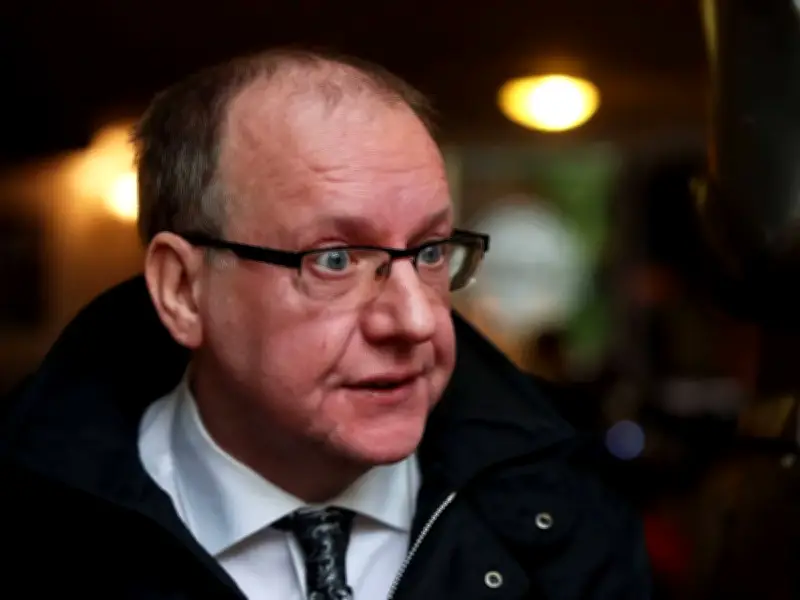
Paul Ferris, the former Glasgow gangland enforcer who was acquitted of murder in one of Scotland's most famous trials, died in Glasgow on Tuesday aged 62. He had written books about his underworld experiences, one of which was turned into a Bafta-award winning film starring Line of Duty actor Martin Compston as Ferris.
Acquitted in 1992 murder trial
In 1992, Ferris was acquitted at the High Court in Glasgow of the murder of Arthur Thompson Jnr, son of crime boss Arthur Thompson Snr, in what was then the longest trial in Scottish criminal history. He was later found guilty of conspiracy to sell or transfer prohibited weapons, dealing in firearms, and possessing explosives at London's Old Bailey in 1998.
The Daily Record's crime reporter Norman Silvester spent decades following Ferris's life and crimes. Silvester described the scene outside the High Court after the acquittal: "The smartly dressed good looking 28-year-old stood on the front steps with both arms raised to the acclaim of the waiting crowd."
From enforcer to author and film subject
Ferris had been a former friend and ally of the Thompsons, said to be closer to the father than even his own son. At the age of 19 he had become the crime boss's feared enforcer, collecting debts on his behalf. The murder trial, which began in March 1993, lasted 56 days and cost an estimated £4 million.
Ferris was also cleared of attempting to murder Arthur Thompson Snr by repeatedly driving a car at him and threatening to murder William Gillen by shooting him in the leg. Charges of illegal possession of a firearm and supplying heroin, cocaine and ecstasy were also thrown out by the jury.
Conviction and later life
After his acquittal, Ferris disappeared under the radar but re-emerged four years later after his arrest in a police raid in Mayfair, London. He was convicted at the Old Bailey in 1998 and sentenced to 10 years imprisonment, later reduced to seven, after being convicted of gun running and possessing explosives.
While in prison, he co-authored his best-selling biography The Ferris Conspiracy with Reg McKay and has since published four other books. A film based on his life, The Wee Man, featuring Martin Compston as Ferris, was released in 2013.
Final interview and plans for sequels
In his last interview, given in July this year, Ferris told Silvester about his plans for a second and third follow-up to The Wee Man and his efforts to go straight. The sequel, titled Ferris, was to cover the period from 1992-2002 when he moved down south and was arrested in London on gun running charges. The third movie, called Going Straight, planned to document the time from his release from prison to the present day.
Ferris admitted that any money he made from the movies would be used to settle a long-running five-figure tax debt. He said: "I am not doing any of this to be the big gangster - I am doing it to tell my life story. It's about how somebody living that life might not see where they are going."
He described his decision to go straight as a "eureka" moment while in prison in London, after learning that MI5 had carried out a lengthy photographic surveillance on him. Ferris said: "You can't fight the government. It's impossible. If the Government and MI5 are on to you then you are on their radar for the rest of your life."
Ferris, who had five children and said none of them were involved in crime, also said he was aware of recent gang wars in Scotland related to the feud between the Lyons and Daniel crime families. He added: "I know both the Lyons and Daniel families and they know my position - it's always been neutrality."